
A landmark UK Biobank study reveals that advanced cardiovascular-kidney-metabolic syndrome sharply increases cancer risk, creating a critical opportunity for targeted screening.
Clinicians typically manage cardiovascular, renal, and metabolic disorders to prevent heart attacks or kidney failure. Yet metabolic dysfunction also fuels oncogenesis. Ignoring these systemic connections leaves high-risk patients vulnerable to undetected early-stage tumors.
A new analysis published in Frontiers in Endocrinology shows that metabolic and cardiovascular health directly tracks with long-term cancer development. Researchers tracked 399,034 participants (389,289 with genetic data) over a median follow-up of 13.7 years. During this window, 48,247 incident cancer cases were recorded, proving that metabolic decay operates as a major driver of malignancy.
That systemic risk demands a shift in preventive care.
Understanding these broader systemic influences aligns with growing evidence on non-traditional metabolic risk drivers, as highlighted in the European Heart Journal. The study demonstrates that as CKM stages progress, cancer risk rises steeply independently of background factors.
Mapping the Escalating Risk
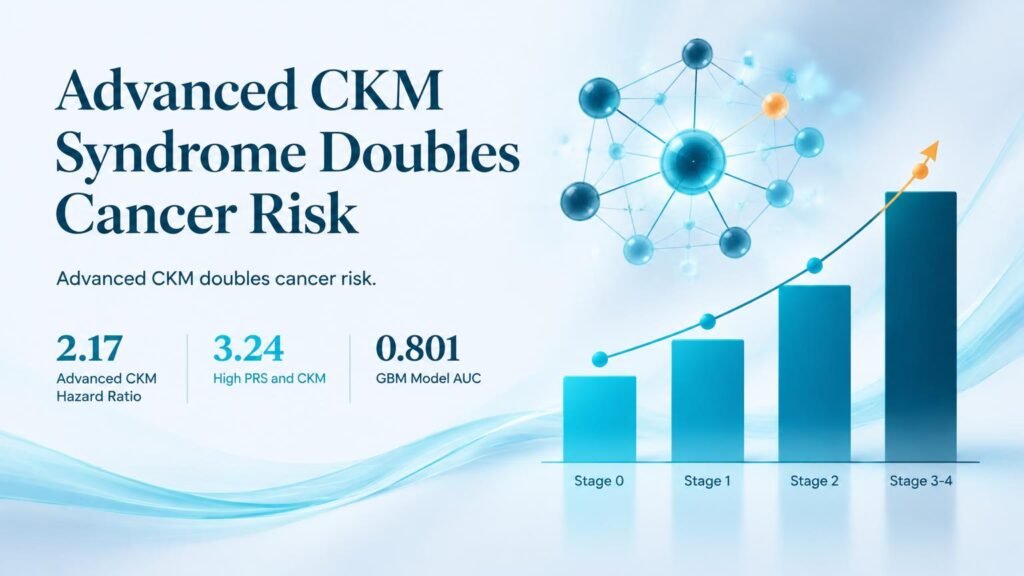
The statistical jump from early metabolic impairment to advanced disease is stark. Compared to healthy baseline controls at stage 0, participants at stage 1 saw a hazard ratio (HR) of 1.01, while stage 2 rose to an HR of 1.21. Advanced CKM syndrome (stages 3–4) more than doubled the baseline risk with an HR of 2.17.
When inherited genetic risk enters the equation, the danger compounds significantly. Patients combining high polygenic risk scores with advanced CKM syndrome faced the highest overall threat, reaching an HR of 3.24.
- Stage 3–4 CKM: Associated with an HR of 2.17 for incident cancer risk compared to stage 0.
- Genetic amplification: High polygenic risk plus advanced CKM elevated the HR to 3.24.
- Gradient progression: Minimal risk elevation in stage 1 (HR 1.01) accelerating through stage 2 (HR 1.21).
- Biological pathway: Total bilirubin served as the primary mediator, accounting for 44.45% of the total observed association.
Predictive Modeling in Practice
To turn these cohort observations into clinical tools, researchers screened potential markers using feature selection algorithms. They isolated 14 key predictors to build eight machine learning models targeting patients with advanced CKM. The Gradient Boosting Machine (GBM) model delivered the strongest performance, achieving a test area under the curve (AUC) of 0.801.
Restricted cubic splines revealed distinct non-linear associations for diastolic blood pressure, neutrophil count, alkaline phosphatase, and the TyG-BMI index. Addressing residual risk factors beyond standard metabolic markers mirrors ongoing efforts to address hidden cardiovascular and systemic threats, detailed in recent research from the European Heart Journal.
Predictive accuracy in an observational cohort is not proof of clinical utility. The UK Biobank relies on a single-country cohort that skews healthier than the general population, which limits direct global extrapolation. Furthermore, an algorithm predicting cancer risk does not prove that treating CKM syndrome will lower actual tumor incidence.
Clinicians should view these findings as a compelling reason to screen advanced CKM patients more vigilantly for malignancy, rather than assuming cardiovascular management alone is enough.
Source abstract and full publication details available via Frontiers in Endocrinology.