
Instead of replacing doctors, generative AI is turning patients into more cooperative and trusting partners in the exam room.
Clinicians have long feared that patients searching their symptoms online leads to friction and self-treatment. Generative AI was expected to worsen this trend by handing patients highly confident, sometimes inaccurate, self-diagnoses. Yet new evidence suggests that pre-visit AI searches actually make patients more collaborative, not more combative.
This challenges the defensive stance many health systems take toward patient-facing AI. Rather than trying to discourage AI triage, clinics should recognize it as an educational tool. When patients use AI to parse their symptoms before an appointment, they arrive better prepared to understand their doctor’s reasoning.
The prediagnostic gray zone
A mixed-methods study published in the Journal of Medical Internet Research analyzed how patients integrate AI into their care-seeking journey. Researchers gathered qualitative insights from 48 adults and surveyed 546 participants who used generative AI for health consultations. The data shows that patients primarily use AI in a “prediagnostic gray zone” for basic orientation and informal triage, rather than as a final medical authority.
The quantitative analysis revealed a clear chain reaction in patient behavior:
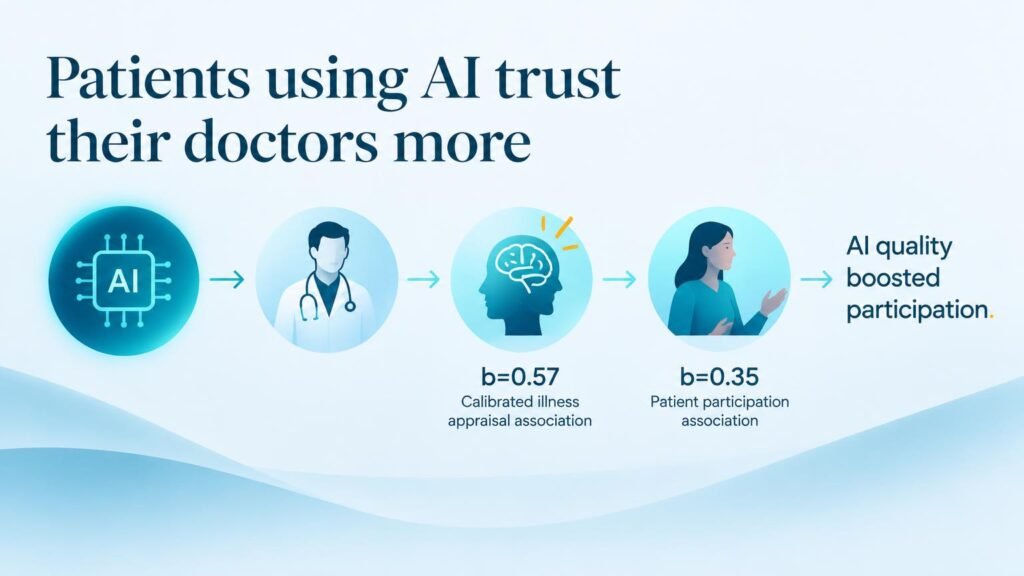
- Perceived AI quality was positively associated with calibrated illness appraisal (b = 0.57, 95% CI 0.49-0.64).
- This realistic appraisal of illness severity was positively linked to active patient participation during clinical visits (b = 0.35, 95% CI 0.28-0.43), with a significant indirect association of 0.20 (95% bootstrap CI 0.14-0.26).
- High perceived AI quality helped patients validate their eventual diagnosis (b = 0.69, 95% CI 0.61-0.76) and comprehend it (b = 0.65, 95% CI 0.58-0.73).
- Both diagnosis validation (b = 0.15, 95% CI 0.07-0.23) and comprehension (b = 0.20, 95% CI 0.12-0.28) directly increased patient trust in their physicians.
A boost for trust
The indirect pathways to trust were equally telling. The indirect association between perceived AI quality and trust in physicians was 0.10 (95% bootstrap CI 0.04-0.17) through diagnosis validation, and 0.13 (95% bootstrap CI 0.07-0.19) through diagnosis comprehension. AI does not replace the doctor. Instead, it acts as an interpreter that makes the doctor’s eventual diagnosis easier to accept.
While earlier research, such as a study on GPT-3’s diagnostic and triage accuracy in The Lancet Digital Health, focused heavily on whether the AI gets the clinical facts right, this new work shows that the psychological framing matters just as much. Even if the AI is not a perfect diagnostic engine, it prepares patients to ask better questions.
The clinical reality
This study has clear limitations. The data relies on self-reported surveys and convenience sampling within China, meaning these trust dynamics may differ in other healthcare systems. Additionally, the study does not measure clinical accuracy, only patient perception.
The practical takeaway for healthcare providers is to stop fighting the AI tide. Instead of dismissing patients who bring AI-generated notes to appointments, clinicians should use those notes to anchor the conversation. This approach saves valuable consultation time and builds a stronger therapeutic alliance.
Read the full study in the Journal of Medical Internet Research.