

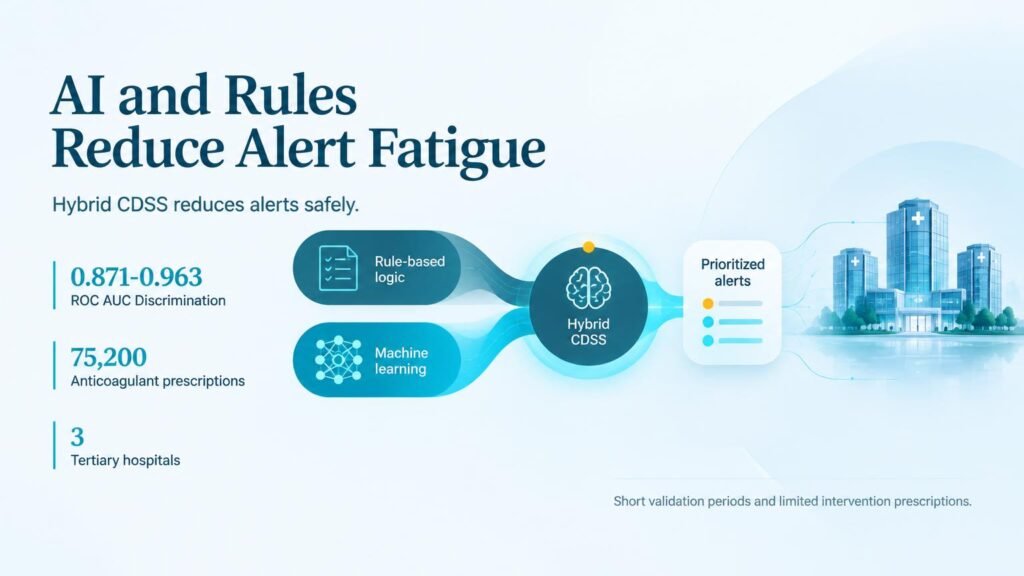
Hospital pharmacists wasting time on irrelevant software alerts can now use hybrid AI to isolate high-risk anticoagulant errors.
Hospital pharmacists routinely ignore clinical alerts because most of them are irrelevant noise. This alert fatigue is dangerous, especially with high-alert medications like anticoagulants where a dosing error can cause fatal bleeding. A new multicenter study challenges the industry’s reliance on pure machine learning by proving that combining old-school clinical rules with modern AI can filter out the noise.
This hybrid approach shifts the focus from raw prediction to operational utility. Pure machine learning models often act as black boxes, while rule-based systems are too rigid. By stacking a classifier on top of clinical rules, the system does not just flag errors. It predicts whether a human pharmacist will actually need to intervene. This changes how we evaluate clinical AI, moving the metric from theoretical accuracy to actual workload reduction.
How the Hybrid System Works
Researchers built the hybrid system using 75,200 anticoagulant prescriptions from a tertiary hospital. The final system combined 44 patient-specific rules and 1,129 drug-drug interaction rules with a CatBoost machine learning model. They then tested it across three different hospitals to see if the logic held up outside the development site.
The results show a significant reduction in unnecessary alerts. In the internal validation phase, the system generated alerts for only 18.9% of prescriptions. Crucially, every single one of those 88 alerts was technically correct, and 88.6% were deemed clinically relevant by staff.
Performance Across Hospitals
- The system maintained strong discrimination across external sites with an AUROC of 0.871 to 0.963.
- External alert rates remained low, ranging from 22.6% to 32.1% of prescriptions.
- Actual pharmacist intervention was required in 18.8% to 57.1% of the flagged external cases.
- The model missed zero critical errors, reporting zero false negatives during the study.
The Operational Reality
These metrics are impressive, but the real-world utility remains unproven. The validation periods were short, and the actual number of prescriptions requiring a pharmacist’s intervention was small. A tool that performs well in a brief trial can still fail when subjected to the chaotic, long-term workflows of a busy hospital ward.
Furthermore, we must distinguish diagnostic accuracy from actual patient outcomes. Just because the AI correctly flags a bad prescription does not mean it automatically reduces patient bleeding events or hospital stays. We still need clinical trials to prove this software actually keeps patients safer.
For hospital IT leaders, the takeaway is clear. Do not buy pure machine learning tools that promise to reinvent clinical workflows from scratch. Instead, invest in hybrid systems that respect and build upon the established, rule-based clinical guidelines already trusted by your staff.
This analysis is based on research published in the Journal of Medical Internet Research.