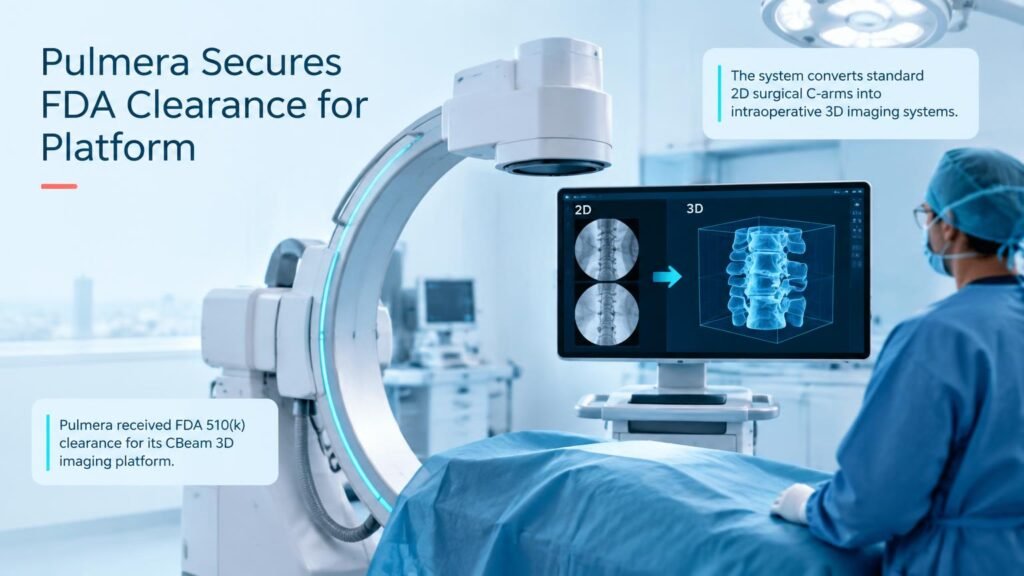
Hospitals can now bypass million-dollar imaging upgrades by converting their existing 2D surgical hardware into 3D systems.
Hospitals face a constant, expensive pressure to acquire the latest intraoperative imaging suites. Instead of buying entirely new machinery, a newly cleared platform retrofits standard 2D surgical C-arms to generate intraoperative 3D images. This shifts the financial equation for operating rooms trying to keep pace with modern surgical demands.
The retrofit reality
There are more than 30,000 existing 2D C-arms currently in U.S. hospitals. Replacing these units with native 3D imaging systems requires massive capital expenditure. By retrofitting existing hardware, hospitals can access advanced imaging without the capital strain. The technology has already been used clinically in spinal fusions and extremity surgeries.
A recent $2.25 million NIH grant aims to push this compatibility further, targeting complex applications like lung nodule biopsies. This funding highlights the federal interest in scalable, cost-effective clinical upgrades.
The workflow hurdle
But retrofitting is not a magic fix. Software-driven upgrades must prove they do not add friction to surgical workflows. If calibration or processing times slow down an operation, the capital savings are quickly lost to increased operating room costs.
The real test will be clinical throughput. If surgeons have to wait for software to render, the bottleneck shifts from the balance sheet to the patient table. Reconstructed 3D images must match the diagnostic clarity of native 3D systems to ensure patient safety. For now, this approach offers a pragmatic middle ground. It allows resource-constrained hospitals to extend the lifespan of their current hardware while upgrading their clinical capabilities.