
A new neural network detects oral cancer risk with near-perfect accuracy, but its real value lies in exposing how lifestyle habits and biology collide.
Why do we wait for a painful tissue biopsy to confirm oral cancer when the warning signs are already floating in a patient’s saliva? For decades, early detection of oral squamous cell carcinoma has stalled because clinicians lacked a way to connect a patient’s daily habits with microscopic cellular damage. This study challenges the idea that we must rely on invasive tissue samples to map cancer risk.
By combining simple lifestyle data with saliva biomarkers, a neural network achieved near-perfect predictive power. This suggests that the future of oncology screening is not in the clinic, but in non-invasive, multi-source data integration. It forces us to rethink the boundary between lifestyle tracking and clinical diagnostics.
Mapping the biological tipping point
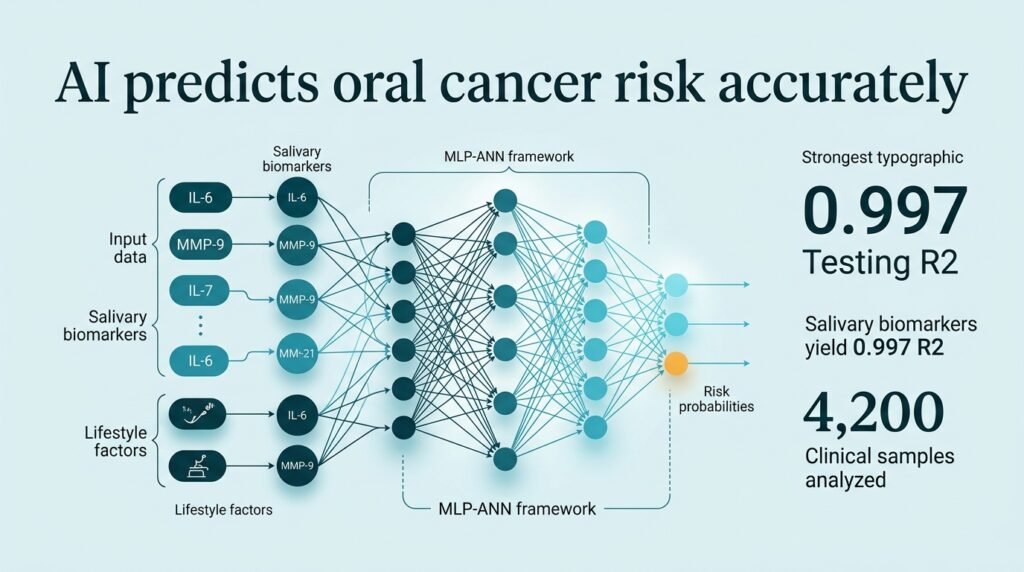
Researchers analyzed a curated dataset of 4,200 clinical samples to build the predictive framework. They tested eight different machine learning algorithms using fivefold cross-validation. The clear winner was a Multi-Layer Perceptron Artificial Neural Network (MLP-ANN). This model achieved a testing R2 of 0.997, meaning it explained almost all the variance in patient risk with minimal relative error.
To prevent the AI from being a black box, the team applied SHapley Additive exPlanations (SHAP) to map how different variables influenced the risk score. The results showed a clear hierarchy of risk factors:
- Alcohol consumption and smoking emerged as the dominant global drivers of malignancy risk.
- Elevated salivary levels of MMP-9 and IL-8 served as strong positive biomarkers for cancer.
- High antioxidant capacity showed a protective, inverse relationship against oxidative stress.
The model captured complex, non-linear interactions. It mapped specific saturation thresholds, showing exactly how cumulative carcinogen exposure interacts with inflammatory biomarkers. This means clinicians can see the precise point where a patient’s smoking habit crosses a biological threshold into high-risk territory.
The limits of perfect prediction
We must look at these findings with healthy skepticism. An R2 of 0.997 is incredibly high, which often flags potential overfitting, even with rigorous cross-validation. The study relied on a single curated dataset, meaning the model needs validation in diverse, real-world clinical settings before it can be trusted as a diagnostic tool.
This finding matters because it moves oral cancer screening away from late-stage visual inspections. Instead of waiting for a visible tumor to form, dentists could run a quick saliva test during a routine cleaning to calculate an exact risk score. It turns a subjective clinical guess into a precise, biological forecast.
Read the full study in BMC Oral Health.