
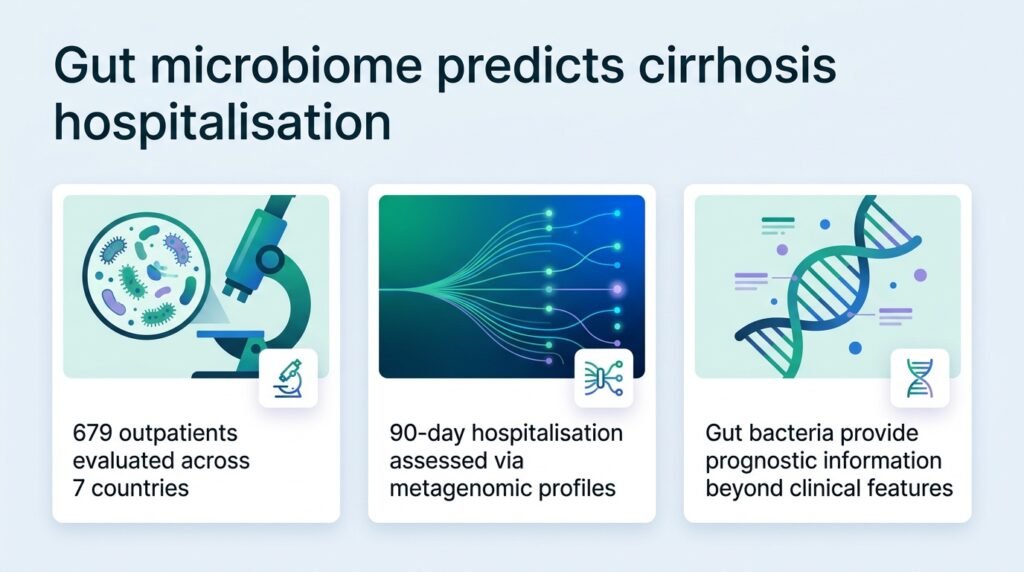
Analyzing the gut microbiome could prevent costly hospitalizations for patients with advanced liver disease.
Doctors can track liver damage with standard blood tests, but they still struggle to predict which cirrhosis patients will suddenly deteriorate. Standard clinical metrics only capture liver function, ignoring the systemic chaos happening in the gut. This diagnostic blind spot leads to unexpected, emergency hospitalizations that strain healthcare systems and endanger patients.
A multinational study challenges this status quo by proving that stool metagenomics can flag high-risk patients before they crash. By analyzing the gut microbiome, researchers built a predictive model that outperforms traditional clinical tools. This shifts our understanding of cirrhosis from a localized liver disease to a systemic disorder heavily driven by the gut-liver axis.
The predictive power gap
Standard clinical models often fail to catch sudden complications in cirrhosis. In this study tracking 679 outpatients across seven countries, 25% of the patients required non-elective hospitalization within 90 days. Those who ended up in the hospital consistently showed lower microbial diversity in their gut, a signature that remained identical across different countries despite regional diet variations.
The researchers identified specific biological markers that signal an impending clinical crash. The data revealed distinct taxonomic and functional shifts in the gut metagenome of patients headed for the hospital:
- A set of 19 bacterial species was independently associated with 90-day hospitalization risk.
- High-risk patients showed enrichment of pathogens like Enterococcus faecium and Veillonella rogosae, alongside a depletion of beneficial, short-chain fatty acid-producing bacteria.
- The clinical-only prediction model scored an Area Under the Curve (AUC) of 0.79, while the microbiome-only model scored 0.74.
- Combining clinical data with microbiome profiling boosted the predictive accuracy to an AUC of 0.84.
Why this matters
This finding complicates the traditional hepatology workflow. For decades, clinicians treated gut dysbiosis as a late-stage side effect of liver failure rather than an active driver of hospitalization. These results suggest that gut profiling should be integrated directly into routine risk stratification to catch complications before symptoms manifest.
However, translating this into daily practice faces a major hurdle. Metagenomic sequencing is currently too slow and expensive for routine clinical use in most hospital systems. Until we can simplify these 19 bacterial signatures into a rapid, low-cost assay, this superior predictive power will remain out of reach for the average clinic.
Read the full study in Gut.