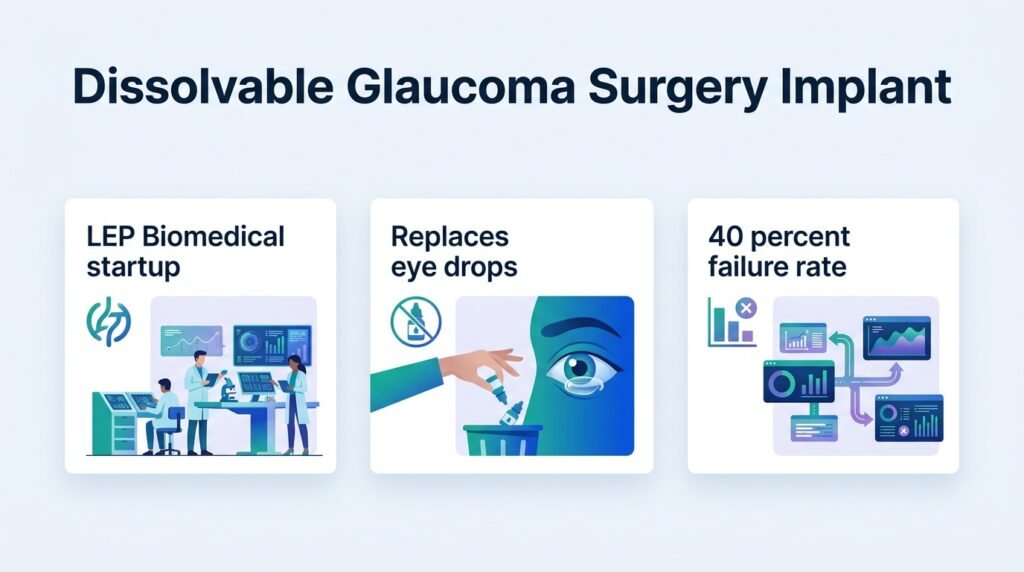
Glaucoma surgery fails up to forty percent of the time because patients cannot manage their own recovery.
The post-surgery regimen for glaucoma is notoriously brutal. Patients must self-administer complex eye drop schedules for weeks to prevent scarring. When patients miss doses, the surgical drainage site heals over, rendering the operation useless.
The Compliance Trap
Clinicians have long known that human error is the weak link in ophthalmic surgery. LEP Biomedical is attempting to bypass human behavior entirely with a 3D-printed, biodegradable mesh called HyaGuard. Placed directly in the eye during surgery, this implant slowly releases anti-inflammatory drugs and dissolves on its own.
This shifts the burden of recovery from the patient back to the technology.
The Clinical Hurdle
But shifting the burden is not a guaranteed victory. The startup is currently in the pre-clinical phase, seeking four point seven million euros in seed funding to begin first-in-human trials. Translating lab success to human eyes is a notoriously difficult leap.
Biodegradable materials must dissolve at an incredibly precise rate. If they degrade too quickly, they fail to prevent scarring. If they degrade too slowly, they risk triggering a foreign-body reaction in an already delicate surgical site.
If successful, this approach could redefine recovery for over five hundred thousand surgeries globally each year. It proves that the next major leap in surgical outcomes might not come from a sharper scalpel, but from automating the patient’s recovery.