A massive surge in medical AI synthetic data research has produced thousands of academic papers but almost zero real-world clinical tools.
For a decade, computer scientists promised that AI-generated synthetic data would solve healthcare’s biggest bottlenecks. They claimed artificial patient records and simulated medical images would bypass privacy laws, cure data scarcity, and speed up clinical trials. The research pipeline responded with a torrent of papers. Yet, when you look for these tools in actual hospitals, they are missing.
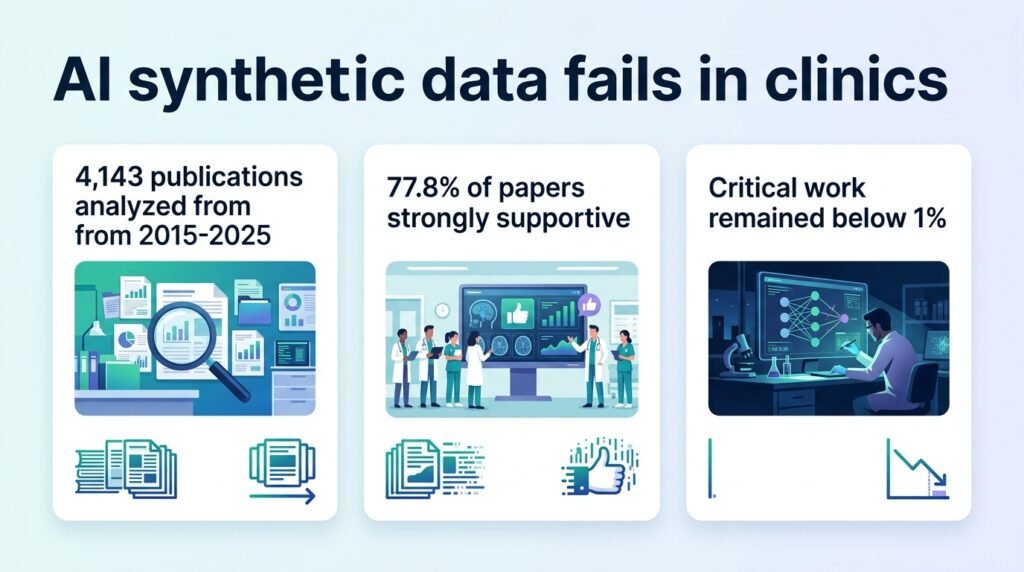
This is not just a slow rollout. It is a fundamental mismatch between what AI can easily generate and what clinical reality actually demands. A systematic analysis of 4,143 publications from 2015 to 2025 reveals a striking disconnect. While research volume grew continuously, only 27 publications reported actual operational use of synthetic data. The rest remains confined to academic theory.
The academic hype bubble
The research community has acted as a cheerleading squad rather than a critical evaluator. An overwhelming 77.8% of the analyzed papers were strongly supportive of synthetic data. Meanwhile, critical work accounted for less than 1% of the literature. This lack of skepticism has blinded the field to practical clinical hurdles.
Highly cited primary research concentrated heavily on molecular and pharmaceutical applications, where structure-prediction models excel. But translating these molecular designs into actual therapies requires clinical trial data that synthetic generators still cannot reliably replicate. The field has prioritized easy academic wins over difficult clinical validation.
This bias is clear in the types of data being generated. Medical imaging dominated the database of papers. It is relatively easy to generate fake X-rays because image structures have well-understood geometric rules. In contrast, complex patient data remains largely ignored. Omics and tabular clinical records lack these simple geometric patterns, making them much harder to simulate safely.
The missing clinical guardrails
Why does this translation gap persist? Without strict evaluation standards, clinicians cannot trust synthetic cohorts. If a synthetic dataset misses a rare drug interaction or misrepresents a demographic, patient lives are at risk. We cannot treat synthetic data as a shortcut to bypass real-world clinical trials.
To bridge this gap, the industry must pivot away from basic image generation. We need to focus on the hard, unglamorous work of clinical validation. The key requirements for progress include:
- Standardized evaluation frameworks to test synthetic data safety before clinical use.
- Mandatory deployment reporting to track how these tools perform in real hospital workflows.
- New AI architectures capable of encoding complex biological rules for tabular and omics data.
A reality check for investors
This study is a wake-up call for healthcare investors and researchers alike. Funding should shift away from redundant image-generation projects. Instead, it must target the messy work of validating tabular clinical data. Until we establish rigorous standards, synthetic data will remain an academic exercise. The promise of private, abundant medical data is real, but we cannot hype our way into the clinic.
Read the full study in medRxiv.