
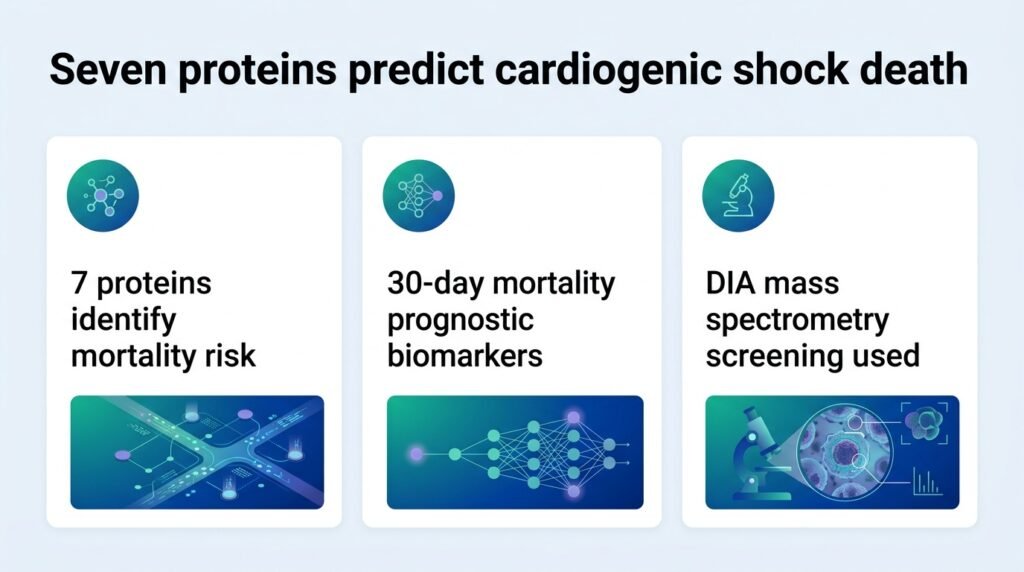
Existing clinical models fail to predict which heart attack patients will survive cardiogenic shock, but a new seven-protein signature could change how we triage critical cardiac care.
When cardiogenic shock strikes after a heart attack, doctors fly blind.
Standard clinical risk scores rely on crude bedside metrics. They often miss the silent molecular storm that actually kills the patient. This trial suggests we must look beyond hemodynamics to find answers.
By combining mass spectrometry with machine learning, researchers mapped a protein signature that flags 30-day mortality risk before clinical signs worsen. This challenges the traditional reliance on blood pressure and heart rate alone. It suggests metabolic and oxidative failure, not just mechanical pump failure, dictates survival.
Mapping the lethal storm
The researchers tracked two consecutive patient groups: a discovery cohort of 30 patients and a verification cohort of 60 patients. Using Data-Independent Acquisition mass spectrometry, they initially identified 216 proteins that differed between survivors and non-survivors. They used weighted gene co-expression network analysis to link these proteins to oxidative stress and energy metabolism.
Next, they applied Boruta feature selection and nested cross-validation to isolate the most predictive signals. This process narrowed the field to a tight, seven-protein panel: YWHAZ, QDPR, MDH2, FAH, PSMA1, FABP5, and AHCY. This metabolic focus aligns with previous research. For instance, a plasma proteome analysis previously identified VEGFR1 as a key prognostic marker in shock. Similarly, researchers have used a high-throughput targeted proteomics discovery approach to study reperfusion in myocardial infarction. The new study builds on this foundation by proving that a multi-protein panel outperforms single-marker strategies.
Upgrading standard risk models
The performance metrics show a clear diagnostic lift over current clinical standards:
- The seven-protein panel achieved a mean area under the ROC curve of 0.82 (95% CI: 0.69–0.95) for predicting 30-day mortality.
- Adding the panel to the standard SCAI clinical model improved the integrated discrimination improvement (IDI) by 0.143 (P = 0.016).
- Adding it to the IABP-SHOCK II score boosted the IDI by 0.138 (P = 0.034).
The predictive power remained independent even after adjusting for core clinical confounders. These numbers are not just statistical noise. They represent a significant upgrade to tools that clinicians have relied on for years.
The validation bottleneck
We must be realistic about the hurdles ahead.
This was a single-center exploratory study with a total sample size of only 90 patients across both cohorts. Before this panel can guide bedside decisions, it requires large-scale, multi-center external validation.
Mass spectrometry is also currently too slow and expensive for emergency room triage. For this signature to save lives, developers must translate these seven markers into a rapid, low-cost point-of-care assay. Until then, these proteins remain a promising map without a practical vehicle.
Read the full study in Clinical Proteomics.