Even the most advanced artificial intelligence models frequently cite the wrong medical papers, but a new verification method might fix the problem.
If a medical researcher cannot trust the bibliography of an AI-generated paper, the entire draft is useless. We have moved past the era of completely fabricated “hallucinations” in scientific writing. Today, the threat is far more subtle: real papers cited for claims they never actually made.
This shift from complete fabrication to “misattribution” complicates peer review. It forces editors and researchers to check every single digital identifier manually. This turns AI from a time-saver into a compliance headache.
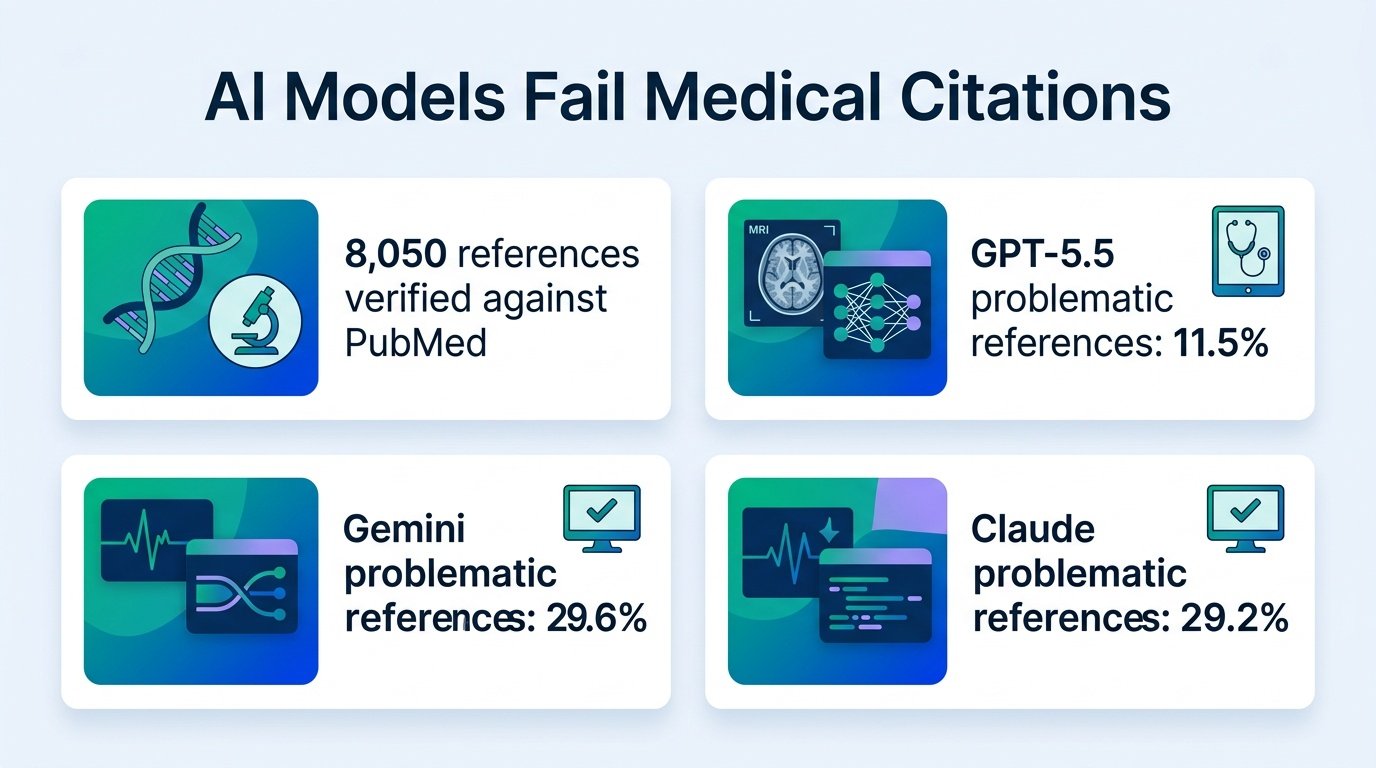
A new study evaluated three frontier models—Claude Opus 4.8, GPT-5.5, and Gemini 3.5 Flash—as they generated 270 cardiology narrative reviews with web search enabled. Researchers cross-checked all 8,050 references against PubMed. The error rates were high: problematic references made up 11.5% of GPT-5.5 output, 29.2% of Claude, and 29.6% of Gemini (P < 0.001).
Crucially, this error rate did not change significantly across topics with different publication volumes (P = 0.052). This means popular medical topics are just as prone to citation errors as niche ones.
The shift to misattribution
The nature of these errors has evolved. Only 0.6% of the errors were pure fabrication. Instead, 77% of the errors were misattributions, where a valid PubMed identifier resolved to an entirely different article. This aligns with broader trends identified in recent literature, such as a longitudinal analysis of AI reference accuracy from 2024 to 2026, which highlights how AI-generated literature struggles with precision even as outright plagiarism declines.
This is a dangerous trap. A quick glance at a bibliography shows real PMIDs and real journal names, giving a false sense of security. It exploits the trust of busy peer reviewers who may only check if the link works, not if the content matches. This raises serious questions about the ethics of using artificial intelligence in medical writing.
Automating the cure
To solve this, researchers tested an LLM-based Chain-of-Verification (CoVe) method against an expert-adjudicated set of 270 references. The results show that automated verification can match human precision.
- The system detected 60 of 62 problematic references.
- It achieved a sensitivity of 96.8%.
- It achieved a specificity of 98.6%.
- It successfully caught every single misattribution and fabrication in the test set.
This finding matters because it proves we cannot rely on search-enabled LLMs to self-correct their sources. It shifts the burden of proof. Journals should stop banning AI outright and instead mandate automated verification pipelines like CoVe before submission.
However, the study has limits. It focused entirely on cardiology. The CoVe system itself relies on LLMs, which could introduce their own secondary errors in different medical specialties.
Read the full study in medRxiv.