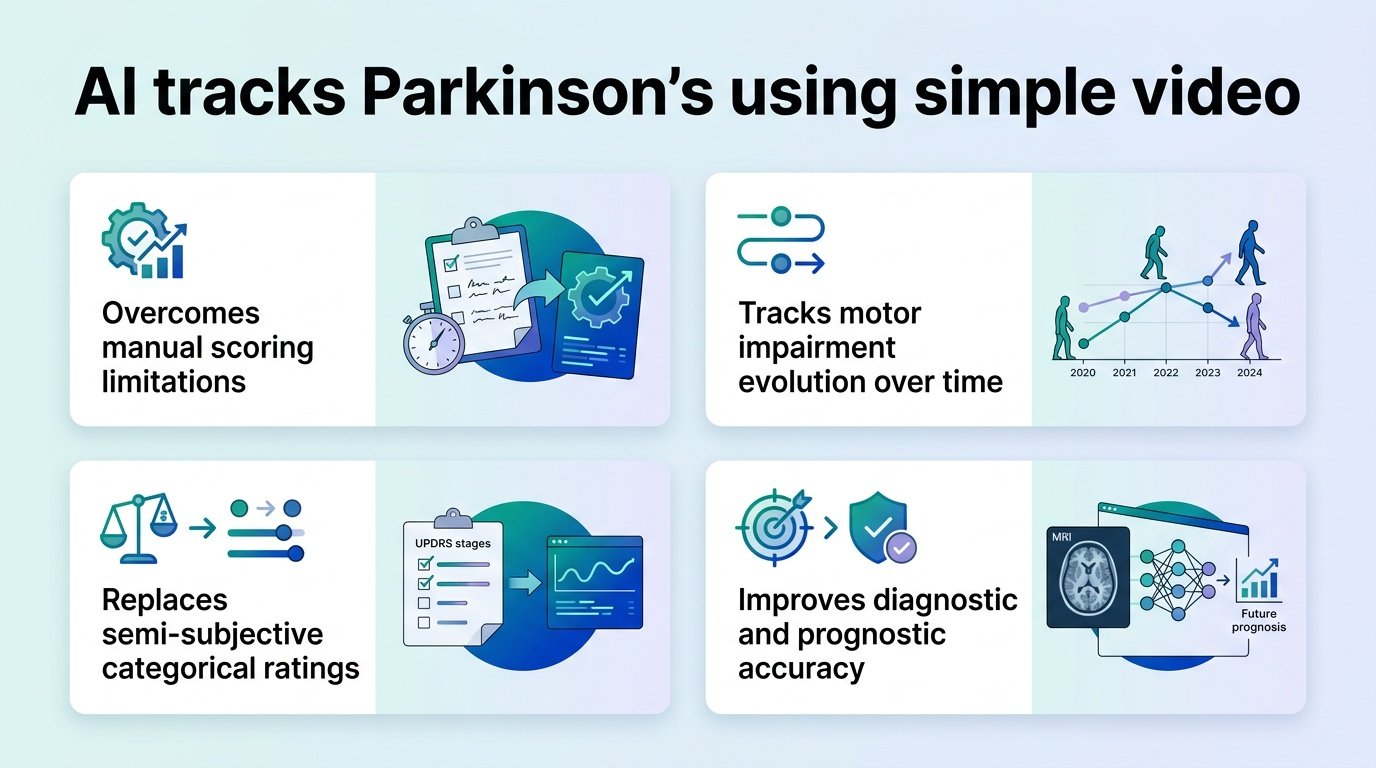
A new 3D tracking system turns standard patient videos into precise data that can estimate how long someone has lived with Parkinson’s disease.
Doctors still grade Parkinson’s disease by watching patients tap their fingers or walk down a hallway. This manual approach relies on subjective, categorical scales that miss the slow, subtle slide of motor decline. It makes tracking the disease imprecise and highly variable between different clinics.
A new study challenges the assumption that we need expensive wearable sensors to capture this decline. By converting standard clinical videos into 3D coordinates, researchers proved that mathematical patterns in everyday motion can reveal how far the disease has progressed.
The real shift here is the ability to infer time since diagnosis. This suggests that Parkinson’s leaves a distinct, continuous physical signature that human eyes simply cannot quantify. It changes how we define disease progression.
How the math works
The researchers built a markerless 3D pose tracking system to analyze patients performing three standard motor tasks. These activities targeted different motor systems: fine hand movements, forearm rotation, and whole-body walking. By capturing these diverse movements, the system gathered a comprehensive view of physical impairment.
Instead of using a black-box AI, the team extracted explainable kinematic features across multiple spatiotemporal scales. The machine learning models combined these physical measurements to analyze how movement patterns shift over time.
- The system successfully classified whether a participant had Parkinson’s disease.
- It mapped distinct movement characteristics to duration-defined severity.
- The model automatically inferred the time elapsed since diagnosis.
This multi-scale approach is crucial. By looking at both tiny hand tremors and broad walking strides, the algorithm avoids the blind spots of single-task sensors. It paints a complete picture of the patient’s physical state.
The clinical reality
This finding matters because clinical trials for neurodegenerative diseases often stall due to noisy, subjective measurements. If a digital biomarker can objectively estimate disease duration, drug developers can run shorter trials with highly precise endpoints. It moves the industry away from coarse, manual rating scales that require expert consensus.
However, we must look at the limitations. The study relies on a synchronized camera setup, which is easier to run in a research lab than in a busy clinic. We also need to see how this model performs across larger, more diverse patient populations with different body types, ages, and clothing.
Even with these hurdles, the research shows that video is no longer just a visual record. It is a dense source of clinical data that could streamline how we evaluate new therapies.
Read the full analysis in npj Parkinson’s Disease.