A massive multi-center analysis reveals that standard lab ranges may hide the earliest signs of acute kidney injury.
Why do hospital patients with “normal” lab results still suffer sudden organ failure? For years, clinicians have relied on broad, static reference ranges to flag danger. But a new meta-analysis suggests these standard safety nets fail to catch acute kidney injury (AKI) before it strikes.
This challenges the binary way medicine views lab results. We treat biomarkers as safe or unsafe based on arbitrary cutoffs. The reality is a sliding scale of risk that begins well within what we currently call the normal range.
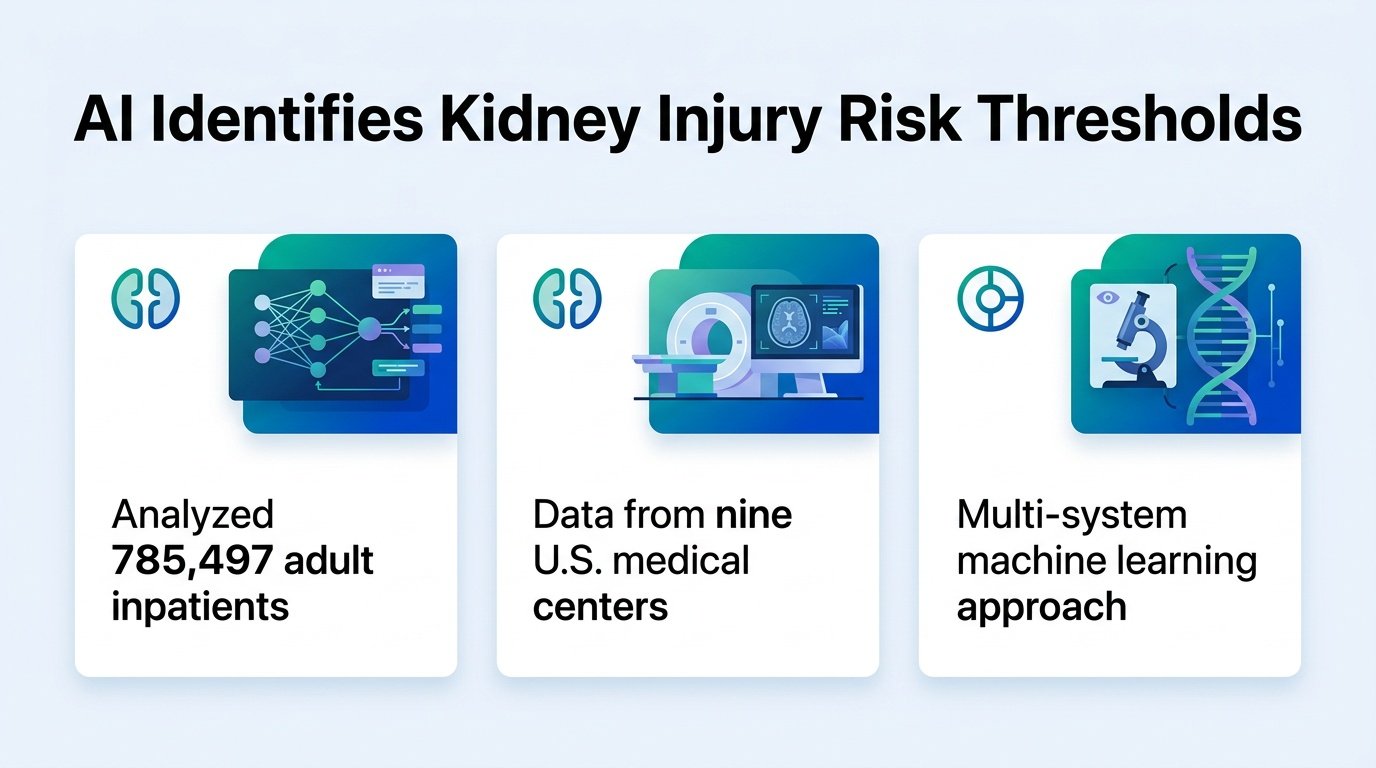
Researchers analyzed electronic health records from 785,497 adult inpatients hospitalized between 2010 and 2019. The data spanned nine U.S. academic medical centers within the PCORnet network. By building gradient boosting machine models at each site and combining them through meta-regression, the team mapped how subtle shifts in common lab values drive risk.
The Hidden Danger Zones
The data shows that risk rises long before a patient hits traditional danger thresholds. For instance, a mild rise in glucose from 100 mg/dL to 140 mg/dL is associated with a 1.46-fold higher risk of AKI. Similarly, anion gap and chloride show elevated risk well within their standard reference ranges. Anion gap carries a 1.14-fold risk increase across 4 to 12 mmol/L, while chloride shows a 1.28-fold increase across just 96 to 100 mEq/L.
Why This Matters
This is not just about predicting failure earlier. It is about redefining what “normal” means for a hospitalized patient.
This builds on earlier predictive work, such as a 2018 machine learning model that proved the viability of EHR-based forecasting. However, while previous models focused on binary prediction, this new analysis exposes the continuous, non-linear nature of physiological decline. Another study on emergency department prediction highlighted the need for early triage, but this meta-analysis provides the specific chemical thresholds needed to make those alerts actionable.
If clinicians wait for a lab value to turn red on their screen, they have already lost the window for preventive hydration or drug adjustments.
Key Risk Thresholds
- Glucose increases from 100 to 140 mg/dL trigger a 1.46-fold AKI risk.
- Chloride shifts between 96 and 100 mEq/L yield a 1.28-fold risk increase.
- Anion gap changes from 4 to 12 mmol/L correlate with a 1.14-fold risk rise.
- Potassium, calcium, and sodium exhibit complex quadratic associations with patient risk.
The Limits of Prediction
We must acknowledge the boundaries of this data. The study relies on retrospective EHR data, which may not fully reflect current clinical protocols. Additionally, while meta-regression identifies strong associations and bivariate interactions, it cannot definitively prove that these specific electrolyte shifts cause kidney failure.
Still, the clinical implication is clear. Hospitals must move away from static alerts and toward dynamic, risk-weighted algorithms that flag these creeping, sub-threshold trends.
Read the full preprint on medRxiv.