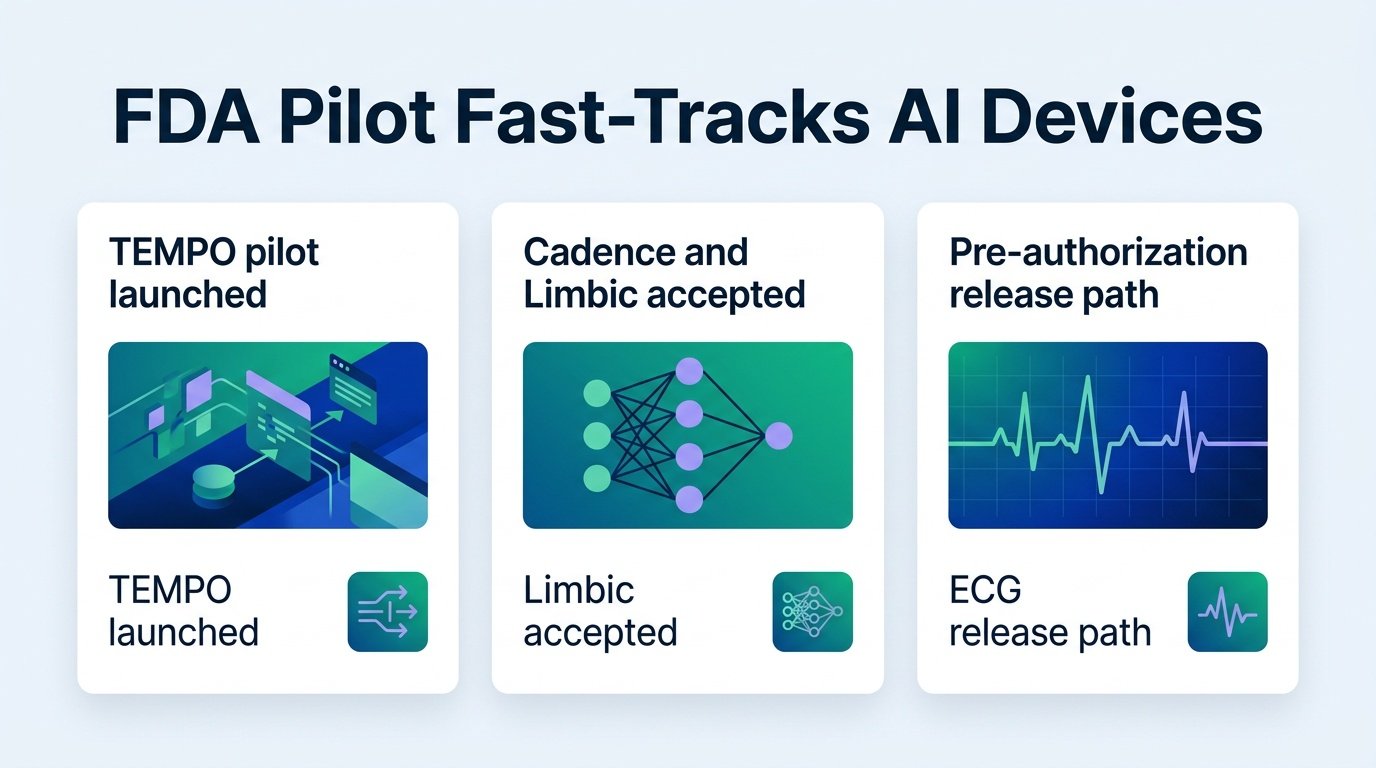
The federal government is letting medical artificial intelligence reach patients first and prove its safety later.
How much uncertainty should we tolerate in clinical software? A new pilot program from federal regulators is testing the absolute limit of that question. By allowing select digital health tools to bypass traditional premarket clearance, officials are shifting the burden of proof from controlled lab trials to real-world clinics.
Four companies—including Cadence, Limbic, Dexcom, and SonderMind—are entering this experimental pathway. They will deploy their technologies to patients without standard marketing authorization. In exchange, they must feed real-world performance data back to regulators.
The regulatory gamble
This is a fundamental shift in how medical software is policed. Instead of demanding ironclad proof of safety upfront, regulators are adopting a “try first, evaluate later” posture. It is a direct response to the rapid evolution of generative AI.
Proponents argue this is the only way to scale care amid severe clinician shortages. Generative AI moves too fast for traditional regulatory cycles. If we wait for multi-year clinical trials, the technology is already obsolete by the time it launches.
Unmapped safety boundaries
But the strategy carries obvious risks. Critics point out that participating companies are largely defining their own safety boundaries and contraindications. This hands-off approach could expose vulnerable patients to hallucinated clinical advice or flawed triage algorithms.
If a postmarket monitoring system fails to catch errors quickly, the consequences will be measured in patient harm. Regulators are betting that real-world data will catch flaws faster than clinical trials. It is a high-stakes experiment that redefines the very meaning of a medical device.