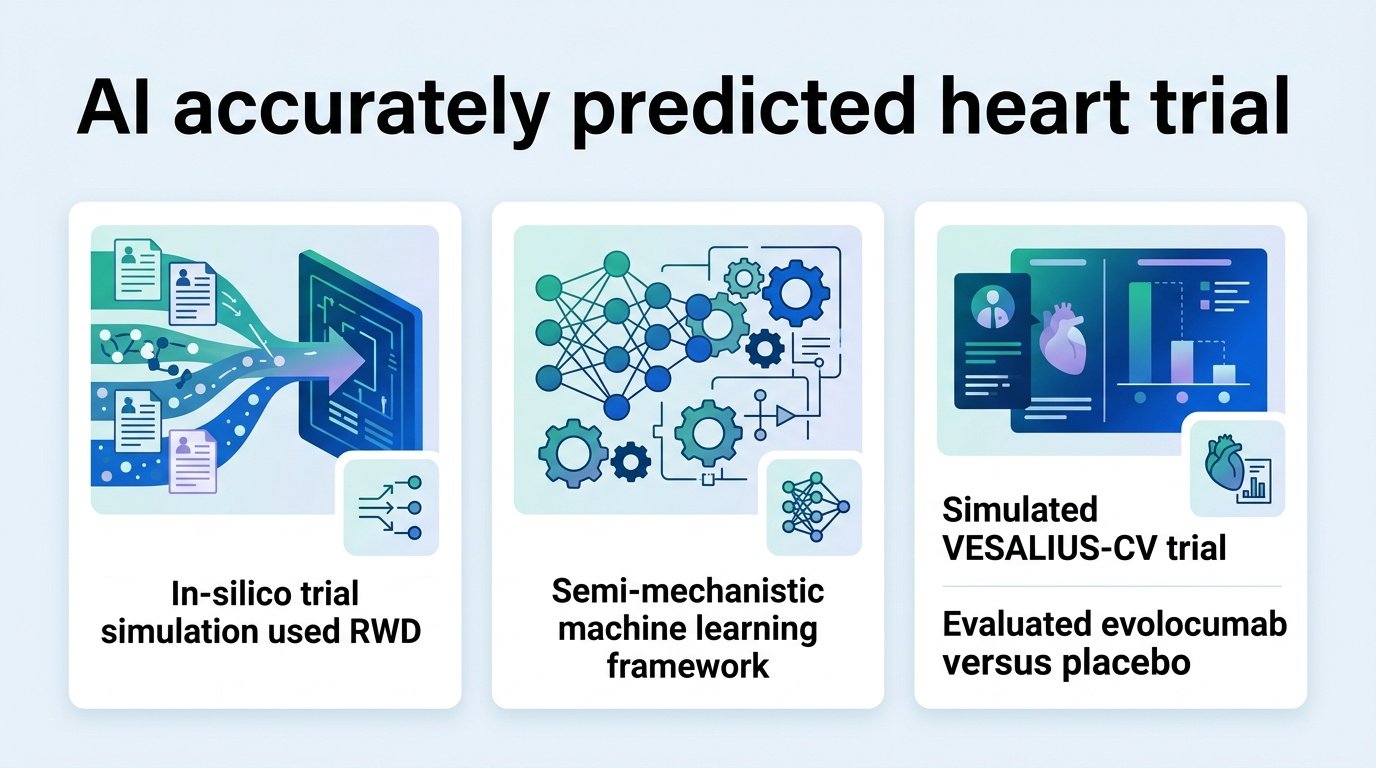
Before the results of a massive cardiovascular trial were made public, an AI model had already mapped out the drug’s success with startling precision.
Drug trials cost hundreds of millions of dollars and take years to fail or succeed. What if we could know the answer before the first patient is even enrolled? This is no longer a theoretical question for drug developers.
A new study simulating the VESALIUS-CV trial shows that real-world data and machine learning can forecast clinical outcomes before they happen. This challenges the long-held belief that clinical trials are unpredictable black boxes that can only be solved by years of human testing. It forces us to rethink how we design trials and manage risk in drug development.
Predicting the future
Researchers used a semi-mechanistic machine learning framework to simulate the VESALIUS-CV trial, which evaluated the drug evolocumab against a placebo. The AI was trained on patient-level real-world data and a drug-centric knowledge graph to build virtual trial arms. This allowed the team to run the trial in-silico before the actual results were disclosed to the public.
The locked model predicted a hazard ratio of 0.78 (95% CI, 0.70-0.87) for major adverse cardiovascular events at 54 months. When the real clinical trial wrapped up, the actual hazard ratio was 0.75 (95% CI, 0.65-0.86) at 55 months of median follow-up. The AI did not just get the direction right. It nailed the exact magnitude of the drug’s benefit.
This level of accuracy suggests that virtual trials are moving from academic concepts to practical tools. This shift is already reshaping discussions around artificial intelligence in cardiovascular pharmacotherapy.
Proving the model works
To prove this was not a lucky guess, the researchers put their model through rigorous retrospective testing. They simulated 22 randomized cardiovascular trials covering 24 between-arm comparisons. The model showed strong patient-level discrimination, with ROC-AUC values between 0.80 and 0.90 across follow-up horizons.
The AI predicted trial success with an F1 score of 0.83, a precision of 0.79, and a sensitivity of 0.89. These numbers prove the model is robust enough to handle diverse clinical scenarios. It shows that historical data contains enough signal to anticipate how new patient cohorts will react to existing drug mechanisms.
Why this matters
This finding changes how pharmaceutical companies should approach phase 3 trials. Instead of launching massive trials blindly, developers can use these simulations to optimize trial design and weed out failing candidates early. This aligns with the broader push toward extended model-informed drug development.
However, we must be honest about the limits. The model relies heavily on high-quality real-world data. If the baseline data is biased or incomplete, the simulation will fail. It also cannot predict unexpected, off-target side effects that have no historical precedent in the knowledge graph. AI can simulate known biology, but it cannot invent what science has not yet discovered.
- Predicted hazard ratio: 0.78 at 54 months
- Actual hazard ratio: 0.75 at 55 months
- Retrospective ROC-AUC range: 0.80 to 0.90
- Trial success prediction F1 score: 0.83
Read the full study in medRxiv.