
A new study proves that predictive AI for sepsis actually saves hospitals millions, challenging the skepticism surrounding digital health investments.
For years, hospital CFOs viewed clinical AI as an expensive gamble. They doubted whether software predicting patient deterioration could translate into actual budget savings. This new analysis of the BIAlert-Sepsis tool flips that narrative.
The findings suggest that early intervention does more than save lives. It systematically decompresses intensive care units. By shifting the focus from reactive treatment to early prediction, hospitals can fundamentally alter their cost structures. This aligns with a broader historical shift toward algorithmic triage, as detailed in research on the evolution of early surgical infection diagnosis.
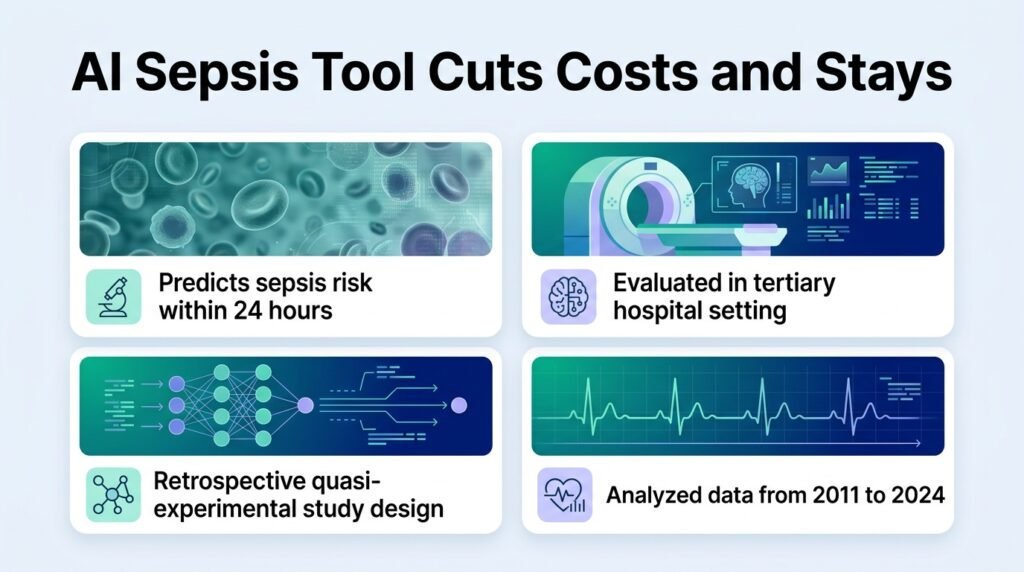
Researchers analyzed **8,039** septic patients admitted to a tertiary hospital between January 2011 and June 2024. The study compared a baseline group of **6,168** patients with **1,871** patients treated after the BIAlert-Sepsis AI was deployed. To keep the data clean, the researchers excluded the highly disruptive COVID-19 pandemic interval. The demographic and clinical characteristics of the patients remained comparable across both periods.
Fewer ICU beds needed
The AI model, which predicts sepsis risk within 24 hours, triggered rapid clinical responses that kept patients out of intensive care. ICU admissions dropped from **34.4%** to **30.4%**. When patients did require intensive care, their stays were shorter. The hospital saw an average reduction of **0.35** ICU days and **0.59** ward days per patient.
These small daily reductions accumulate into massive operational relief. Fewer days in the ICU means better bed availability for elective surgeries and emergencies.
The financial payoff
The clinical efficiency translated directly into financial savings. The economic evaluation showed that early detection prevents the most expensive complications of sepsis.
- Mean admission costs declined from **26,517€** to **24,630€**.
- Adjusted models showed a **26.1% to 31.1%** reduction in mean admission costs.
- The 5-year model projected a cumulative net benefit of **3.55M€**.
- The estimated return on investment reached **528%**.
Skeptics will rightly point out the study’s quasi-experimental, before-and-after design. It cannot fully rule out other hospital-wide quality improvements that occurred over the 13-year span. However, the interrupted time series analysis confirmed a sustained cost decline specifically after the AI was deployed.
This is not just about cheaper care. It is about proving that predictive software can pay for its own implementation and maintenance while improving patient flow. For health systems hesitant to fund digital tools, these numbers provide a concrete blueprint for financial viability.
This analysis is based on a study published in PLOS Global Public Health.