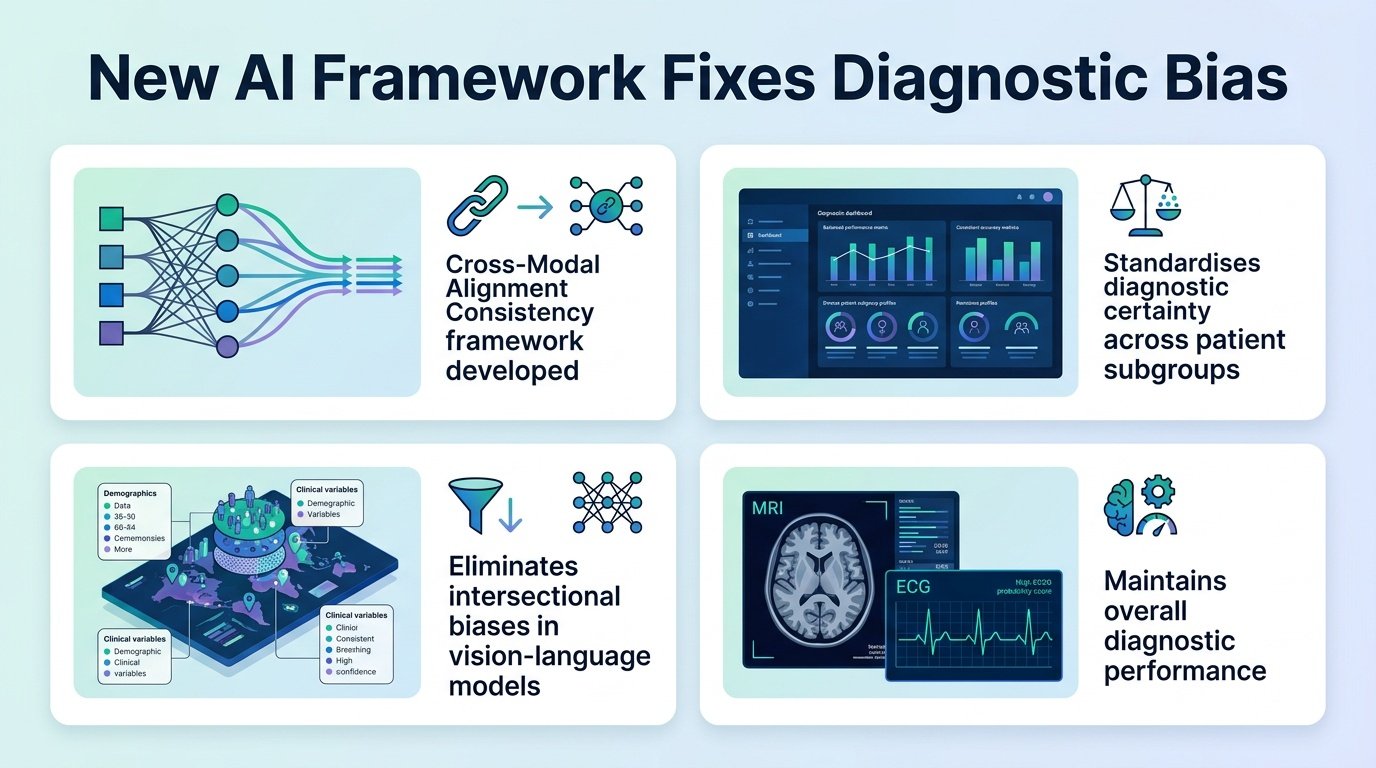
A new training framework proves that medical AI can close the diagnostic gap for marginalized patients without sacrificing overall accuracy.
When a medical AI misdiagnoses a patient, the error is rarely random. It is often a predictable failure of intersectional bias, where patients at the crossroads of certain ages, genders, and races face much higher rates of missed diagnoses.
For years, computer scientists believed they faced a zero-sum game. They assumed that making an algorithm fairer meant making it less accurate overall. This new study challenges that trade-off directly.
The trade-off myth
Standard fairness fixes often force models to compromise, lowering overall performance to make results look statistically equal. This is a dangerous compromise in clinical settings where every percentage point of accuracy matters. Previous research, such as a 2025 study in Science Advances, has documented how deeply these demographic biases run in expert-level vision-language models.
The research team developed a training framework called CMAC-MMD to tackle this. It standardizes diagnostic certainty across patient subgroups without needing sensitive demographic data when the model is actually being used in the clinic. This is a crucial detail because collecting race or gender data at the point of care introduces massive privacy risks.
Closing the gaps
The researchers put their framework to the test across two distinct clinical tasks: skin cancer detection and glaucoma screening. They used a dataset of 10,015 skin lesion images (HAM10000) with external validation on 12,000 images (BCN20000), alongside 10,000 fundus images for glaucoma detection.
The results show that fairness does not have to come at the cost of performance:
- In the dermatology cohort, the missed diagnosis gap (the difference in True Positive Rate, or ΔTPR) dropped from 0.50 to 0.26, while overall diagnostic accuracy (AUC) improved from 0.94 to 0.97.
- For glaucoma screening, the missed diagnosis gap fell from 0.41 to 0.31, while the AUC ticked up from 0.71 to 0.72.
Real-world clinical stakes
This matters because it refutes the excuse that bias is an inevitable byproduct of high-performing AI. It shows we can build models that protect marginalized groups while raising the diagnostic bar for everyone. This is especially vital as Western-trained models are exported globally, a trend that can worsen disparities if left unchecked, as explored in Frontiers in Artificial Intelligence.
However, we must remain realistic about the limitations. While this framework narrows the gap, it does not erase it. A missed diagnosis gap of 0.26 in dermatology is still a significant clinical risk for marginalized patients, and the glaucoma AUC of 0.72 remains modest for standalone screening.
Read the full study in npj Digital Medicine.