Using AI to analyze free-text surgery names could finally make cheap observational health data as reliable as gold-standard clinical trials.
Observational health studies are cheap but notoriously messy. Doctors choose treatments based on the exact surgery a patient gets, creating a massive bias that standard statistical models struggle to clean up. If we cannot control for the specific procedure, the study’s conclusions fall apart.
A new preprint suggests a surprisingly simple fix. Researchers turned to natural language processing to translate raw text into math.
The bias in the text
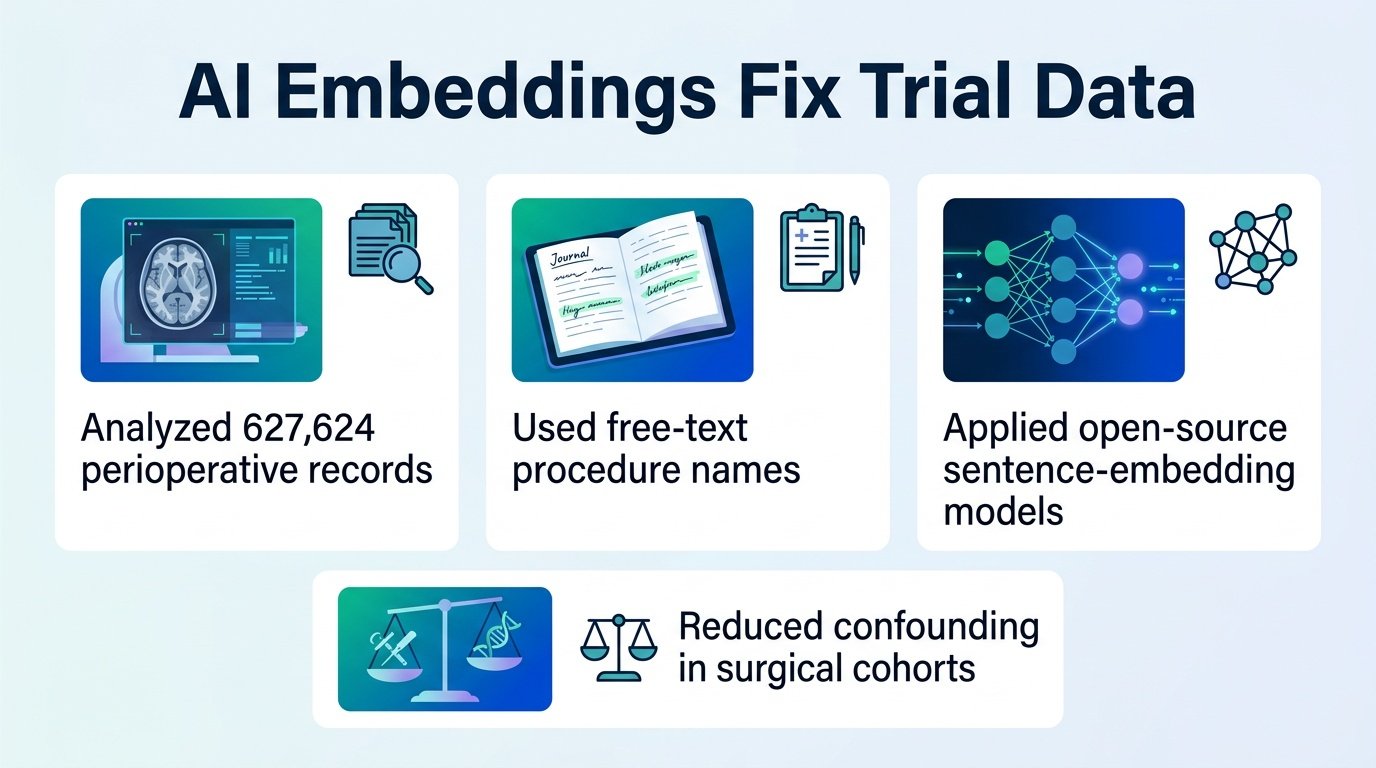
Standard databases struggle to capture the nuance of surgical procedures. Two operations might share a billing code but carry vastly different risks. To solve this, researchers analyzed **627,624** adult perioperative records.
They used open-source models to convert free-text surgery names into vector embeddings, capturing the clinical context hidden in plain English.
This approach challenges the traditional reliance on rigid administrative codes. By letting AI read the surgeon’s actual notes, the researchers built a highly specific map of surgical risk. This map was then used to balance patient groups and eliminate bias.
Replicating the gold standard
To prove the method works, the team tried to replicate the results of three major randomized controlled trials. These trials represent the gold standard of medical evidence, which observational studies usually fail to match.
- In the GA-CARES replication, standard adjustments falsely showed that total intravenous anesthesia reduced cancer mortality. Adding the AI text embeddings corrected this error, yielding a trial-consistent, nonsignificant association with an odds ratio of **0.84** (95% CI, **0.62-1.14**; p=**0.274**).
- In the PADDI replication, the model successfully reproduced the trial’s non-harm finding for 30-day surgical site infections with an odds ratio of **0.72** (95% CI **0.69-0.76**, p<**0.001**).
- In the GAP replication, the AI embeddings were the only method capable of recovering the trial’s null length-of-stay findings across cardiac, thoracic, and abdominal subgroups.
The researchers also tested department indicators and random variables. Neither could match the performance of the text embeddings. This proves that the actual words written by clinicians hold unique, structured clinical value.
The analytical takeaway
This is not just a technical upgrade. It changes how we should value unstructured hospital data. For years, researchers have spent millions of dollars manually cleaning databases or running expensive trials because observational data was deemed too biased.
This study shows that the bias is not an inherent flaw in the data itself. It is a failure of our tools to read it. By using language models to extract clinical context, we can make massive, existing hospital databases highly reliable.
There are clear limitations. This method relies on the quality of free-text inputs, which vary across hospitals. It is also a preprint that requires peer review. However, it suggests that the future of clinical evidence may lie in the messy notes already sitting in electronic health records.
Read the full study in medRxiv.