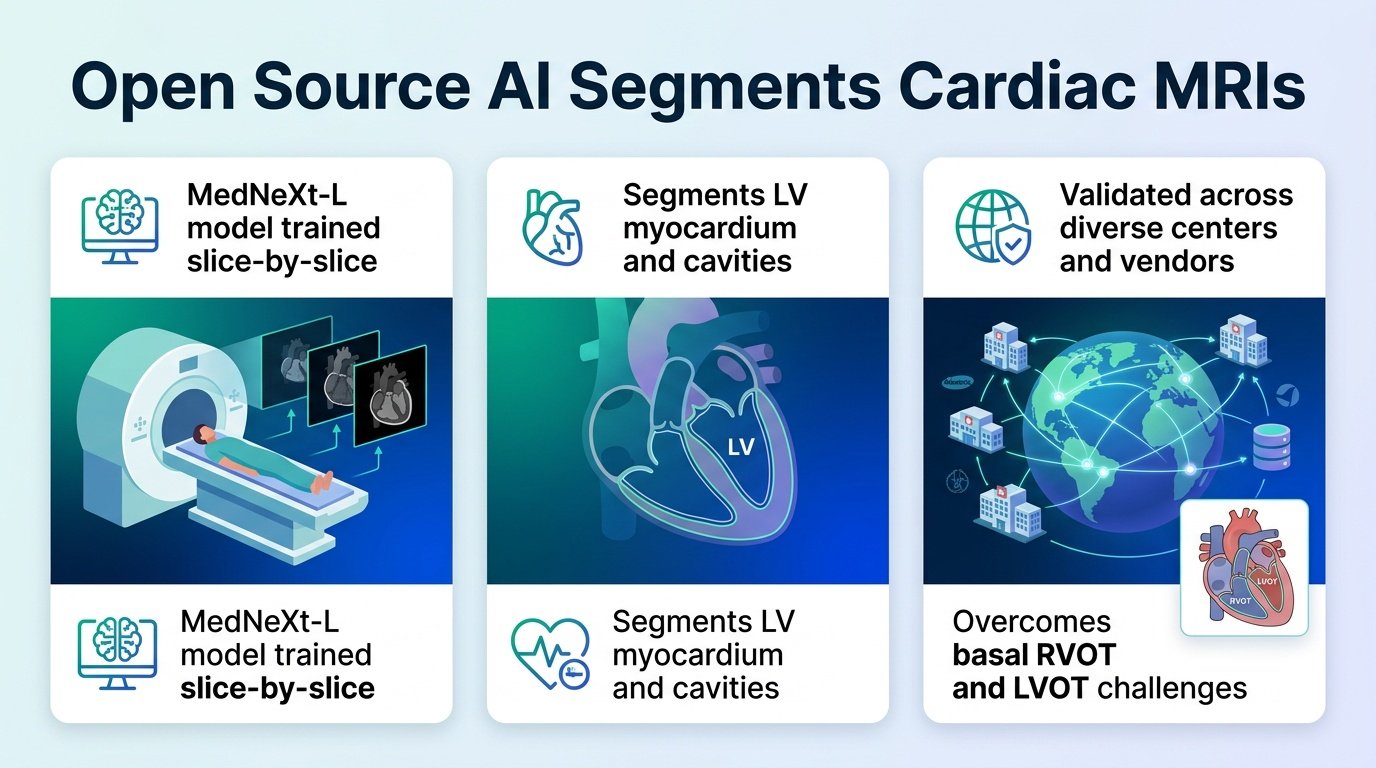
A new open-source AI matches human precision in tracing heart structures but falls short on the critical calculations doctors use to make treatment decisions.
Can an algorithm truly understand the shape of a diseased heart if it has never seen that specific illness before? For years, cardiac imaging AI has stumbled when moving from clean laboratory data to the messy reality of diverse hospital scanners and rare pathologies. The release of CorSeg-CineSAX, an open-source framework trained on 2,382 subjects across 12 centers, challenges the assumption that AI needs hyper-specific training data to perform in the wild. Yet, its performance reveals a persistent, troubling gap between beautiful image segmentations and reliable clinical metrics.
The generalization test
Most medical AI models degrade rapidly when tested outside their training environments. To test its limits, researchers evaluated this model on 1,505 subjects and 31,440 MRI slices, including three external datasets. Crucially, the test included 16 different cardiac diseases, 11 of which the AI had never encountered during training.
The model achieved a combined mean Dice similarity coefficient (DSC) of 0.893, scoring 0.908 on internal tests and 0.883 on external data. It even conquered the technically difficult basal outflow tracts with a DSC of 0.904, nearly matching its mid-ventricular performance of 0.895. This resilience suggests that deep learning can generalize across vendors and rare diseases without expensive retraining, building on earlier efforts in automatic cardiac cine MRI segmentation.
Where the math fails
While the pixel-by-pixel tracings are highly accurate, the clinical utility is a different story. The AI outperformed human observers in segmenting the left ventricular cavity with a DSC of 0.923 versus the human 0.894. However, when translating these shapes into clinical metrics, the system faltered.
- The model matched humans on volume and mass measurements with an intraclass correlation coefficient (ICC) of 0.961 or higher.
- Left ventricular ejection fraction accuracy dropped to an ICC of 0.855, well below the human benchmark of 0.969.
- Right ventricular ejection fraction reached only 0.900, failing to match the human observer agreement of 0.931.
- The cardiac apex remained the most difficult anatomical region to map, yielding a lower DSC of 0.842.
This discrepancy matters because ejection fraction is the primary metric cardiologists use to diagnose heart failure and guide surgery. A high Dice score is meaningless if the resulting clinical metric is too unstable for bedside decisions, echoing challenges seen in other ventricle segmentation and flow quantification models. The math is highly sensitive. A tiny, few-pixel error at the difficult cardiac apex compounds rapidly when calculating the difference between maximum and minimum heart volumes.
The open source compromise
By releasing the source code, trained weights, and a standalone application, the developers are bypassing the typical commercial gatekeeping of medical software. This transparency is admirable, but it shifts the burden of validation onto individual clinics. Because the AI’s left ventricular myocardium segmentation score of 0.847 still lags behind the human benchmark of 0.875, clinicians cannot yet trust this tool to run entirely on autopilot.
Instead of replacing human readers, this tool acts as a rapid drafting mechanism. It forces us to rethink the goal of cardiac AI. The value is not in achieving total autonomy, but in accelerating the tedious parts of the workflow while leaving the final, high-stakes clinical calculations to human eyes.
This analysis is based on research published in medRxiv.