
A new machine learning tool challenges the rigid, decades-old rule used to decide who qualifies for a cochlear implant.
For decades, deciding who gets a cochlear implant has come down to a rigid, binary threshold. If a patient falls just one percentage point on the wrong side of the line, they are routinely denied a life-altering device. This strict “yes or no” approach does a disservice to patients who fall into the clinical gray zone.
A new study shifts the conversation from arbitrary cutoffs to personalized probabilities. By using machine learning to analyze patient data, researchers have created a tool that does not just follow a rule, but calculates individual success rates. This challenges the assumption that clinical guidelines must be simple to be useful.
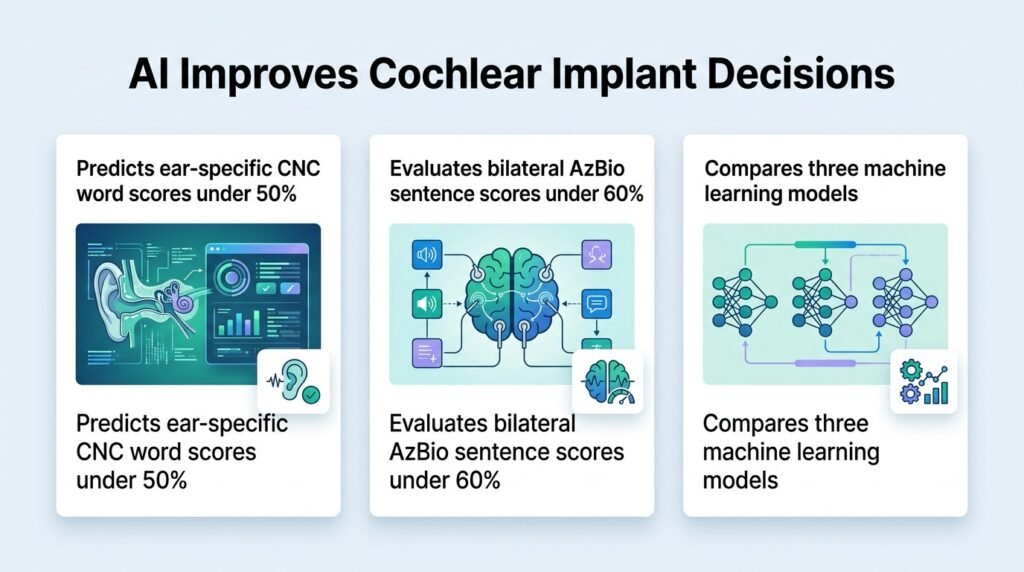
To build this tool, researchers analyzed a massive retrospective cohort of 1,878 patients and 3,756 ears from an institutional registry and the HERMES database. They trained three machine learning models—logistic regression, random forest, and XGBoost—using patient age, audiometric thresholds, and word recognition scores. They benchmarked these models against the traditional “60/60 rule,” which flags patients with a pure-tone average of 60 dB or worse and a word recognition score of 60% or worse.
The performance breakdown
The algorithms did not achieve a total blowout victory, but they excelled where the traditional rule falters. The data reveals a highly nuanced trade-off between the old way and the new machine learning models:
- For CNC word scores under 50%, the traditional 60/60 rule held a higher F1 score of 0.83 compared to the AI’s 0.77 to 0.79.
- However, the AI models showed superior sensitivity of 0.80 to 0.84 compared to the rule’s 0.77, with an AUROC of 0.88 to 0.89.
- For AzBio sentence scores under 60%, the AI clearly won, scoring an F1 of 0.79 to 0.80 against the rule’s 0.71.
- The AI also showed higher specificity of 0.86 to 0.87 compared to the rule’s 0.76, with an AUROC of 0.89 to 0.90.
Embracing the gray zone
This is not a case of technology replacing human clinical judgment. The authors openly admit that the machine learning models are not dramatically superior to the 60/60 rule across every single metric. Instead, the real value of this tool is clinical nuance.
Instead of giving a patient a binary rejection, clinicians can use the web-based platform to present a personalized probability curve. This is crucial for borderline candidates who might otherwise be missed. It reframes the clinical consultation from a rigid gatekeeping exercise into a shared, data-driven decision.
The shift to probability
The study is limited by its retrospective design. While the database is large, retrospective data cannot perfectly predict how these models will perform in diverse, real-world clinics. Prospective trials are still needed to prove that these probability scores actually lead to better patient choices and post-surgery outcomes.
Even with these limitations, the implication is clear. Medicine is slowly realizing that human biology rarely fits into neat, binary boxes. By replacing a rigid cutoff with a gradient, this tool could prevent borderline patients from slipping through the cracks of the healthcare system.
Read the full study in The Laryngoscope.