AI Model Decides Heart Surgery From Angiography
A new AI foundation model trained on over 800,000 heart videos can predict surgical needs directly from angiograms, challenging the traditional reliance on human-only visual interpretation in the cath lab.
Can an AI look at a moving X-ray of a beating heart and instantly decide if a patient needs a stent or open-heart surgery?
Cardiologists pride themselves on the subjective art of reading angiograms. This new model suggests that this clinical intuition is highly codifiable. By mapping video pixels directly to written medical reports, the AI bypasses the need for tedious manual labeling, proving that foundation models can master highly specialized invasive imaging. This challenges the assumption that medical AI must be trained on hyper-specific, hand-annotated datasets for every single clinical task.
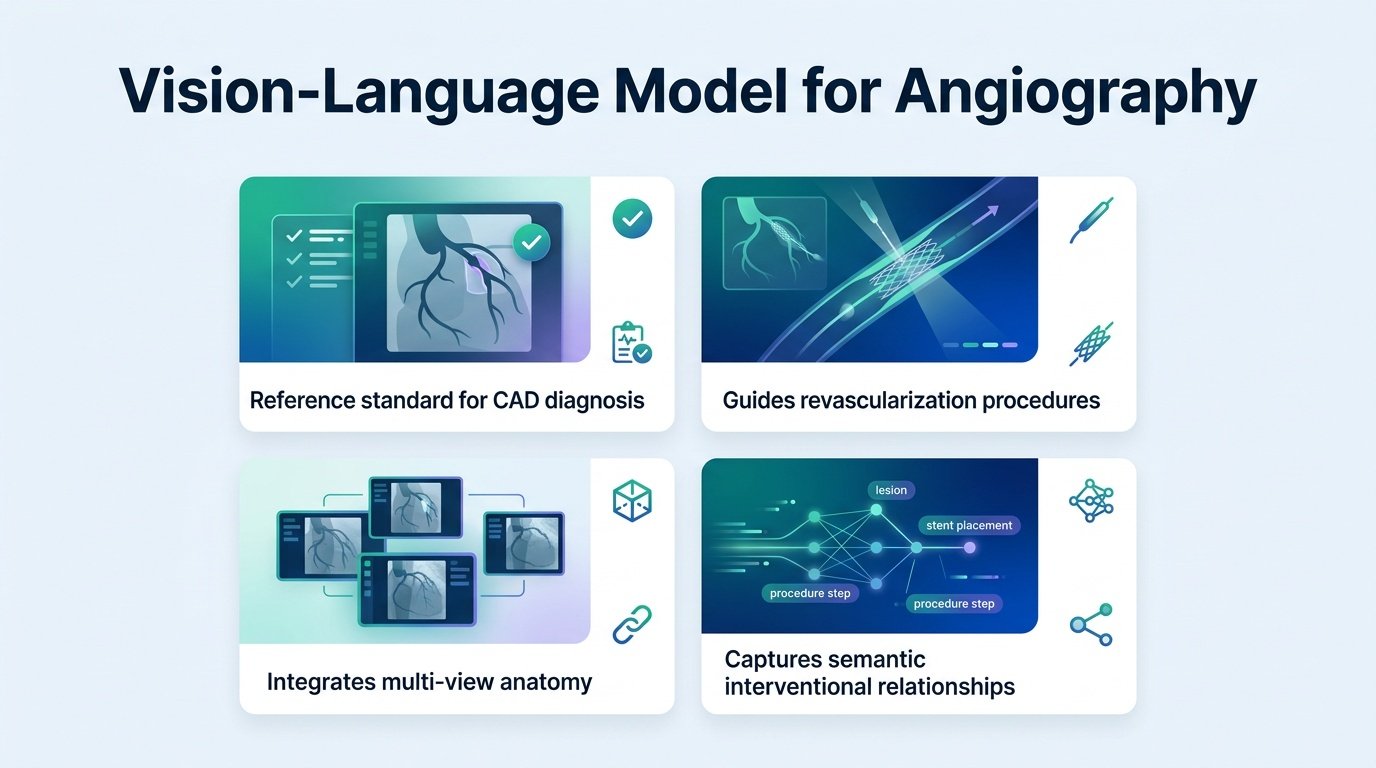
Researchers built CAG-MIND using a massive dataset of 135,475 coronary angiography examinations. This pool contained 812,850 angiographic videos sourced from Zhongshan Hospital and Shanghai Geriatric Medical Center. Instead of paying experts to label every frame, the team used a large language model to extract structured data from routine clinical reports, pairing the text with the corresponding video views. This approach aligns with other recent attempts to merge perception and reasoning in cardiac imaging, such as the ARIADNE framework, which also targets trustworthy coronary analysis.
Strong performance with less data
The results show that the model excels even when it has never seen a specific task before. In zero-shot testing, CAG-MIND achieved a mean AUROC of 0.686 on internal data and 0.745 on an external cohort. Once fine-tuned with task-specific labels, its performance jumped significantly.
Here is how the fine-tuned model performed across key diagnostic and treatment decisions:
- Detecting coronary stenosis: 0.940 AUROC in both cohorts.
- Predicting the need for balloon or stent placement: 0.900 internally and 0.907 externally.
- Recommending coronary artery bypass grafting (CABG): 0.877 internally and 0.875 externally.
Why this matters
The real analytical breakthrough here is data efficiency. CAG-MIND beat fully fine-tuned competing models while using only 10% of the labeled training data.
In clinical AI, labeling data is the primary bottleneck. If a model can achieve superior accuracy with a fraction of the annotated examples, the cost and time required to deploy specialized clinical tools drops precipitously. This shifts the bottleneck of medical AI from manual annotation to raw computational pretraining.
The reality check
Despite these strong numbers, caution is required. The model was trained on retrospective data from just two medical centers in China. Real-world cath labs feature diverse imaging equipment, varying operator techniques, and different patient demographics that could degrade performance.
Furthermore, a high AUROC on paper does not guarantee better patient outcomes. Before this tool can safely guide a cardiologist’s hand during an active heart attack, it must undergo prospective clinical trials to prove its recommendations actually save lives.
Read the full preprint on medRxiv.