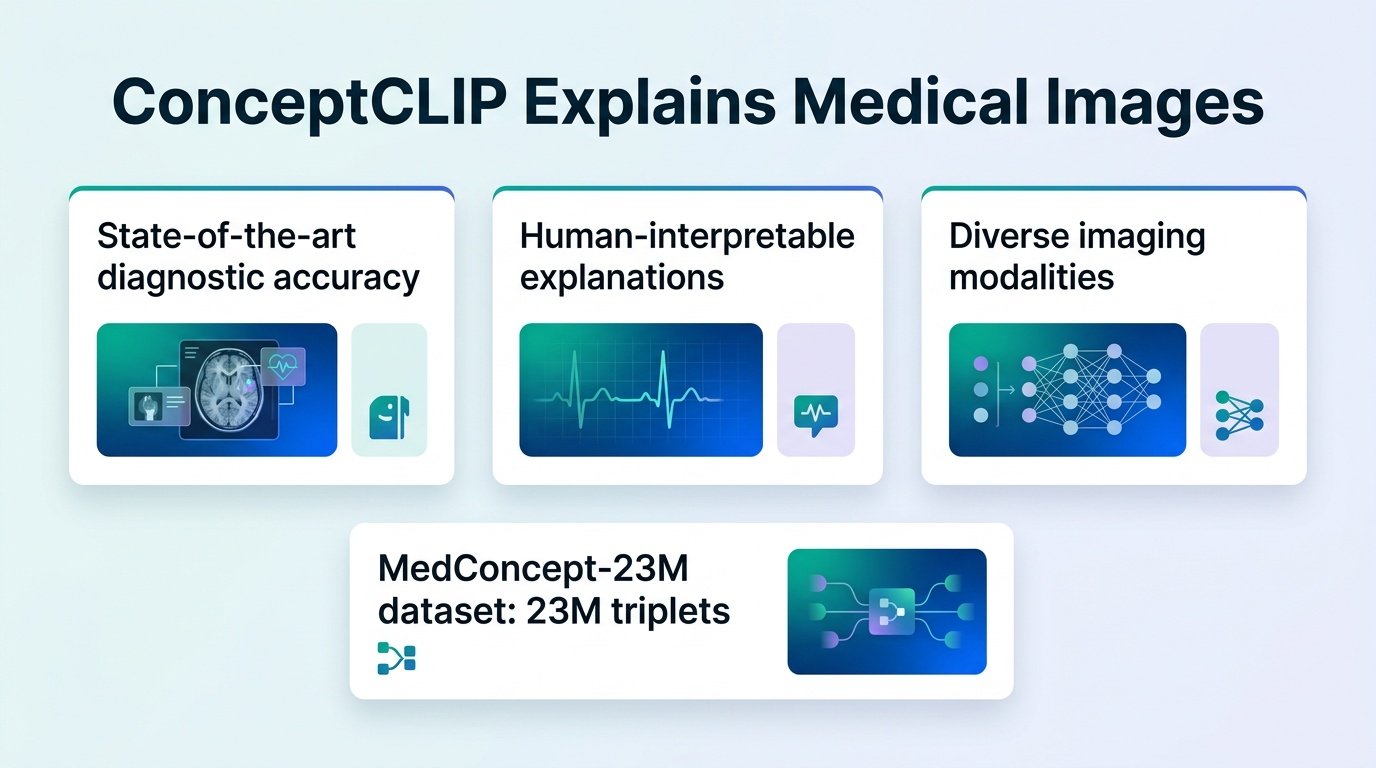
A new artificial intelligence model uses 23 million data triplets to explain its clinical decisions instead of acting as a black box.
Why do doctors reject highly accurate medical AI? The answer is simple: they do not trust decisions they cannot see. For years, developers built larger, more complex neural networks that acted as black boxes, forcing clinicians to take diagnoses on faith. This approach created a dangerous bottleneck in clinical adoption.
A new study challenges the long-held assumption that AI must sacrifice performance to remain interpretable. Researchers introduced ConceptCLIP, a biomedical foundation model designed to explain its reasoning. By showing its work, the model aims to bridge the gap between raw statistical power and clinical utility.
Massive data drives transparency
To solve the trust problem, developers had to change how medical AI learns. They built a massive dataset called MedConcept-23M, which contains 23 million biomedical image-text-concept triplets. This dataset links specific visual regions in scans to concrete medical concepts rather than just raw diagnostic labels.
Traditional models often rely on simple classification labels, which limits their clinical utility. This challenge is well-documented in the Overview of State-of-the-Art Learning-Based Classification Methods in Medical Imaging. ConceptCLIP departs from this limitation by aligning images with both text and regional concepts, allowing it to point to the exact features driving its decisions.
Testing across ten modalities
The researchers tested the model on a massive scale to prove its utility. The evaluation pushed the system far beyond the narrow tasks typical of older medical algorithms.
- The model underwent testing across 78 datasets covering 10 imaging modalities.
- A clinician user study evaluated the system across 3 modalities.
- The concept-based explanations helped clinicians verify predictions and catch potential errors.
This broad testing shows the model is not a one-trick pony. It handles everything from X-rays to MRIs while explaining its work. The clinical study proved that these explanations actually help doctors spot errors, which is the real test of any medical tool.
The reality of clinical trust
This finding matters because it shifts the bottleneck of clinical AI from raw accuracy to human adoption. If a doctor can see exactly why an AI flagged a lung nodule, they can verify the finding in seconds. This targeted verification reduces the risk of automation bias, where doctors blindly agree with a machine.
However, the model still faces significant hurdles. Training on 23 million triplets requires massive computing power, which limits who can build or update these models. We also need to see how it performs in messy, real-world hospital workflows where scan quality is often poor and patient data is incomplete.
Read the full study in Nature Biomedical Engineering.