New AI model pinpoints rare disease genes
By combining graph neural networks with language models, researchers have closed the gap between messy clinical symptoms and hard genetic data.
Why does it still take years to diagnose a rare genetic disease when we can sequence a genome in hours? The bottleneck is no longer reading the DNA. It is matching a patient’s erratic symptoms to a single mutated gene among thousands of possibilities.
This challenge is usually met by human experts manually combing through databases. A new model called GenPhenia suggests we can automate this clinical intuition. By treating symptoms as a network rather than a static checklist, the tool challenges the idea that AI cannot handle the messy, iterative reality of bedside medicine.
Mapping symptoms to genes
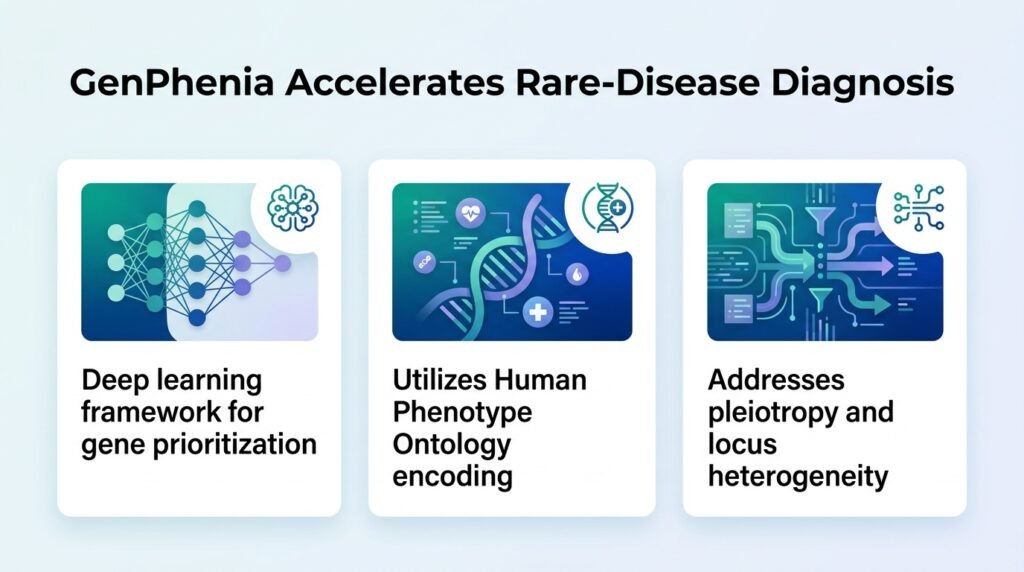
GenPhenia combines graph neural networks with BERT-based language embeddings to process clinical features. It translates standard medical terms into a map of interconnected symptoms. This approach mirrors the broader shift toward multi-layered diagnostic tools, similar to strategies explored in AI-driven detection of inherited neurological disorders.
Instead of looking at genes in isolation, the system models how phenotypes interact. This allows the AI to refine its predictions as doctors gather more clinical clues over time. The framework was trained on synthetic clinical histories and validated using real-world cohorts across endocrinology, cardiology, and immunology.
The diagnostic numbers
The model was tested on the difficult MCRD benchmark dataset, which mimics real-world diagnostic hurdles. The results show a massive leap in accuracy compared to older tools.
- Achieved a 60% Top-1 recall rate, placing the correct gene at the very top of the list.
- Reached an 80% Top-10 recall rate on the benchmark.
- Outperformed existing computational methods, which scored less than 30% Top-10 recall under the same conditions.
These numbers are not just academic victories. In real clinics, moving a diagnostic target from a list of hundreds down to the top ten saves weeks of manual literature reviews. It shifts genomic analysis from an open-ended search to a targeted confirmation.
The limits of prediction
However, we must be realistic about the data. GenPhenia relies heavily on the Human Phenotype Ontology to standardize patient symptoms. If a clinician enters vague or incomplete notes, the model’s accuracy will inevitably degrade.
This dependency highlights a broader challenge in modern genomics. As noted in a review on shifting paradigms from Mendel to multi-omics, tools are only as good as the clinical data feeding them. AI cannot replace the careful, iterative work of physical examinations. It merely accelerates the math once those observations are made.
Read the full study in Human Genomics.