A new regulatory fast-track for cancer software signals a major shift in how medical AI will evolve after entering the clinic.
Radiation oncology is notoriously slow. Mapping tumors and surrounding healthy organs—a process called contouring—takes hours of manual labor for clinical teams. Automating this step is highly desirable. Nearly 60% of cancer patients require radiation therapy during their treatment journey.
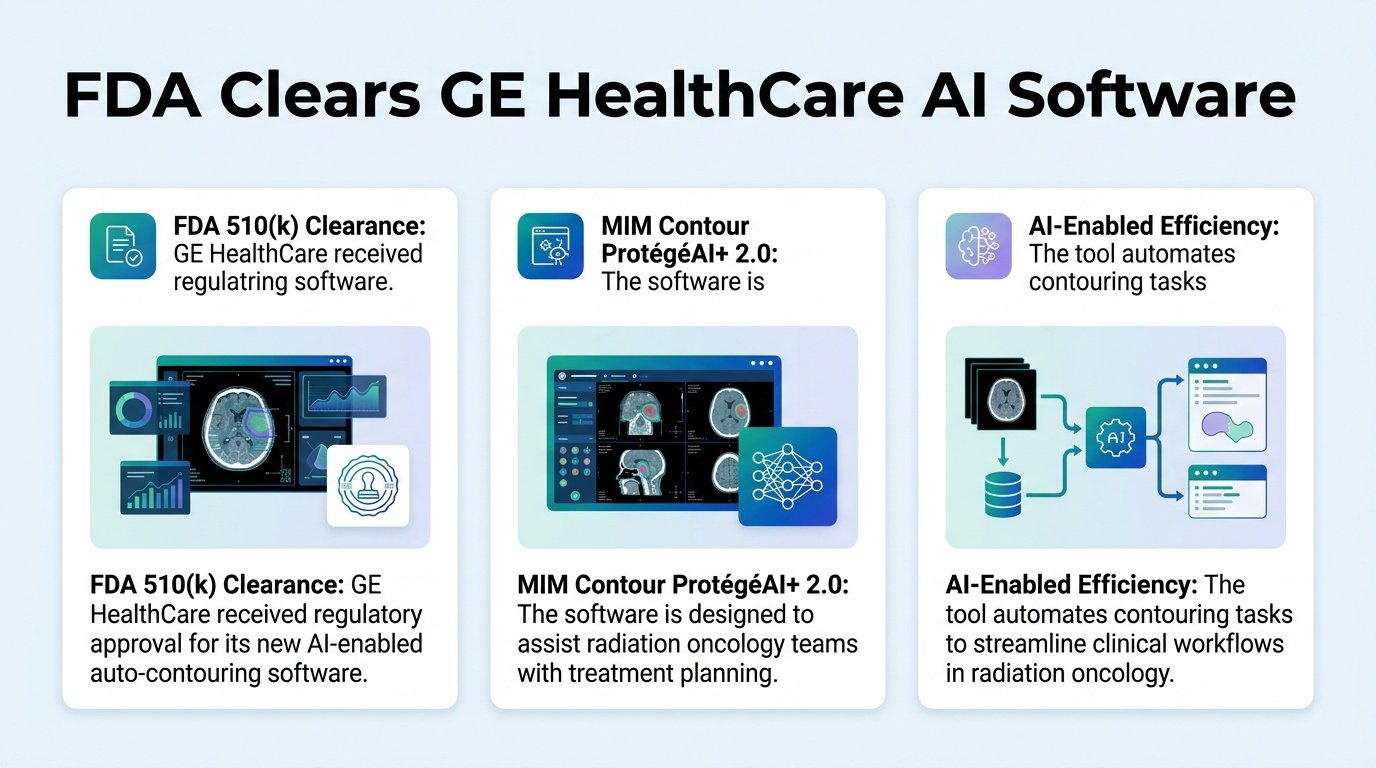
The FDA recently cleared GE HealthCare’s MIM Contour ProtégéAI+ 2.0. The software uses a neural network to automate contouring for brain and male pelvis scans. But the real story is not the automation itself. It is how the software will update in the future.
The Regulatory Shift
This clearance includes a Predetermined Change Control Plan (PCCP). This regulatory framework allows the developer to deploy future AI model updates and expand to other anatomical regions without requiring additional FDA reviews.
Normally, software updates require months of regulatory waiting. Now, the algorithm can iterate almost in real-time. This is a massive competitive advantage. It turns a static medical device into a living, learning system. The FDA is acknowledging that static AI is dead AI. To be useful, algorithms must adapt to new clinical data without bureaucratic delays.
The Clinical Reality
Automating contouring saves critical days between diagnosis and first treatment. However, clinical trust remains the ultimate hurdle. AI models can struggle with atypical anatomy or post-surgical changes. If oncologists must constantly correct the AI’s mistakes, the time savings evaporate. The PCCP model solves the regulatory bottleneck, but clinicians still hold the red pen.