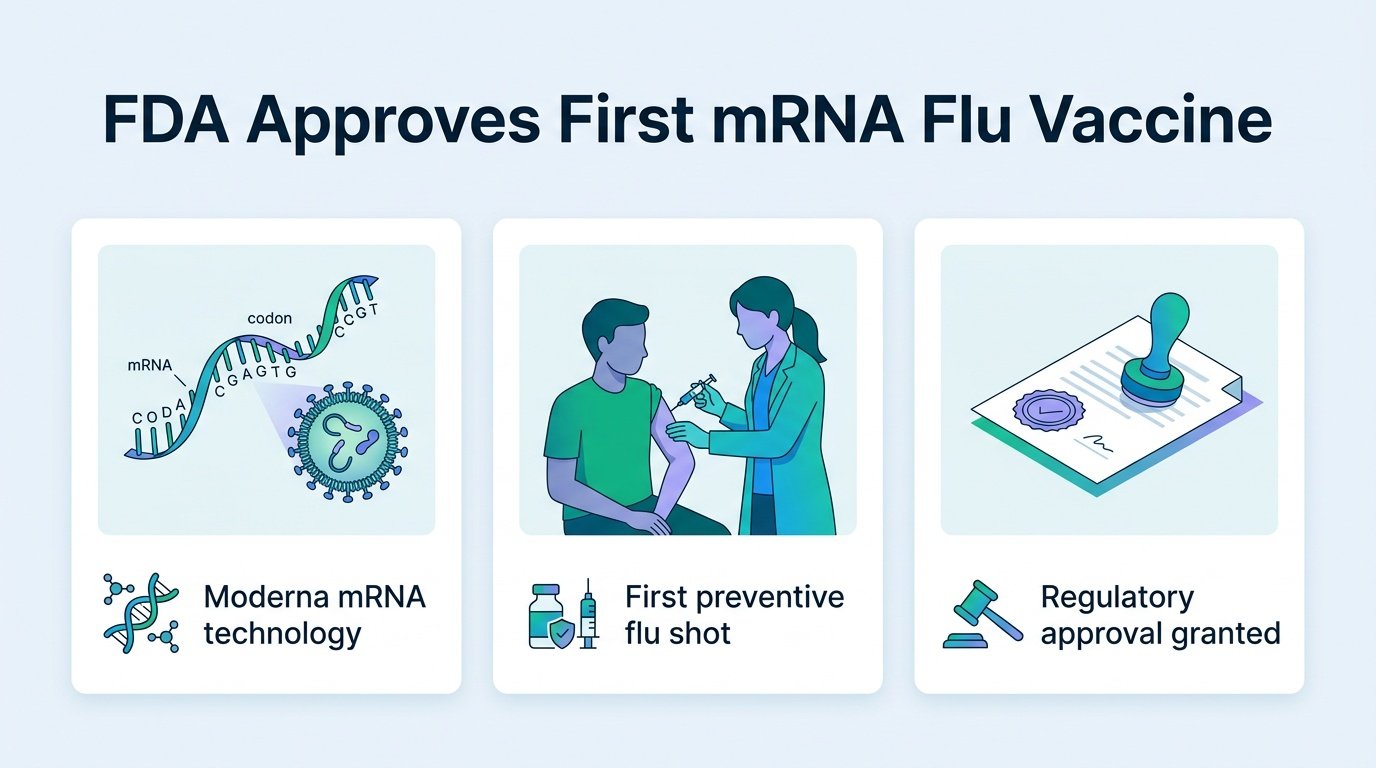
The regulatory clearance of the first mRNA influenza vaccine marks a major shift in public health, but the real battle lies in public trust.
The FDA’s approval of Moderna’s mFlusiva for adults aged 50 and older completes a dramatic regulatory turnaround. Just months ago, a former biologics chief refused to even review the application. Now, after intense public outcry and a swift reversal, the vaccine is cleared to debut for the 2026–2027 flu season.
This approval marks Moderna’s fourth commercial mRNA product. It signals that regulators are willing to back mRNA for mainstream, non-pandemic infectious diseases.
The Efficacy Edge
This is not just another seasonal shot. Traditional flu vaccines rely on decades-old chicken-egg cultivation, which often allows the virus to mutate during production. mRNA bypasses this bottleneck entirely.
Clinical trials involving 40,000 participants demonstrated that mFlusiva is up to 27% more effective than traditional flu shots. In the world of influenza, where vaccine efficacy often hovers around 40% to 60%, a 27% improvement is a massive technical leap. It allows developers to target circulating strains with speed and precision.
But superior science does not guarantee market adoption.
The Trust Deficit
Moderna’s real test is not manufacturing, but persuasion. The vaccine enters a highly polarized public health landscape. Ongoing skepticism toward mRNA technology, occasionally amplified by high-ranking health officials, presents a formidable barrier.
For healthcare providers, the challenge is clear. They must convince a skeptical public that a technology born in a global crisis is now the best choice for routine seasonal care. If political headwinds suppress uptake, the clinical superiority of this vaccine will remain a purely theoretical victory.