New AI predicts readmissions for complex patients
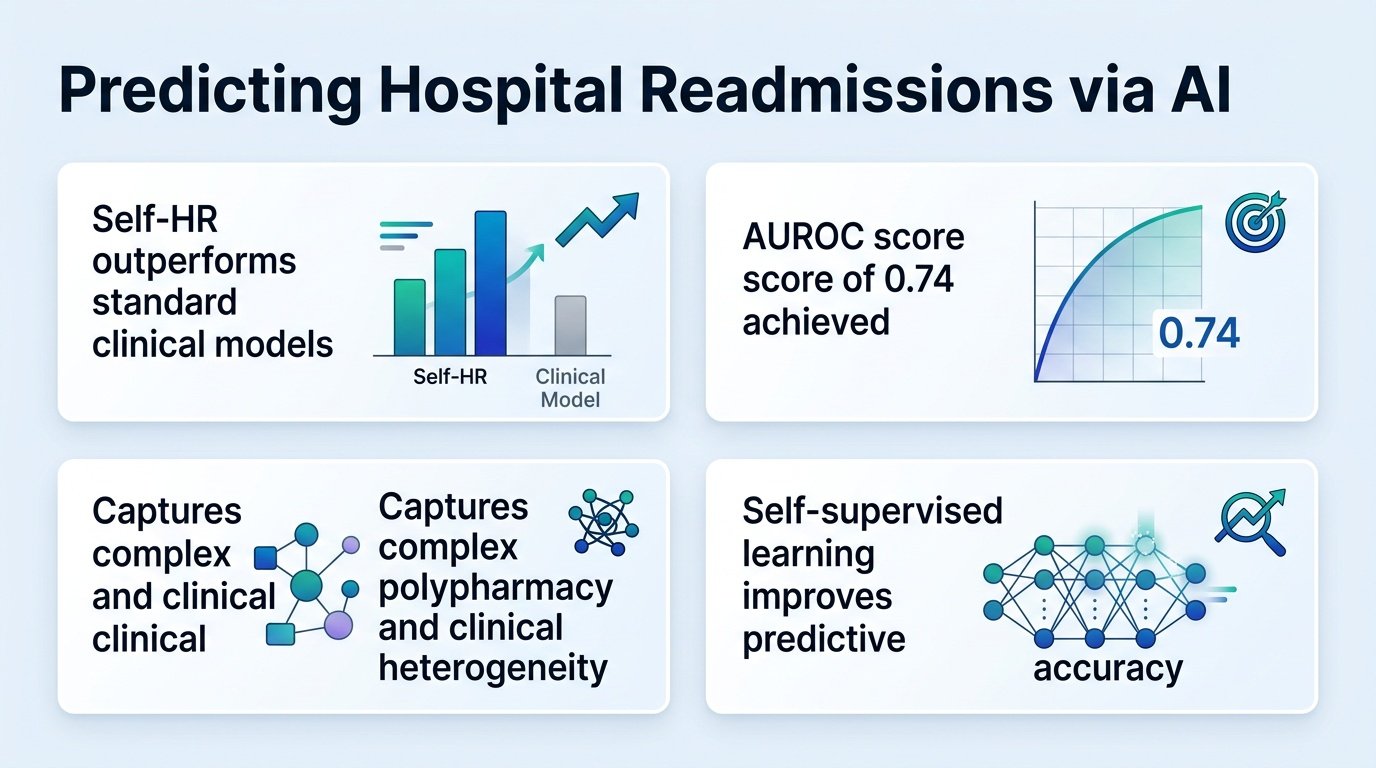
A new self-supervised AI model accurately flags which complex, multi-illness patients are most likely to end up back in the hospital.
Hospital discharge is often a guessing game for patients with multiple chronic illnesses. Doctors look at a patient with diabetes, heart disease, and depression, and must decide if they are truly safe to go home. Traditional predictive tools usually focus on a single disease, failing when forced to handle the messy reality of multiple chronic conditions.
This study challenges the industry’s reliance on fully labeled, pristine clinical datasets. By utilizing self-supervised learning, the Self-HR model proves that AI can learn the complex patterns of patient journeys without human experts labeling every single variable first. This shifts the focus from massive, expensive data-cleaning efforts to smarter algorithmic architecture that thrives on raw, messy electronic health records.
Tracking the complex patient
Researchers built and tested the Self-HR model using data from 99,207 UK Biobank participants, all of whom lived with two or more long-term conditions. To prove the model works in the real world, they validated it against an external database of 79,224 multimorbid individuals from the Clinical Practice Research Datalink.
The results show a significant leap over traditional machine learning. In the UK Biobank cohort, Self-HR achieved an AUROC of 0.92 and an AUPRC of 0.75, outperforming standard supervised baselines like XGBoost and Random Forest. On the external validation set, it maintained a strong AUROC of 0.86 and an F1 score of 0.67 for the readmitted class.
Why this resilience matters
Hospital systems are drowning in unstructured, partially labeled data. The real victory here is the model’s resilience to incomplete records. When trained on just 50% labeled data, Self-HR maintained an F1 score of 0.62 for readmitted patients, while the best supervised comparator collapsed to 0.28. This means hospitals do not need perfect, hand-labeled records to deploy effective predictive triage.
The model relies on a hierarchy of clinical data points to make its predictions. Ablation analyses revealed which factors carry the most weight:
- Incident admission diagnoses emerged as the strongest predictive feature.
- Primary care prescriptions and long-term condition history provided critical secondary context.
- The system successfully predicted the duration of emergency admissions through fine-tuning alone, without needing repeat pretraining.
The remaining hurdles
Despite these strong numbers, limitations remain. The dataset relies on historical cohorts, which may not fully reflect the immediate, real-time dynamics of active hospital wards. Additionally, while the model excels at predicting when someone will return, it cannot yet dictate the specific clinical interventions needed to prevent that return.
Read the full preprint on medRxiv.