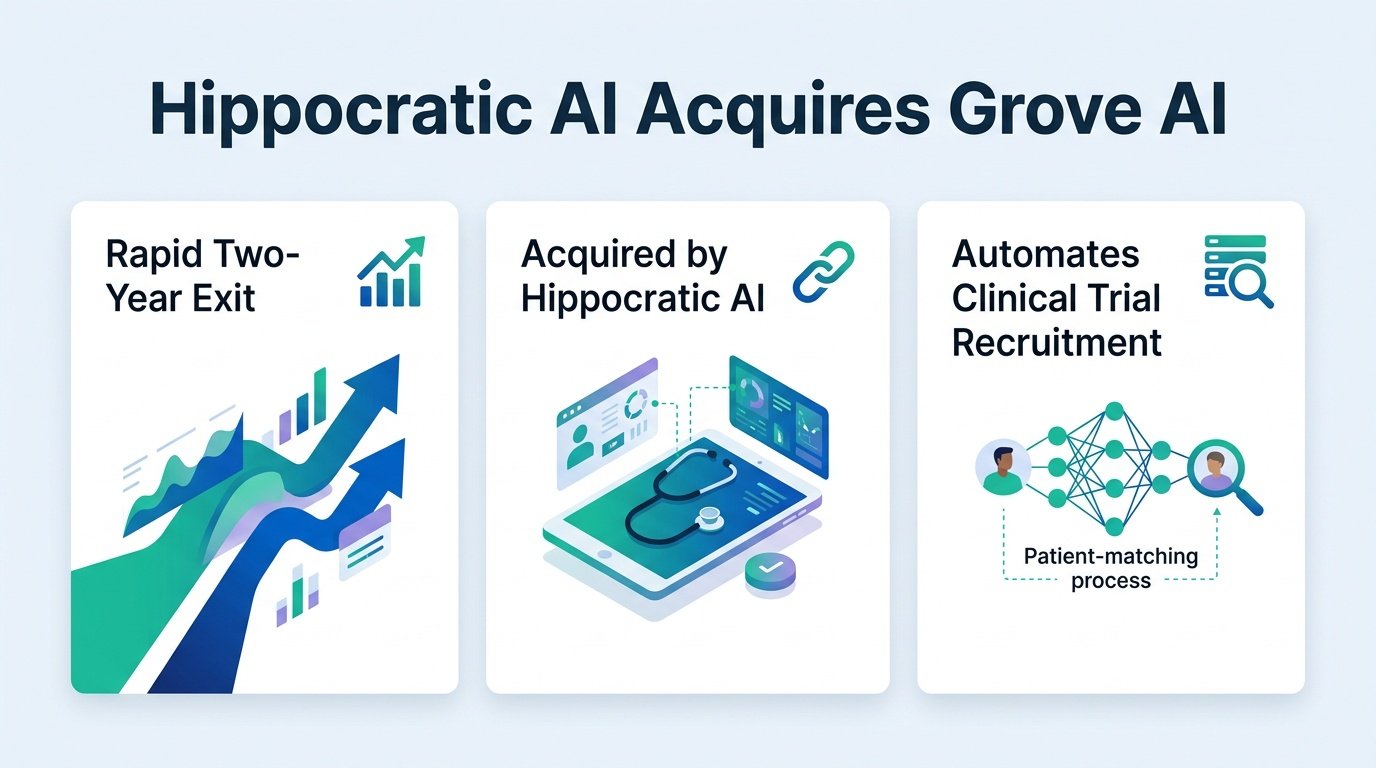
The rapid acquisition of a two-year-old voice tech startup signals a major shift in how pharmaceutical companies recruit patients.
Clinical trials have a notorious bottleneck: finding and keeping patients. Historically, this required armies of human coordinators making endless phone calls. Now, automation is moving from back-office administration straight into patient-facing clinical workflows.
Hippocratic AI’s acquisition of Grove AI, just two years after the startup’s founding, proves that the biopharma industry is desperate for speed. Grove’s voice agent, Grace, has already logged over 10 million patient interactions, handling complex tasks like pre-screening and follow-ups.
The Speed Premium
This is not just a story of a quick corporate exit. It is a signal that the traditional, slow-moving clinical trial infrastructure is being dismantled. By partnering with Boston Consulting Group to scale these voice agents, Hippocratic AI is betting that conversational AI can solve the enrollment crisis.
But this rapid adoption raises hard questions about clinical safety. Replacing human coordinators with synthetic voices introduces serious risks. Medical workflows are highly regulated for a reason.
The Oversight Problem
How do these agents handle nuanced patient queries? If an AI misinterprets a patient’s self-reported symptom during a pre-screening call, the integrity of the entire trial could be compromised.
While the efficiency gains are obvious, the industry has yet to establish clear standards for validation and human oversight. The rush to automate must not outpace the guardrails. For now, the technology is moving faster than the regulatory consensus.