By combining complete electronic health records with bacterial genomes, a new AI platform predicts sepsis outcomes far better than traditional clinical scores.
Doctors treating severe bloodstream infections usually fight on two separate fronts. They watch the patient’s failing vitals, and they wait for the lab to identify the bacteria. But these two streams of data rarely talk to each other in real time. This disconnect costs lives because clinicians must make critical decisions before they fully understand the enemy.
A new platform called SuperbugAI challenges the traditional reliance on isolated clinical scores. By fusing unstructured clinical notes with a novel genomic large language model, it proves that the pathogen’s genetic blueprint is just as vital as the patient’s chart. This shifts the paradigm from reactive critical care to proactive, pathogen-targeted management.
The researchers built and tested their model using a cohort of 2,656 bloodstream infection hospitalizations involving 2,535 patients. The AI ingested entire structured and unstructured electronic health records alongside complete pathogen genome data. This dual-lens approach allowed the system to map how specific bacterial virulence pathways interact with human biology.
Ditching the old scores
The results show a stark gap between legacy triage tools and multimodal AI. The fusion model outperformed the standard APACHE II mortality prediction score by a wide margin. It proved that relying on static clinical calculators is no longer sufficient for complex infections.
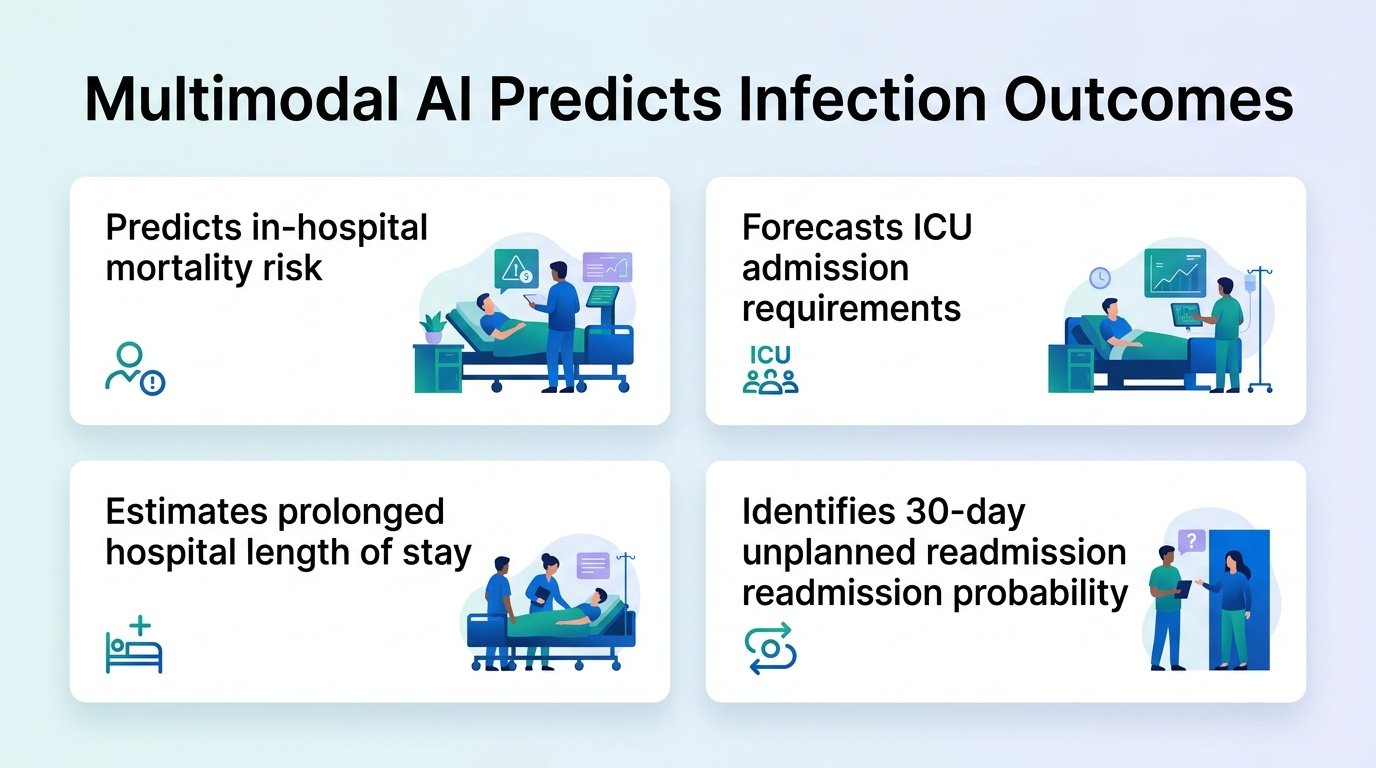
- In-hospital mortality prediction reached an AUROC of 0.93, compared to just 0.77 for the APACHE II score.
- Predicting the need for ICU admission achieved an AUROC of 0.978.
- Prolonged hospital length of stay prediction reached an AUROC of 0.803.
- Unplanned 30-day readmissions were predicted with an AUROC of 0.696.
Why the genome matters
Traditional AI models in this space focus heavily on predicting drug resistance. For instance, recent research on predicting bacterial antibiotic resistance highlights how deep learning can analyze host immune responses. SuperbugAI takes this a step further by using a genomic large language model to read the entire bacterial genome. This lets the model identify virulence pathways that make a specific infection more lethal, even before classic symptoms appear.
However, we must be realistic about implementation. Running genomic sequencing on every bloodstream pathogen in real time is still a luxury. Until hospitals can sequence pathogens in hours rather than days, the genomic portion of this AI will remain a bottleneck. The true value today lies in the AI’s ability to digest messy, unstructured clinical notes that human doctors often miss during a chaotic shift.
The path forward
This is not just about automation. It is about changing what we measure. If future platforms can integrate rapid sequencing at the bedside, we will finally stop treating sepsis as a generic emergency and start treating it as a personalized battle.
Read the full preprint study in medRxiv.