Static blood tests are failing HIV patients who seem healthy on paper but remain at risk of silent immune failure.
Why do up to 40% of patients on successful antiretroviral therapy still face early death from immune failure? Doctors call this condition incomplete immune reconstitution. For decades, clinics have relied on static, single-point blood tests to guess who will crash, frequently missing the slow-motion decline. This diagnostic blind spot leaves a massive portion of the patient population vulnerable to preventable mortality.
This failure of prediction challenges the status quo of HIV monitoring. It suggests that the trajectory of recovery, rather than a single baseline snapshot, is what actually dictates long-term survival. The clinical focus must shift from absolute cell counts to trend lines. This perspective matches other recent shifts toward dynamic tracking, such as using longitudinal metabolomic profiling to identify early biomarkers of immune recovery.
The predictive leap
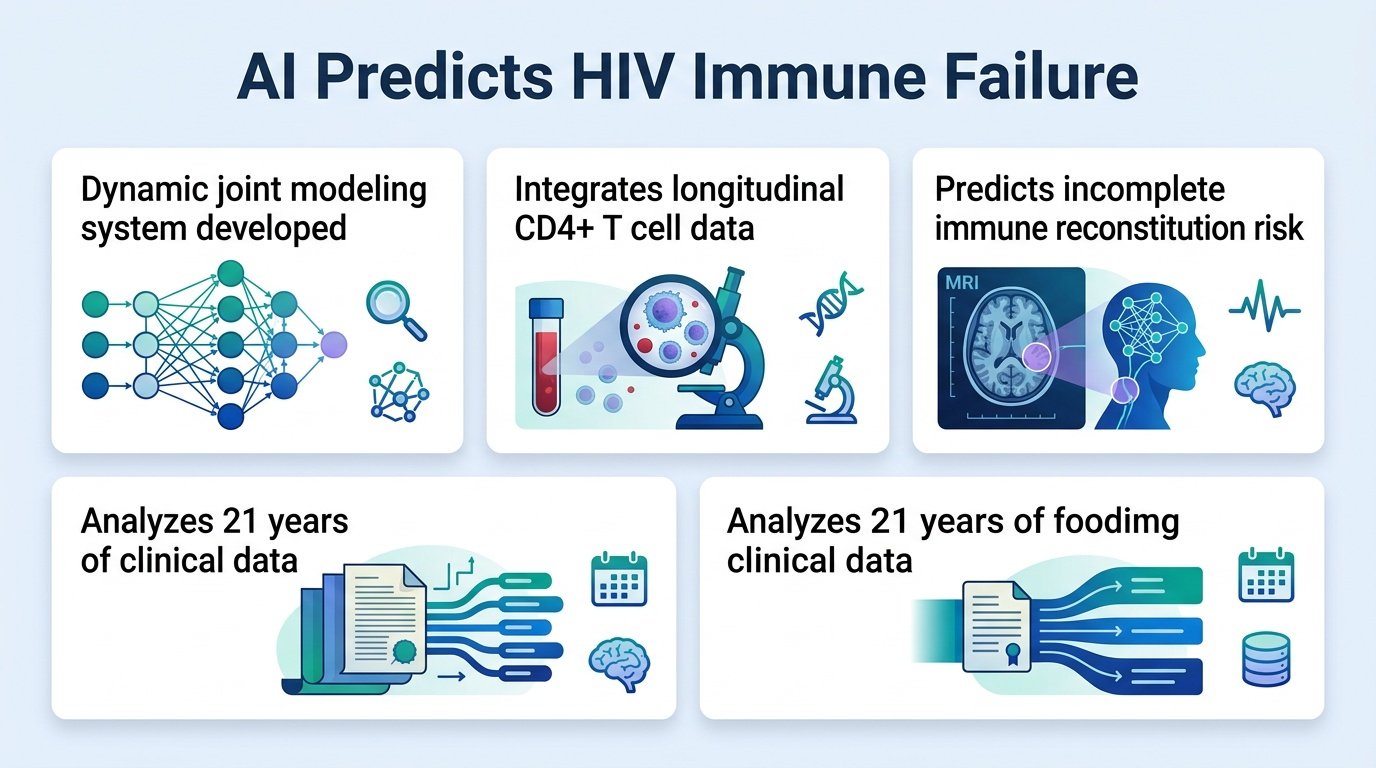
A new study introduces DJPSIIR, a dynamic joint prediction system designed to spot immune failure years before it occurs. Researchers built the model using longitudinal data from 21,862 people living with HIV across 31 Chinese provinces, tracking patients from 2003 to 2024. Instead of taking a snapshot, the system integrates continuous CD4+ T cell counts and CD4/CD8 ratios over time to update risk profiles in real time.
The performance data exposes the weakness of traditional clinical intuition. The system achieved an area under the receiver operating characteristic curve of 0.890 to 0.912 for 5- to 7-year predictions. In head-to-head testing, it consistently outperformed both human expert assessments and 19 alternative machine learning algorithms across multiple validation cohorts.
Why dynamics matter
- The model targets a complication affecting 10% to 40% of patients who are otherwise successfully treated.
- It delivers highly accurate risk profiles 5 to 7 years before clinical failure occurs.
- It successfully outperformed 19 competing machine learning models in predictive accuracy.
This performance proves that static clinical thresholds are obsolete. An immune system is a moving target. By treating CD4 counts as a movie rather than a photograph, the model flags patients whose gradual decline is invisible to standard clinical guidelines. It forces a rethink of what “stable” really means in chronic disease management.
The clinical reality
However, implementing this system in the real world will not be seamless. Bayesian joint modeling requires continuous, clean data streams over years. Many clinics in low-resource settings struggle with fragmented electronic health records, which could limit the tool’s utility where it is needed most. If medicine cannot bridge this digital infrastructure gap, the model remains a luxury tool for wealthy hospital systems.
Clinicians must now decide if they are willing to restructure their data collection to save the subset of patients currently slipping through the cracks. The math is clear, but the workflow integration remains the true hurdle.
Read the full study in Science Advances.