
A local language model can flag stroke patients directly from emergency room triage notes, bypassing the need for cloud-based data sharing.
Minutes dictate whether a stroke patient walks out of the hospital or suffers permanent brain damage. Yet busy emergency room triage desks often miss or delay critical alarms. This trial challenges the assumption that clinical AI must run on massive, cloud-hosted systems to be useful. By deploying a mid-sized model locally, hospitals can process messy free-text notes instantly without sending sensitive patient data over the internet.
Researchers at Monash Medical Centre in Melbourne tested this approach on 3,023 emergency department presentations over a one-month period in 2023. The cohort included 140 actual emergency department Code Stroke activations with a median age of 69 years. Among these, 83 patients had a confirmed stroke diagnosis, with 16 undergoing clot retrieval and 4 receiving clot-busting thrombolysis.
Local models prove their worth
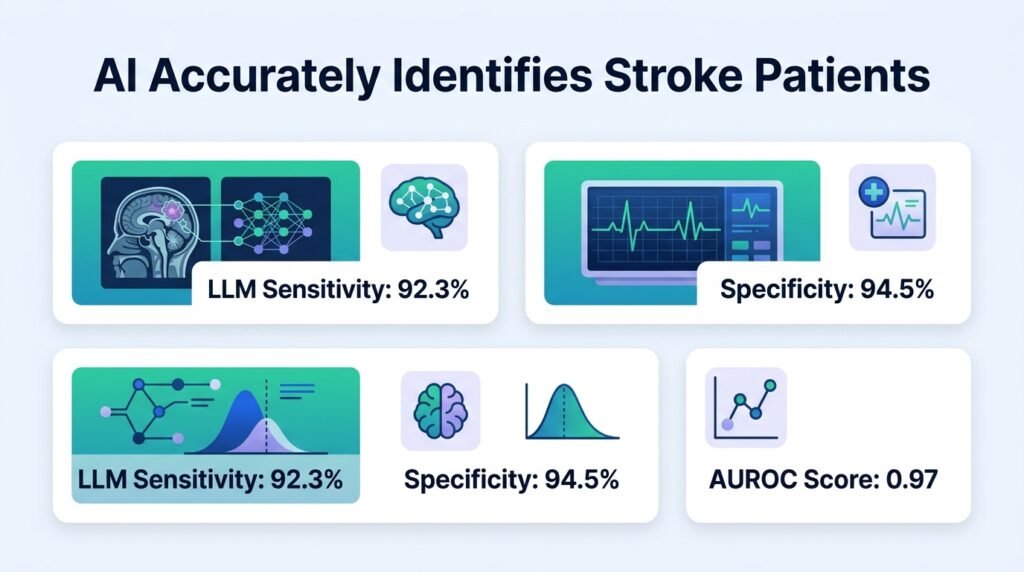
The pipeline used sequential steps to translate, identify symptoms, and exclude mimics. The standout performer, Qwen 2.5 14B, achieved a sensitivity of 0.890 and an exceptional specificity of 0.993. It also posted a positive predictive value of 0.858 and a negative predictive value of 0.995.
This performance outpaced several rival models, including Llama 3.1 8B and Mistral 3 14B. This local text-mining strategy builds on previous efforts to parse unstructured emergency data, such as using natural language processing on paramedic reports to improve stroke diagnosis.
That disconnect between local capability and cloud dependence is the real story here.
Why local deployment matters
The real victory is operational, not just mathematical. Cloud-based AI faces massive hurdles in healthcare due to privacy laws and internet downtime. Running a 14-billion parameter model on local hospital hardware solves both problems at once. We have seen similar success in other neurological emergencies, such as predicting seizure recurrence from clinical notes using language models.
However, the system is not perfect. A sensitivity of 0.890 means the AI still missed 11% of stroke cases. In the high-stakes environment of an emergency room, this tool must remain a safety net rather than a replacement for human clinical judgment.
Key performance metrics
- 3,023 total triage notes analyzed in the retrospective cohort.
- 0.890 sensitivity for the top-performing Qwen 2.5 14B model.
- 0.993 specificity, minimizing false alarms in busy emergency wards.
- 95.0% raw agreement between the validating neurologists.
Local AI is ready for clinical testing, proving that hospitals do not need to compromise patient privacy to gain real-time diagnostic support.
Read the full study in medRxiv.