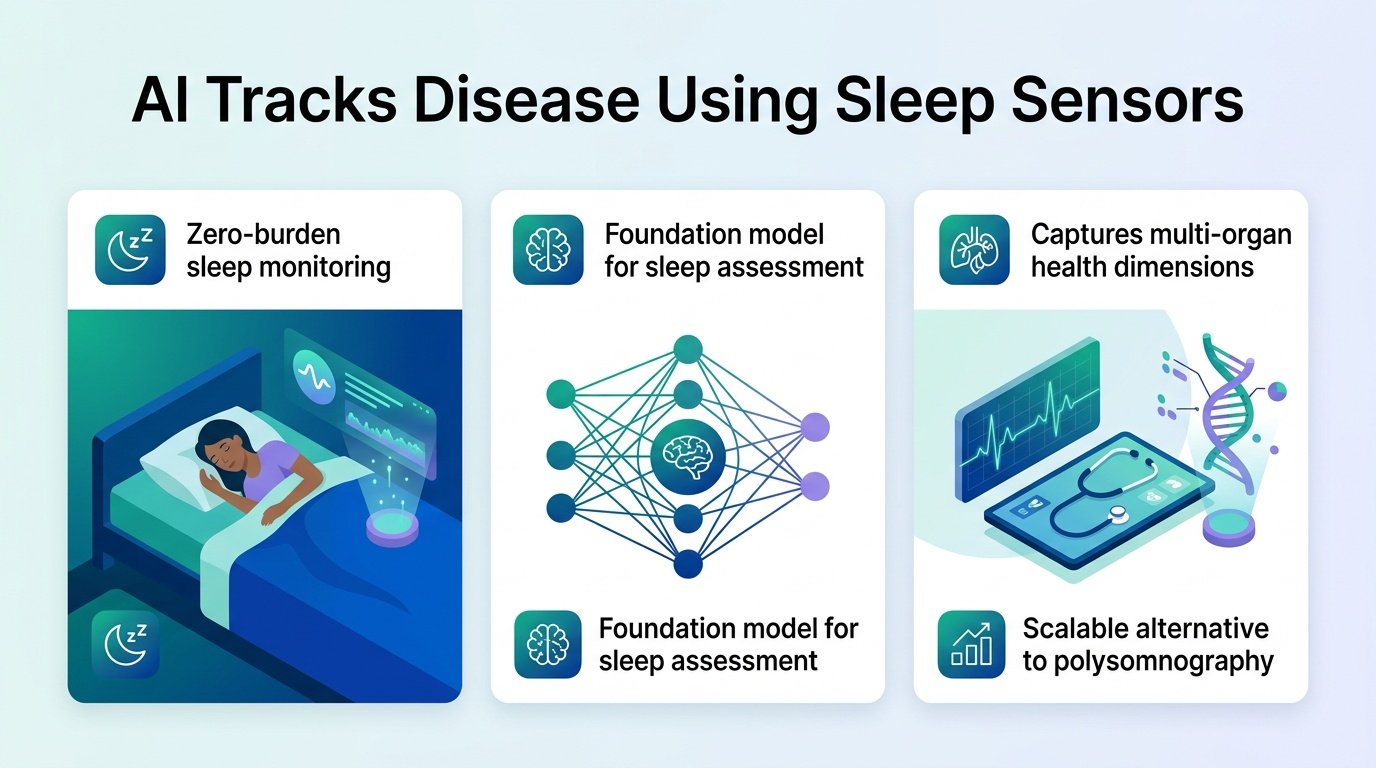
A new foundation model proves that simple heart and breathing signals recorded during sleep can predict complex brain and heart diseases.
Why do we still force patients to sleep in cold clinical labs tangled in wires just to measure their sleep?
For decades, polysomnography has been the undisputed gold standard. But this new model, SleepFounder, suggests we have been looking at the wrong signals. By bypassing brain waves entirely and focusing on cardiorespiratory data, it shifts sleep tracking from a diagnostic tool for sleep apnea into a passive window for systemic disease.
The power of passive signals
The model was trained on a massive dataset of over 1.4 million hours of sleep recordings across 34 cohorts in the United States and China. This scale is crucial. Instead of relying on complex brain-wave caps, the model analyzes simple cardiorespiratory signals. This builds on long-standing efforts to capture vital signs non-invasively, such as early work on measuring heartbeat and respiration under snoring. It also aligns with modern efforts in non-contact heartbeat detection.
The researchers tested SleepFounder on a real-world, under-pillow ballistocardiography (BCG) system. In this physical deployment, it achieved a Cohen’s kappa of 0.621 for five-class sleep staging and an AUROC of 0.949 for detecting moderate-to-severe obstructive sleep apnea. It even predicted age with a mean absolute error of 6.533 years and classified sex with an AUROC of 0.852.
Predicting systemic disease
The real analytical surprise is not that the model can track sleep, but that it can predict systemic organ failure. The model achieved AUROCs greater than 0.75 for 172 disease phenotypes. It also hit concordance indices above 0.75 for 100 phenotypes across 16 clinical chapters.
The model’s predictive power spanned several critical conditions:
- Dementia: AUROC of 0.850 and C-index of 0.845.
- Parkinson’s disease: AUROC of 0.846 and C-index of 0.823.
- Congestive heart failure: AUROC of 0.840 and C-index of 0.768.
- Atrial fibrillation: AUROC of 0.835 and C-index of 0.762.
- Respiratory failure: AUROC of 0.822 and C-index of 0.778.
The clinical catch
This shifts how we think about consumer sleep trackers. They are no longer just novelty gadgets for counting deep sleep minutes. Instead, they are potential early-warning systems for neurodegenerative and cardiovascular diseases.
However, we must remain skeptical. Cardiorespiratory patterns are highly sensitive but non-specific. A sudden drop in sleep quality or heart rate variability can point to dementia, heart failure, or simply a bad cold. Clinicians will need to figure out how to handle the inevitable anxiety of false alarms before these models can be safely integrated into daily medical practice.
Read the full preprint on medRxiv.