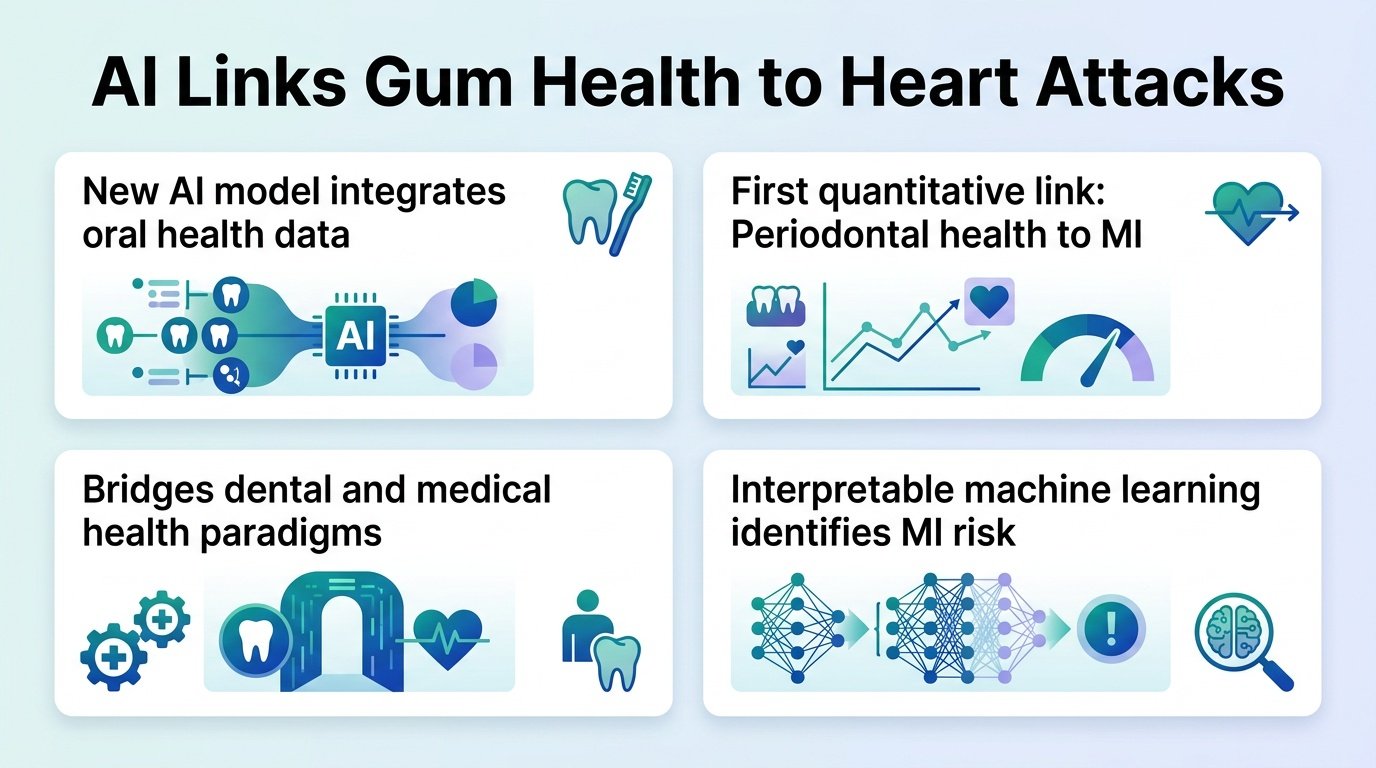
A new machine learning model proves that dental records might be just as important as cholesterol levels for predicting heart attacks.
Why do doctors treat the mouth and the heart as if they belong to different bodies? For decades, medicine has kept cardiology and dentistry in strict, bureaucratic silos. This artificial divide persists despite mounting evidence that systemic inflammation links the two domains.
A new study challenges this status quo by forcing oral health data directly into cardiovascular risk modeling. The results suggest that ignoring the gums when assessing the heart is a major clinical blind spot.
Beyond traditional risk factors
Researchers built an interpretable machine learning framework using a population-based case-control dataset of 1,355 individuals. They trained and evaluated seven supervised classifiers to see if adding periodontal data could accurately identify myocardial infarction (MI) incidence. The top-performing model, XGBoost, achieved an AUC of 0.88±0.01 and an F1 score of 0.74±0.03. After calibration, the model registered a Brier score of 0.14±0.01, proving its risk predictions were highly reliable.
The real value of this analysis lies in what the AI prioritized. Using SHAP (SHapley Additive exPlanations) values, the researchers peeked inside the algorithmic black box. While classic risk factors like age and blood pressure remained dominant, several periodontal indicators emerged as heavy hitters. Specifically, mean clinical attachment loss, plaque index, and gingival bleeding were highly influential in predicting heart attacks.
This shifts the narrative. Periodontitis is not just a localized mouth issue. It is a visible, measurable marker of systemic arterial risk that clinicians can no longer afford to ignore.
Sex differences and clinical limits
The AI also revealed that oral health risks do not affect everyone equally. Sex-stratified SHAP analysis showed distinct, sex-specific patterns in how oral inflammation interacts with cardiovascular health. This suggests that future screening tools must tailor their risk weights based on biological sex to remain accurate.
However, we must view these findings with healthy skepticism. The study relied on a retrospective case-control dataset, which cannot prove that gum disease causes heart attacks. It only proves they are statistically bound. Prospective trials are needed to confirm if treating gum disease actually lowers heart attack rates.
This finding forces us to rethink the boundaries of preventive cardiology. If gum inflammation is a key node in cardiovascular risk, then a dental cleaning is not just cosmetic hygiene. It is active cardiovascular prevention. Cardiologists and dentists need a shared data pipeline.
Key findings
- The XGBoost model achieved an AUC of 0.88±0.01 when integrating oral health metrics.
- Mean clinical attachment loss and gingival bleeding ranked among the most influential predictors of heart attacks.
- SHAP analysis showed that oral inflammation risks differ significantly by sex.
Read the full study in Scientific Reports.