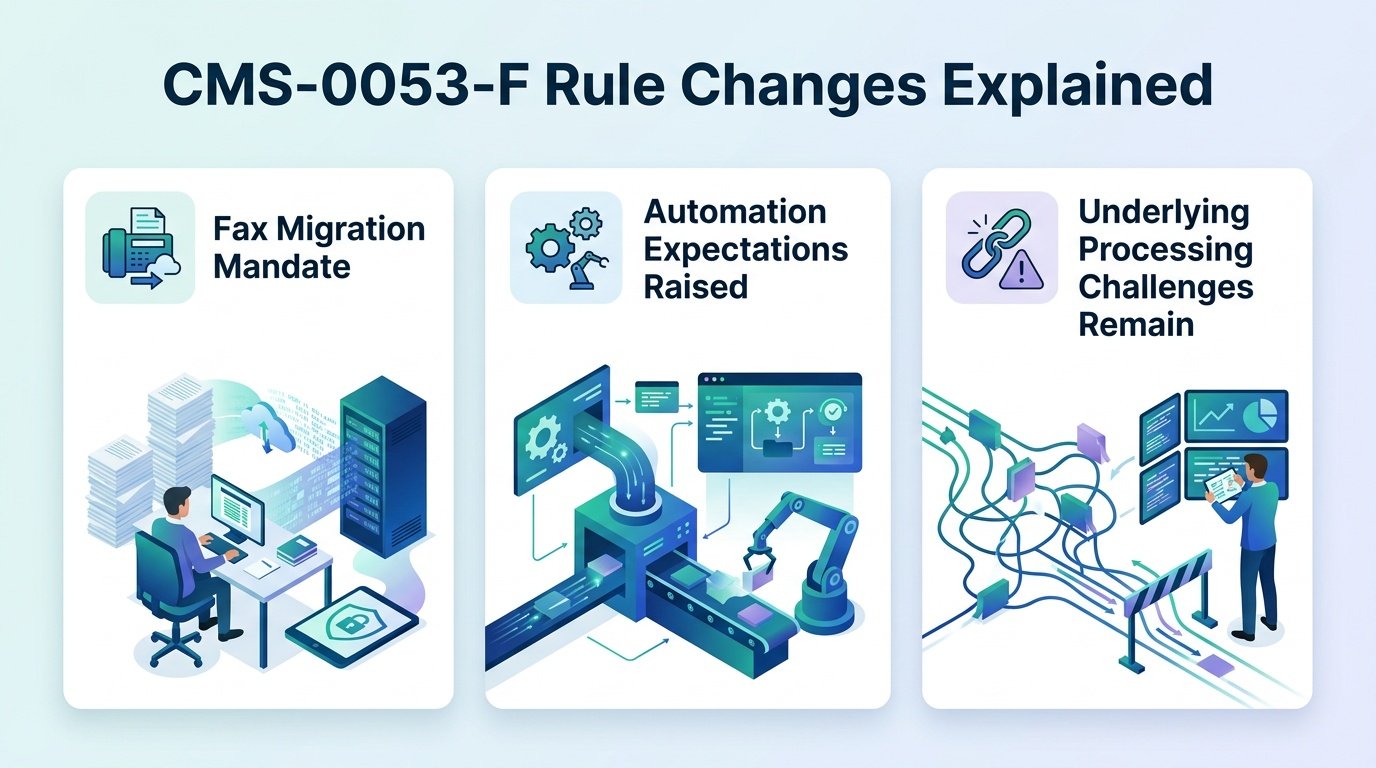
The federal push to eliminate paper faxes from medical billing risks replacing physical paper with digital clutter.
The federal government wants to save $781 million annually by forcing healthcare providers to ditch the fax machine. Under the CMS-0053-F rule, organizations must adopt standardized electronic formats for claims attachments and digital signatures by May 2028.
On paper, this looks like progress. In reality, it is a compromise that misses the point of modern automation. It changes the medium of communication without fixing the actual workflow.
The Legacy Trap
Instead of mandating modern FHIR APIs, the regulation relies on legacy standards like X12 and HL7 CDA. These are digital formats, but they are not smart formats. They carry a high expectation of automated processing without the modern infrastructure needed to make automation easy.
Worse, regulators excluded prior authorization attachments from the final rule after industry pushback. This means the most painful administrative bottleneck in healthcare remains completely untouched by the new mandate.
We are not eliminating the manual workload. We are simply moving it to a different screen.
The Automation Illusion
True efficiency requires structured data that computers can read, understand, and act upon instantly. By settling for outdated digital standards, the industry avoids immediate disruption but delays real interoperability.
Health systems will still need human staff to parse these digital documents. The industry is celebrating a victory over paper while ignoring the fact that the underlying workflow remains broken.