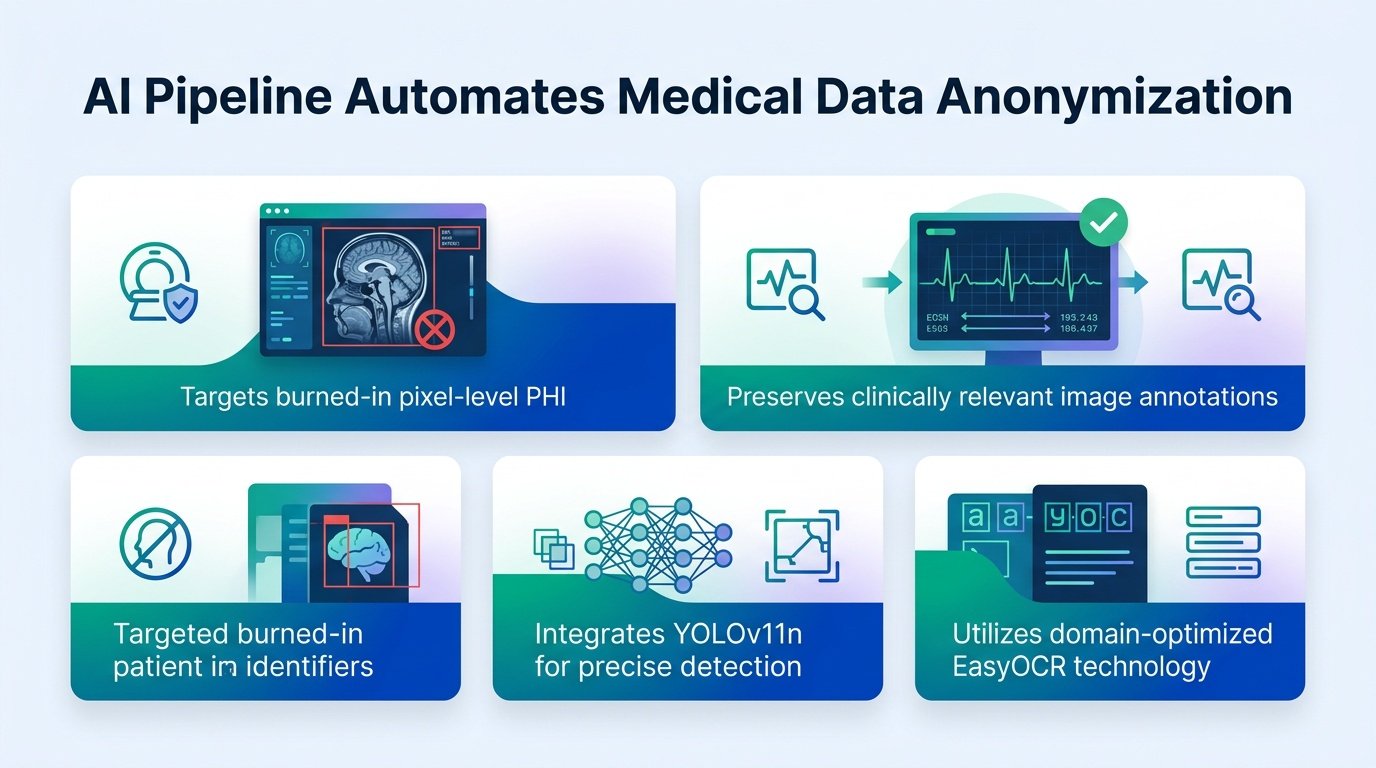
A new deep learning pipeline strips private patient details from medical scans without erasing critical clinical notes.
When hospitals share medical scans for AI training, they face a silent threat. Patient names and social security numbers are often burned directly into the image pixels. Simply blurring all text ruins the clinical value of the scan, but leaving it alone invites massive regulatory fines.
This conflict challenges the lazy “blur-everything” approach to patient privacy. By separating actual patient names from useful clinical annotations, researchers show we do not have to sacrifice data utility to protect privacy. It forces us to rethink the trade-off between data security and diagnostic utility.
How the pipeline works
The researchers built a dual-path system that processes metadata and pixel-level text in parallel. It combines a YOLOv11n text detector, a customized EasyOCR engine, and a hybrid natural language processing classifier. To test the system, the team used 1,042 multi-modality DICOM images, including CT, MRI, X-ray, and ultrasound scans.
They also ran the pipeline on two controlled tissue-mimicking datasets from the Cancer Imaging Archive. These were the RIDER Phantom MRI and the Phantom FDA CT datasets. These reference sets let the team measure exactly how much image quality degraded during the scrubbing process.
The performance metrics
- The system achieved an F1-score of 95.4% and a recall of 96.1% on clinical images.
- It processed each image in just 2.8 seconds.
- Clinical images maintained a structural similarity (SSIM) of 0.969 and a peak signal-to-noise ratio (PSNR) of 28.9 dB.
- The RIDER Phantom MRI achieved an SSIM of 0.986 and a PSNR of 49.0 dB.
- The Phantom FDA CT achieved an SSIM of 0.974 and a PSNR of 31.5 dB.
The reality of the data
These numbers prove that the system preserves pixel fidelity. It successfully blinds institutional and device identifiers without distorting the underlying medical data. This matters because multi-center AI trials require clean, standardized images to train algorithms effectively.
But the system is not foolproof. A recall rate of 96.1% means nearly four percent of private identifiers still slip through the filter. In a database of one million images, that leaves forty thousand leaked patient records. This pipeline is a powerful filter, but hospitals cannot treat it as a total replacement for human oversight.
Read the full study in Frontiers in Computer Science.