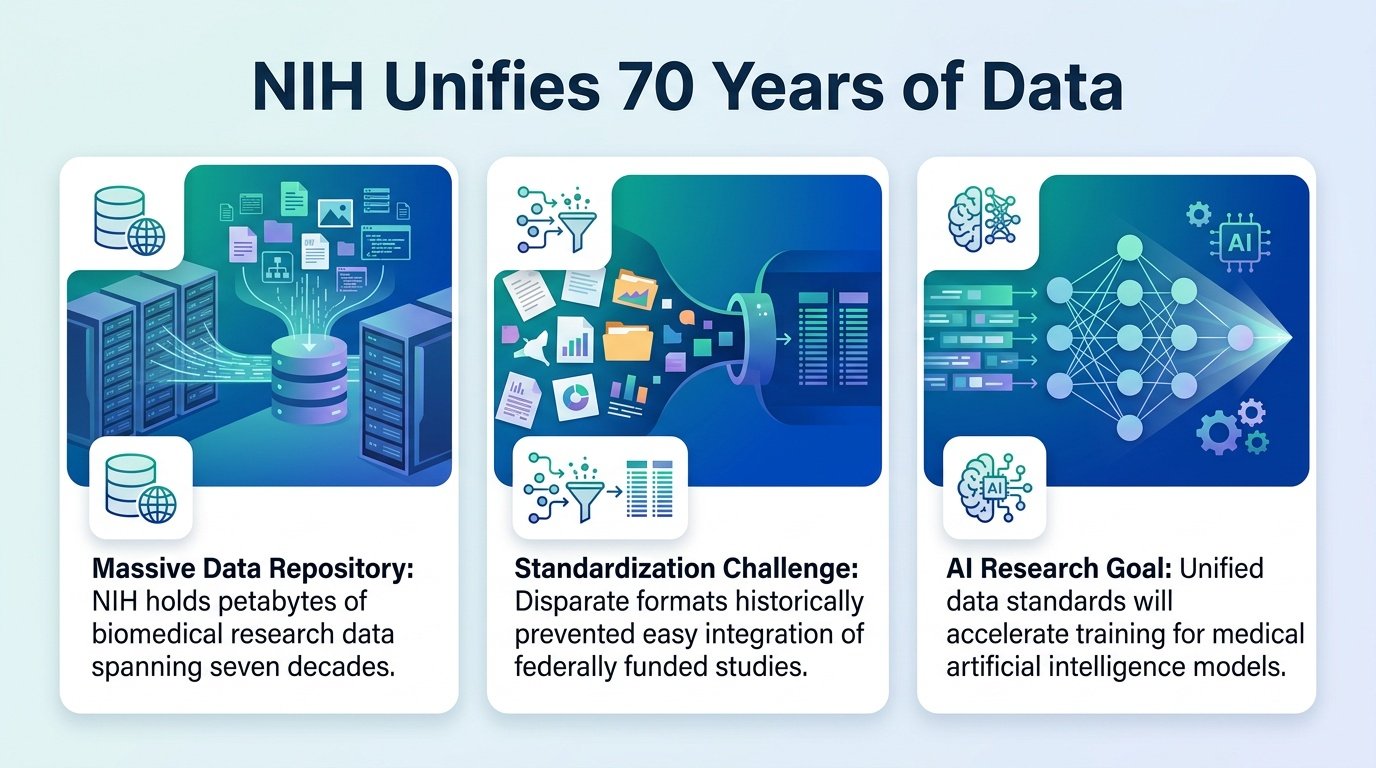
The federal government is trying to force seven decades of incompatible medical research into a single format that artificial intelligence can actually understand.
For decades, the National Institutes of Health has accumulated a massive treasure trove of clinical data. We are talking about 12 petabytes of information covering heart disease, lung conditions, and genomics.
But there is a catch. This data is practically useless for modern machine learning.
Because different institutes collected this information over 70 years using completely different standards, the files cannot talk to each other.
The Translation Problem
AI models require clean, uniform data to spot patterns. Feeding them a chaotic mix of historical formats leads to errors or outright failure.
To solve this, the National Heart, Lung, and Blood Institute is building a cloud ecosystem called BioData Catalyst.
Instead of manually rewriting billions of data points, they are using a pipeline called LinkML to act as a digital converter box. This tool automatically maps old, disparate data into modern standards like FHIR, LOINC, and HPO.
This is not just a technical cleanup. It is a race to make historical research machine-readable.
The Limits of Automation
Can software really translate 70 years of human clinical nuance without losing anything in translation?
The project relies on automated translation paired with clinical validation. But automated mapping is notoriously difficult when dealing with subjective medical notes from the mid-twentieth century.
If the pipeline misinterprets historical terminology, the resulting AI models will train on flawed assumptions. The true test of this initiative will be whether researchers can trust the translated outputs enough to build clinical tools.