title: AI matches doctors in diagnosing rare infections
A new study shows that local language models can analyze complex genomic data just as accurately as panels of medical experts.
Metagenomic sequencing can find almost any pathogen in a drop of spinal fluid. The trouble is that it finds everything, including harmless background noise, leaving doctors to argue over what is actually making the patient sick. Resolving these debates usually requires a scarce panel of elite specialists.
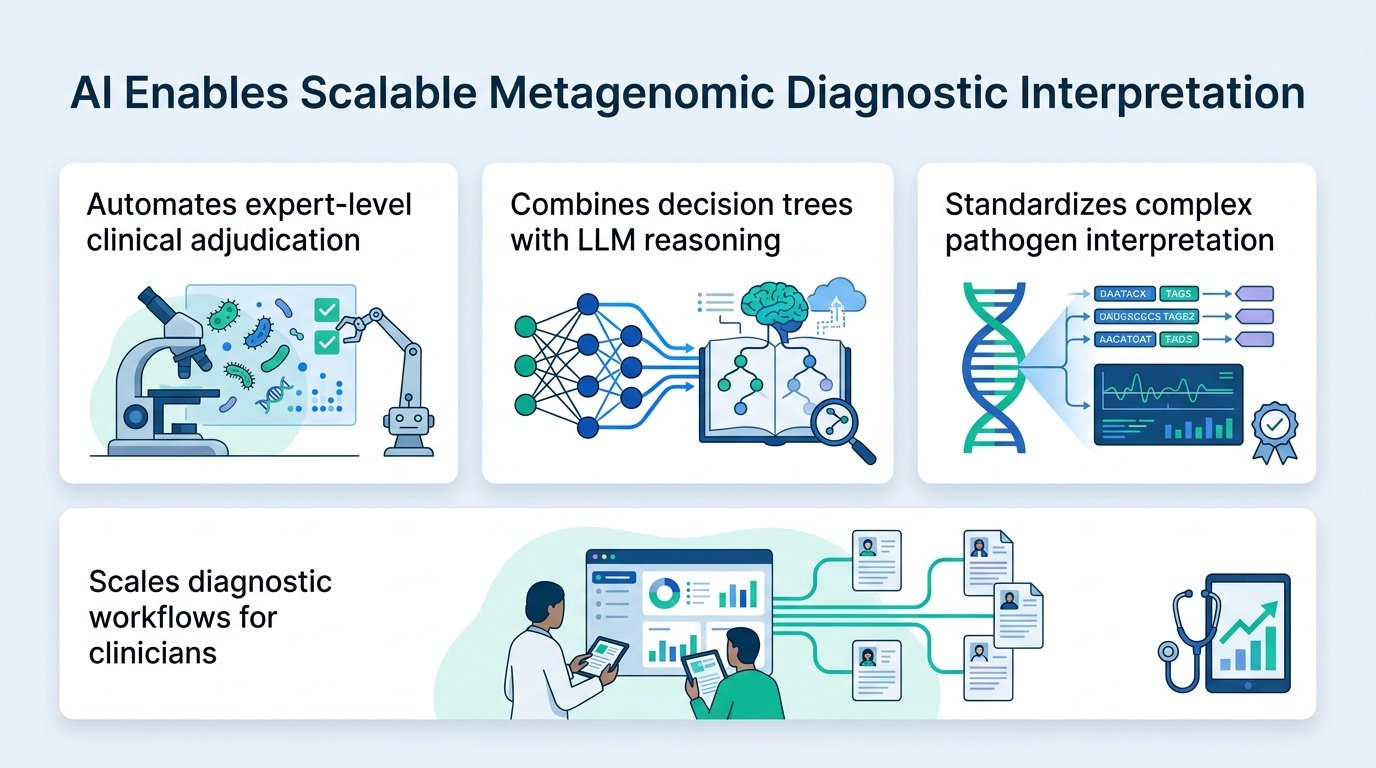
This study challenges the idea that clinical judgment is too nuanced for automation. By pairing decision trees with a locally deployed open-weight model called Qwen3, researchers bypassed the need for human consensus panels. This shifts the bottleneck of advanced diagnostics from human availability to computing power. It suggests that the future of diagnostics lies not in building larger AI models, but in constraining existing models with strict clinical rules.
Researchers built and tested these diagnostic classifiers using data from the META-GP study in Victoria, Australia, spanning 2024-2025. They focused on sterile-site specimens, specifically cerebrospinal and ocular fluid. The validation dataset included 96 samples, consisting of clinical samples, spike-ins, and controls, while a separate heterogeneous development cohort contained 78 samples.
The power of context
The AI’s accuracy hinged heavily on whether it was given the patient’s clinical history. When restricted to raw lab data, the system performed well but made errors. Once researchers fed the model basic clinical notes, its accuracy reached near-perfection because the AI could weigh the genomic data against real-world symptoms. This proves that raw data alone is rarely enough for a safe diagnosis.
- Without clinical notes, the model achieved 94.4% sensitivity and 95.4% specificity across 79 samples above the limit of detection.
- With clinical notes, performance rose to 97.2% sensitivity and 100% specificity.
- In the 78-patient development cohort, the automated system successfully flagged clinically significant pathogens that routine hospital testing completely missed.
The reality check
These results are impressive, but the study has clear boundaries. The data comes from a preprint and is limited to sterile fluids like spinal and eye wash, where any microbe is highly suspicious. Applying this to non-sterile sites like the gut or lungs, where billions of harmless microbes live, will be vastly more difficult.
Furthermore, the system relies on local deployment. While running Qwen3 locally protects patient privacy and avoids sending data to external cloud servers, hospitals must still maintain the hardware to run these models. This infrastructure cost could limit adoption to well-funded urban medical centers. If they can manage the tech, they can standardize diagnostic decisions across entire health systems, reducing the gap between elite teaching hospitals and rural clinics.
Read the full preprint in medRxiv.