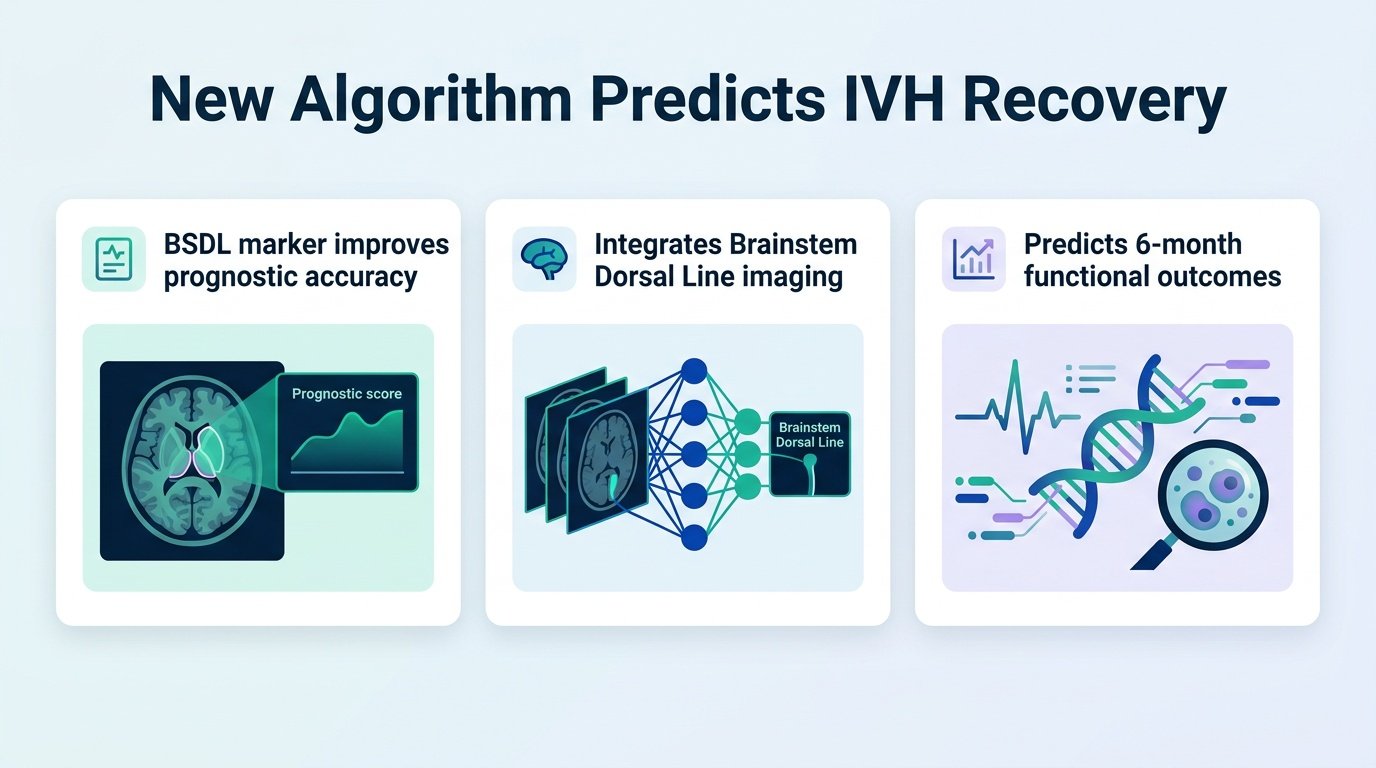
A simple anatomical marker combined with machine learning could change how clinicians predict long-term recovery after a severe brain bleed.
How do you decide the fate of a patient who has just suffered a catastrophic brain bleed? For years, predicting whether an intraventricular hemorrhage (IVH) survivor will walk again or remain severely disabled has been an educated guessing game. Clinicians rely on subjective clinical scores that often miss the subtle anatomical shifts driving long-term recovery.
That disconnect is the real clinical bottleneck.
This is where a new multicenter study challenges the status quo. By focusing on a specific anatomical marker—the Brainstem Dorsal Line (BSDL)—and pairing it with an advanced algorithm, researchers have bypassed complex, expensive imaging metrics. This suggests that the most valuable prognostic data is already sitting in standard scans, waiting for the right mathematical lens to interpret it.
Testing the predictive model
The researchers built and tested their model using data from 728 patients across nine Chinese tertiary centers collected between 2020 and 2024. The training and validation cohort included 610 patients, where 27.9% experienced unfavorable outcomes at six months. To prove the model could work in the real world, they tested it on an external validation group of 118 patients, who had a 26.3% rate of poor outcomes.
The team narrowed down a massive pool of clinical data to nine key predictors. Among these, BSDL grade 2—which measures physical displacement of the brainstem—emerged as the single most critical factor for predicting a patient’s six-month recovery. When integrated into the TabICLv2 machine learning algorithm, the results were remarkably precise.
The algorithm’s performance
In the external validation test, the TabICLv2 model outperformed seven other machine learning approaches. The key metrics tell the story:
- An area under the receiver operating characteristic curve (AUC) of 0.9014, showing high accuracy.
- An area under the precision-recall curve (AUPRC) of 0.8192.
- An F1 score of 0.7742, indicating a strong balance between precision and recall.
- A clinical net benefit across threshold probabilities ranging from 0.05 to 0.97.
The reality check
This is not just about high AUC scores. The real value lies in the simplicity of the BSDL marker. If a simple line on a standard CT scan can predict recovery with 90% accuracy, we must rethink our reliance on expensive, slow MRI protocols in acute emergency settings. This shifts the focus from high-tech imaging to smarter interpretation of existing data.
However, we must remain cautious about immediate adoption. This study is a retrospective analysis of patients in China, and the model has not yet been tested in prospective, real-time clinical trials. Algorithms often stumble when moving from historical datasets to active emergency rooms where scan quality varies. Until this tool is tested at the bedside, it remains a highly promising proof of concept rather than an active diagnostic tool.
Read the full preprint in medRxiv.