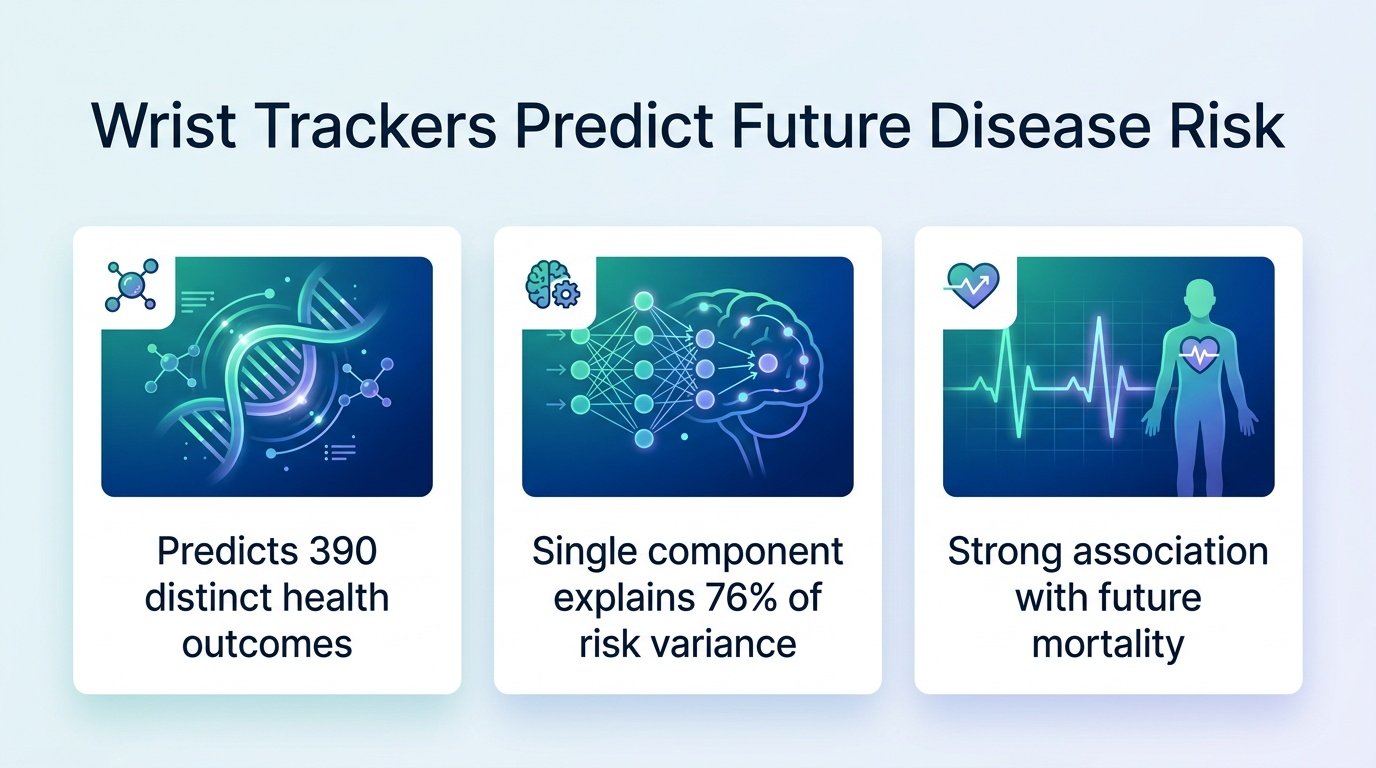
A single week of wrist-worn movement data can forecast hundreds of future health conditions years before they are diagnosed.
Can seven days of wrist movement predict your death or a future Parkinson’s diagnosis? For years, consumer wearables have been dismissed as glorified step counters. This new analysis of UK Biobank data suggests they are actually powerful clinical crystal balls.
The tension here lies between raw data and clinical utility. Doctors routinely order expensive blood panels and imaging scans to assess long-term risk. Yet, a simple sensor tracking how you move during a standard workweek might capture the same underlying biological decline.
This finding challenges the prevailing wisdom that we need highly specialized, expensive biomarkers to screen for chronic diseases. Instead, a single, shared axis of physical movement explains the vast majority of our future health risks. It means the most valuable diagnostic tool of the next decade might already be strapped to your wrist.
The predictive power
Researchers analyzed one week of accelerometry data from 97,696 participants. They used two frozen self-supervised AI models to evaluate 390 different health outcomes. When tested on a held-out group of 5,253 participants, the system achieved a mean concordance score of 0.688.
Surprisingly, a single statistical component explained 76% of the predicted risk variance across all conditions. This shared axis directly correlates with overall future disease burden and mortality. It suggests that how we move is a unified signature of systemic aging.
Specific disease signatures
While general frailty explains most of the risk, the AI still spotted unique signatures for specific illnesses. Disease-specific scores improved prediction accuracy for 85 of 101 well-powered outcomes. The most striking results appeared in neurodegenerative diseases, where the model flagged early signs of Parkinson’s disease up to five years before clinical diagnosis.
- The model achieved a five-year AUROC of 0.90 for Parkinson’s disease across 428 cases.
- Daytime movement patterns contributed the most to these predictions.
- Sleep patterns and genetic data only added value in highly selective cases.
The clinical reality
This approach is not without hurdles. While the Parkinson’s signature remained strong even after adjusting for lead-time bias, translating these population-level risk scores into individual clinical actions is incredibly difficult. Telling a healthy patient they have a high risk of Parkinson’s based on how they swing their arm during the day could trigger immense anxiety without offering a clear cure.
Furthermore, the study relies on UK Biobank participants, who tend to be healthier and wealthier than the general public. We need to see if these models hold up in more diverse, less active populations before deploying them widely.
Still, the implications are clear. We must stop viewing wearable data as a collection of isolated metrics like daily steps or sleep stages. The real value lies in the continuous, subtle signature of how a human body moves through the world.
Read the full preprint in medRxiv.