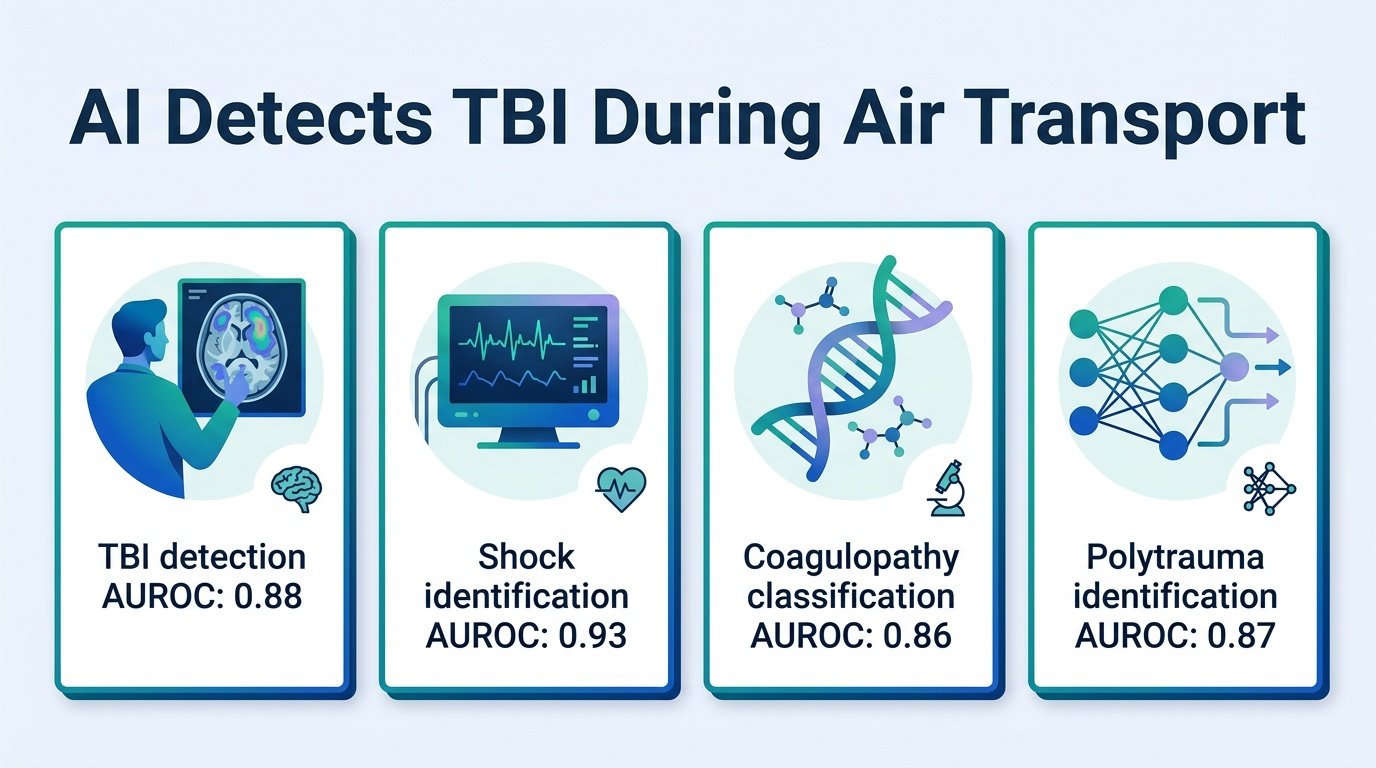
AI spots brain injuries during helicopter transport.
By analyzing continuous vital signs in the air, machine learning can identify traumatic brain injuries before the helicopter even lands.
When a patient is airlifted with a head injury, the flight medic has only minutes to make life-or-death decisions. Standard clinical assessments in a noisy, vibrating helicopter are notoriously unreliable. This is where the paper challenges the status quo.
We usually think of AI as a tool for the quiet radiology suite. This study proves that machine learning can operate in the chaotic “golden hour” of trauma care, turning raw, messy physiological streams into diagnostic signals. It shifts our understanding of triage from reactive observation to predictive modeling.
Researchers analyzed data from 1,025 trauma patients aged 18 to 65 transported by helicopter to an urban academic trauma center. The cohort was 70% male, with a median age of 38 and a median Glasgow Coma Scale score of 15. Using this dataset, the team tested ElasticNet and XGBoost algorithms against three distinct data streams: clinical variables, continuous physiological monitoring, and a combination of both.
What the algorithms found
The models showed strong predictive power across five critical clinical phenotypes:
- Identifying the presence of TBI achieved an AUROC of 0.79.
- Distinguishing mild from moderate-to-severe TBI hit an AUROC of 0.79.
- Detecting polytrauma in moderate-to-severe TBI reached the highest accuracy at 0.89.
- Predicting coagulopathy and shock yielded AUROCs of 0.77 and 0.78 respectively.
The real insight lies in the division of labor between data types. Clinical data excelled at predicting TBI severity and polytrauma. However, continuous physiological data was crucial for spotting hidden threats like shock and coagulopathy.
Why does this division of labor matter? Coagulopathy is a silent killer in brain trauma that usually requires hospital lab work to diagnose. By proving that continuous vital signs can flag this condition in transit, the study suggests we can bypass the typical diagnostic delays that cost lives. This finding builds on previous work in prehospital identification of TBI endophenotypes, showing that we must look beyond static scores. It also aligns with efforts to optimize damage control resuscitation by identifying high-risk patients early.
The limits of flight
We must be realistic about the hurdles. The study relied on a specific cohort transported to a single urban academic center, which may not represent rural transport realities. Moreover, the algorithms require clean, continuous physiological data, which is notoriously difficult to maintain in chaotic transport environments.
Even with these challenges, the implications are clear. Waiting for a hospital CT scan to classify a brain injury is a legacy approach. By proving that AI can run these numbers in flight, this research paves the way for automated triage systems that prepare trauma bays before the helicopter rotors even stop.
This research was published in Physiological Measurement.