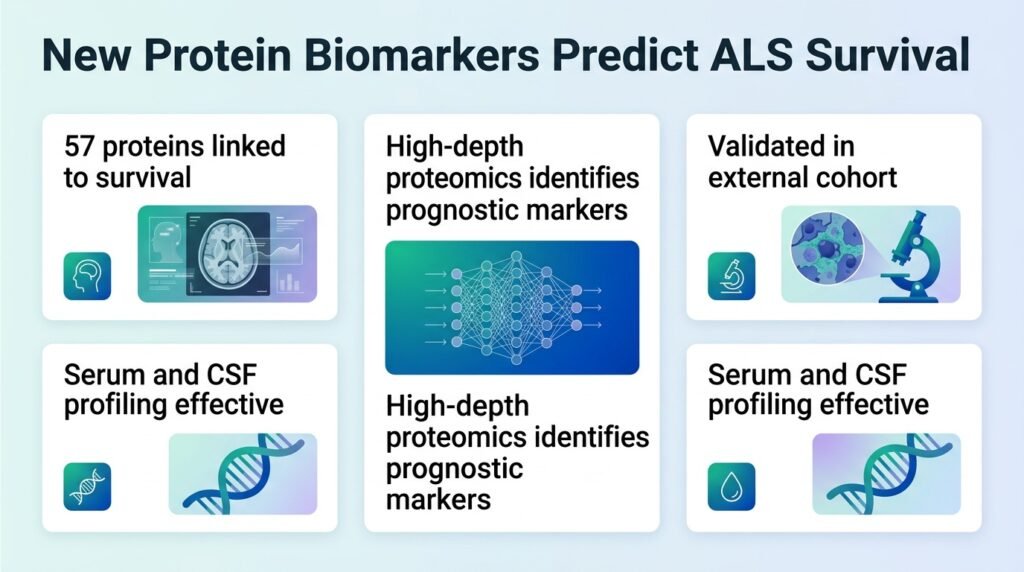
New protein panels predict ALS survival.
Measuring a single protein has been the gold standard for tracking ALS, but a new multi-protein signature suggests we have been missing the bigger biological picture.
Why is it so hard to tell someone how ALS will progress? The disease is notoriously unpredictable, leaving patients and doctors in the dark. Some patients survive for decades, while others decline in months.
For years, researchers have leaned on a single structural protein called NEFL to track this decline. This new study suggests that reliance is a mistake. Relying on one biomarker ignores the complex, multi-system chaos of ALS.
To build a better map, researchers analyzed **1,095** biological samples from **426** people with ALS. They looked at **851** blood serum samples and **244** spinal fluid samples. They then validated their findings in a separate, independent group of **349** patients to ensure the patterns were real.
The analysis identified **57** proteins in blood and **5** in spinal fluid that correlate with survival.
Beyond a single biomarker
The researchers used these findings to build a more sophisticated forecasting tool. Instead of looking at NEFL alone, they combined multiple biological signals.
- A panel of **9** serum proteins, including NEFL and peripherin, predicted survival better than clinical data and NEFL alone.
- Two specific proteins, **EDA2R** and **calcitonin**, tracked closely with how fast the disease progressed over time.
- Spinal fluid analysis highlighted **TPM3** as a key survival indicator.
This shift from a single marker to a multi-protein panel is the real story here. It suggests that ALS is not just a disease of dying motor neurons, but a systemic failure involving muscle and immune pathways.
Why this matters
This changes how we run clinical trials. Right now, ALS trials are slow and expensive because patient progression varies wildly.
By grouping patients using these **9** proteins, drug makers can run smaller, more targeted trials. They can recruit patients with similar biological trajectories. This makes it much easier to see if a drug actually works.
The road ahead
However, we should temper our expectations. This study is a preprint and has not been peer-reviewed yet.
Moving from a complex lab assay to a cheap, daily clinical test is a massive hurdle. Most hospitals are not equipped to run nine-protein assays routinely. Until these panels are standardized and cheap, NEFL will likely remain the default tool.
Read the full preprint in medRxiv.