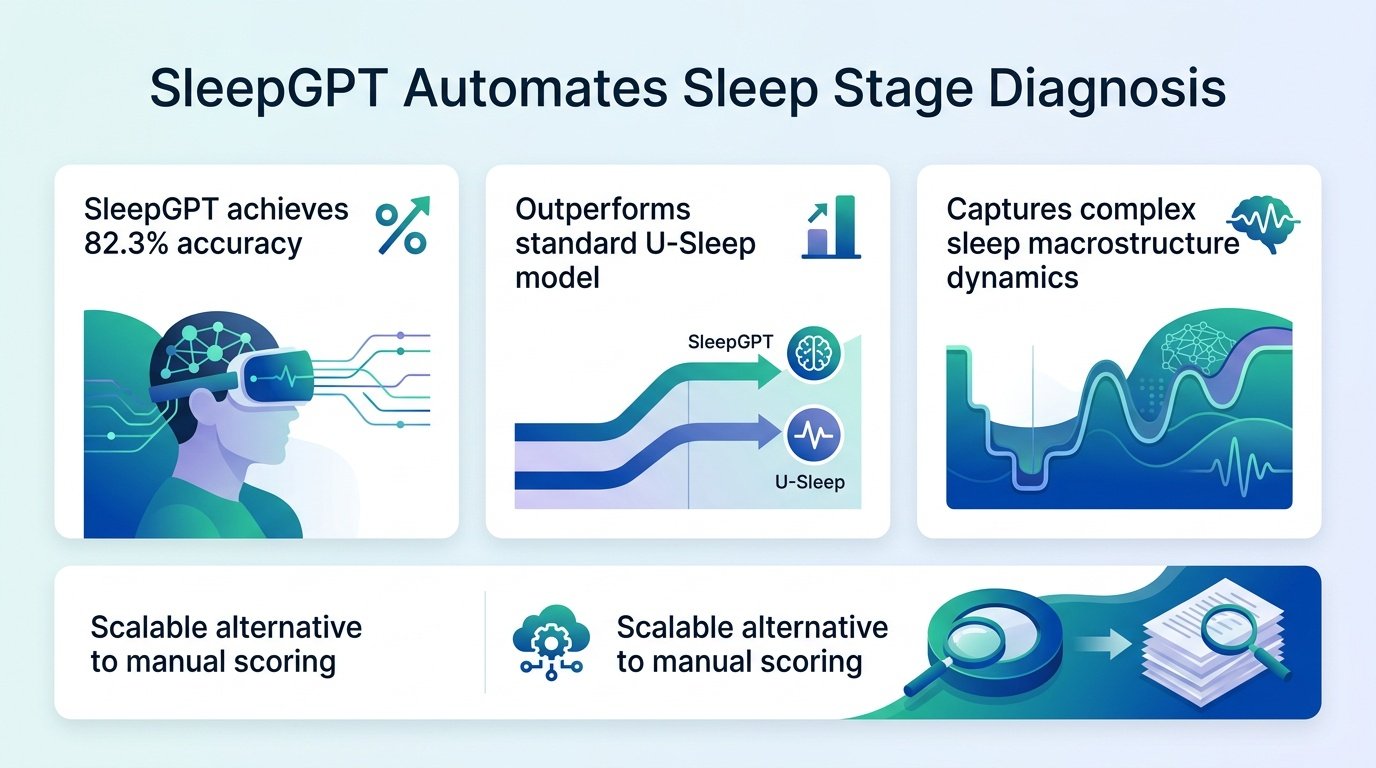
By analyzing the grammar of sleep stages rather than raw brainwaves, a new AI bypasses the need for expensive clinical hardware.
Ditching raw brainwaves
Why do we still force patients to sleep in uncomfortable labs wired to dozens of sensors just to diagnose a sleep disorder? For decades, clinical sleep medicine has assumed that accurate diagnosis requires raw, high-fidelity physiological signals. This hardware-centric approach keeps diagnostic sleep tracking locked inside expensive clinics.
A new model called SleepGPT challenges this assumption. By treating sleep stages like words in a sentence, the AI learns the “grammar” of sleep macrostructure. This shift suggests that the temporal sequence of sleep stages holds massive diagnostic value on its own, independent of the physical sensors used to capture it.
This approach could decouple sleep diagnostics from clinical hardware. Instead of chasing perfect raw data, researchers can use lighter, cheaper wearables to get rough stage estimates, then let the AI clean up the noise. It changes how we view the relationship between sensor quality and diagnostic accuracy.
The data behind the grammar
To teach the model the rules of sleep, researchers pretrained SleepGPT on over 5.8 million expert-annotated sleep stage labels. These labels came from 5,793 whole-night polysomnography recordings. The model was then tested across multiple benchmarks totaling 1,320,654 epochs.
The results show that the model functions as a versatile plug-in. It successfully upgraded the accuracy of existing sleep-staging tools. Key performance metrics include:
- Achieved high-accuracy staging using low-density wearable EEG data across 120,095 epochs.
- Approached clinical-grade polysomnography performance using only these wearable inputs.
- Accurately identified Type-1 narcolepsy and abnormal sleep dynamics across clinical cohorts totaling 685 patients.
While models like CareSleepNet excel at classifying raw physiological signals, SleepGPT operates on a higher layer. It refines those raw classifications by analyzing the logical flow of sleep cycles over time. This layered architecture means clinical teams do not have to replace their existing software to benefit from sequence modeling.
The hardware-free future
This sequence-first approach has a massive practical implication. Because the model processes stage sequences rather than raw electrical signals, it is highly resistant to device-specific noise. A cheap headband and a clinical bedside monitor speak the same language of sleep stages, meaning the AI can analyze data from both with minimal loss of accuracy.
However, we must note the limitations. SleepGPT is not a standalone diagnostic tool. It still relies on an upstream model or sensor to generate the initial sleep stage sequence. If the initial stage classification is completely wrong, the model’s downstream analysis will suffer. It is an optimizer, not a magic wand.
Even so, this research proves that the structural pattern of our sleep is a powerful biomarker. We no longer need perfect clinical wires to see it.
Read the full preprint on medRxiv.