

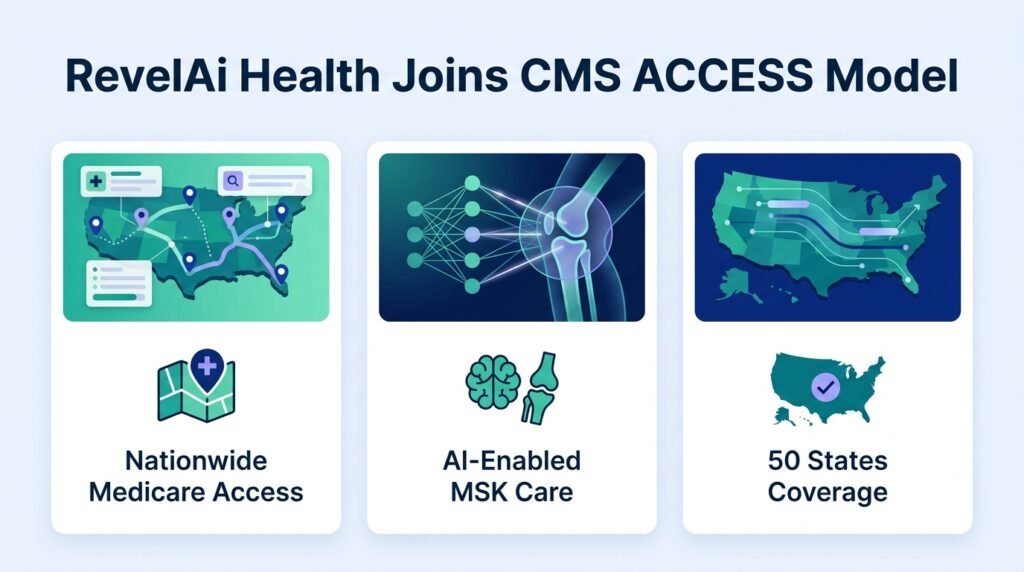
A new federal payment model is forcing digital health companies to prove their tools actually heal patients, not just log clinical hours.
For years, digital health platforms survived on fee-for-service billing. They made money by doing more, not necessarily by doing better. That era is ending.
The federal government is launching a ten-year initiative called the ACCESS Model on July 5, 2026. It replaces traditional billing with outcome-aligned payments. Under this framework, **half of all reimbursement is tied directly to measurable clinical improvements**.
The Outcome Gamble
This is a massive shift for the industry. RevelAi Health, alongside partner Understood Care, is among the first cohort of over 150 organizations entering this high-stakes environment. They will deploy AI-guided bone, joint, and behavioral health support to Medicare beneficiaries nationwide.
If patients do not get better, these companies do not get fully paid.
Tying 50% of revenue to clinical outcomes introduces immense volatility. If a patient fails to complete their exercises, or if their behavioral health metrics plateau, the developer absorbs the financial hit. It forces a hard question: Can AI-driven chronic care actually deliver consistent, measurable recovery at scale?
The Private Ripple Effect
The impact extends far beyond Medicare. Private insurers representing **165 million members** have already committed to aligning with this new payment structure.
This is no longer a government pilot. It is a market realignment. Tech vendors can no longer hide behind engagement metrics or app downloads. They must deliver clinical proof, or they will go broke.