AI model explains its own radiology decisions
A new foundation model breaks open the black box of medical imaging by forcing AI to show its work through clinical concepts.
How can a doctor trust an algorithm that cannot explain its own decisions? For years, radiologists have rejected highly accurate AI models simply because they cannot see how the software reached a diagnosis. This skepticism is entirely justified.
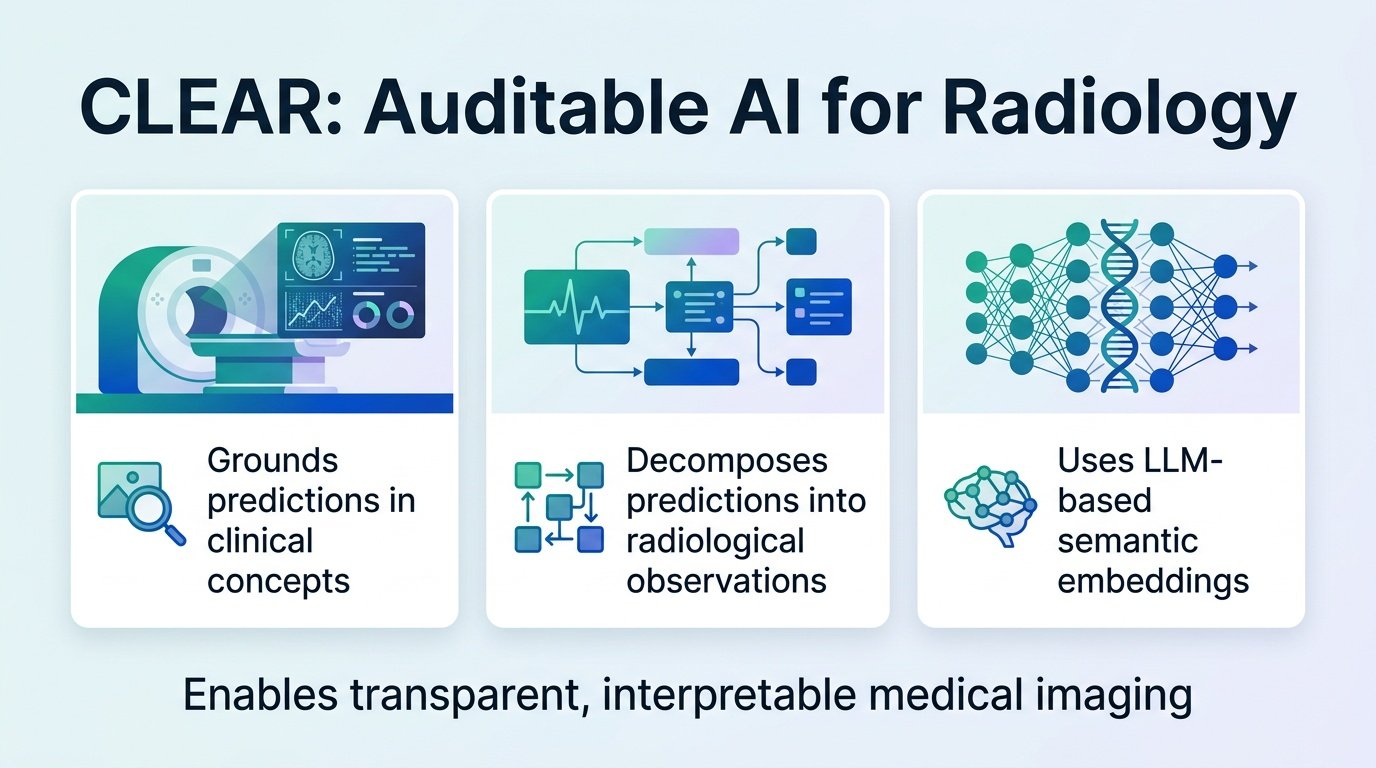
The launch of CLEAR (Concept-Level Embeddings for Auditable Radiology) challenges the industry’s obsession with raw accuracy over explainability. By mapping chest X-rays directly to language model embeddings, this framework proves that we do not have to sacrifice performance to get transparency. It shifts the debate from whether the AI works to whether we can audit its logic.
Building this trust required a massive scale of clinical data. Researchers trained CLEAR on over 0.87 million image-report pairs collected from 239,391 patients. Instead of outputting a simple probability score, the model breaks down every prediction into weighted contributions from specific radiological observations.
Testing across three continents
To prove the model works outside the lab, researchers ran external validations on four large, physician-annotated datasets spanning the United States, Europe, and Asia. This geographic diversity is crucial, as medical AI often fails when deployed in new hospital systems with different imaging hardware.
- Achieved state-of-the-art classification performance while remaining fully auditable.
- Enabled zero-shot pathology detection without needing task-specific retraining.
- Systematically identified hidden radiological confounders that mislead standard models.
That ability to spot confounders is the real story.
Standard deep learning models often cheat by associating clinical markers, like a pacemaker cable or a biopsy clip, with a disease state rather than identifying the actual pathology. CLEAR exposes these shortcuts by showing clinicians exactly which visual concepts drove the decision.
Why explainability matters now
This auditability addresses a long-standing crisis in medical imaging. As discussed in research on black box challenges in cardiovascular radiology, opaque models threaten patient safety. Clinicians cannot safely adopt tools that hide their reasoning. Furthermore, the push for mechanistic interpretability in medical reports highlights that understanding the clinical code is just as important as getting the right diagnosis.
However, CLEAR is not without limitations. It relies heavily on the quality of the initial large language model embeddings used to define its clinical concepts. If the underlying language model contains clinical inaccuracies, those flaws will propagate into the radiology predictions.
Ultimately, CLEAR shows that the future of clinical AI belongs to models that can be interrogated. If a model cannot explain its reasoning in terms a human doctor understands, it has no place at the bedside.
Read the full study in Nature Biomedical Engineering.