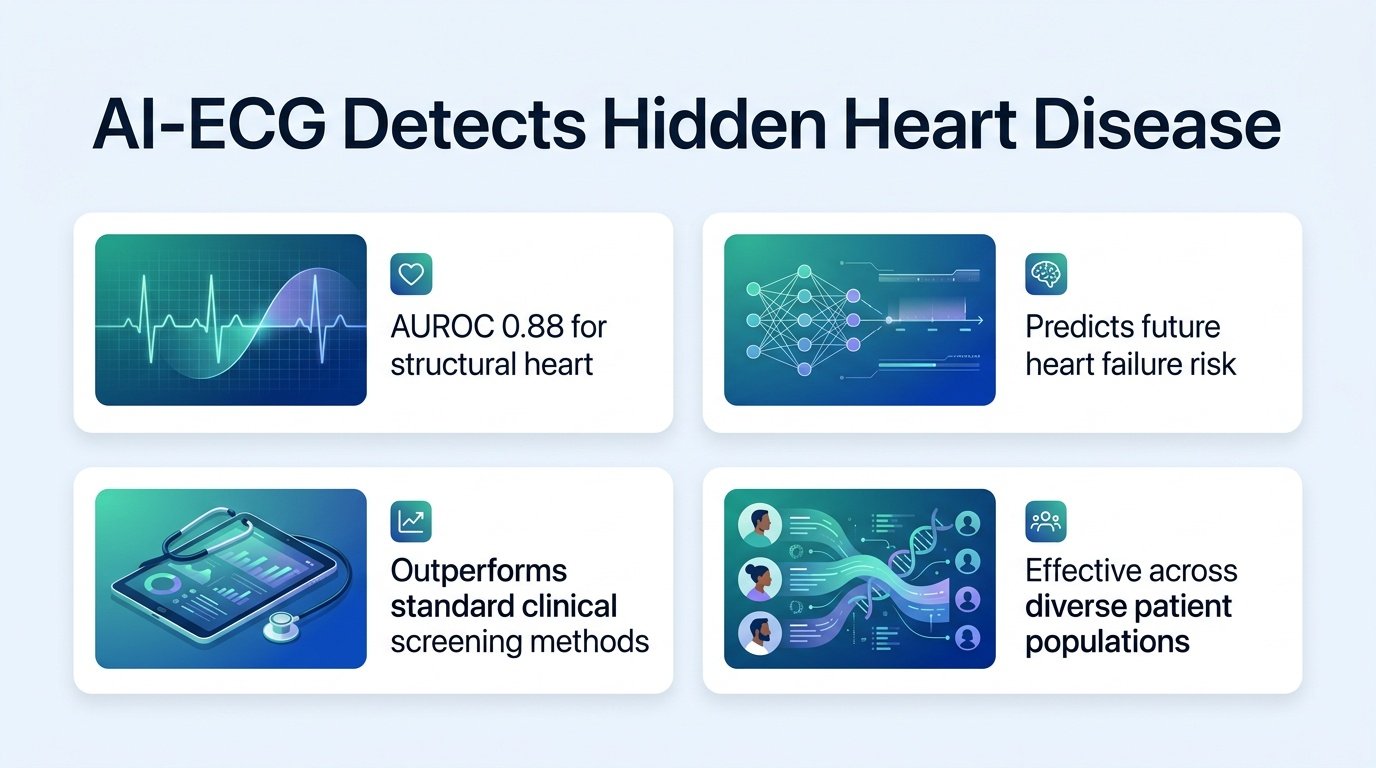
A new composite AI model can spot structural heart disease from a standard ECG before symptoms even appear, but its real value lies in predicting future risk.
How do you catch a silent killer before the damage is done? Echocardiograms are the gold standard for diagnosing structural heart disease, but they are too expensive for routine population screening. This leaves millions of people walking around with undiagnosed heart issues until they land in the emergency room.
This study challenges the idea that AI models must be hyper-specific to be useful. By combining two models trained on systolic and diastolic dysfunction, the composite AI caught things it was not even trained to find, like valvular disease and pulmonary hypertension. This suggests AI-ECG is evolving from a single-disease detector into a broad cardiovascular sieve. It builds on previous work like deep learning-enabled electrocardiogram assessment of valvular heart disease to show that simple electrical signals contain a treasure trove of hidden structural data.
How the data stacks up
Researchers tested the composite AI-ECG on **46,082** patients in a Korean clinical cohort and **36,286** patients in a US dataset. In the Korean group, the AI detected structural heart disease with **71.8%** sensitivity and **88.3%** specificity. In the US group, sensitivity was **76.1%** but specificity dropped to **70.1%**.
Among patients who had no baseline heart disease, the AI proved to be a strong predictor of future cardiovascular trouble. The key performance metrics highlight this predictive power:
- Flagged a **3.75** times higher risk of future heart disease in the Korean cohort.
- Predicted incident risk in the UK Biobank with a hazard ratio of **2.75**.
- Achieved overall predictive C statistics ranging from **0.69 to 0.78**.
The screening bottleneck
This matters because it moves us closer to predicting heart failure years in advance using cheap, existing hardware. It aligns with efforts to use accessible tools, such as estimating left ventricular filling pressure using standard 12-lead ECGs. If we can flag high-risk patients during a routine physical, we can intervene before heart muscle deteriorates.
However, we must look closely at the drop in specificity in the US cohort. A specificity of **70.1%** means nearly one in three healthy patients could get a false positive. In a mass screening scenario, this would flood cardiology clinics with unnecessary, expensive follow-up echocardiograms. We also lack prospective trials. We know the AI can flag historical data, but we do not yet know if acting on these AI alerts actually saves lives or just increases healthcare spending.
Read the full preprint in medRxiv.