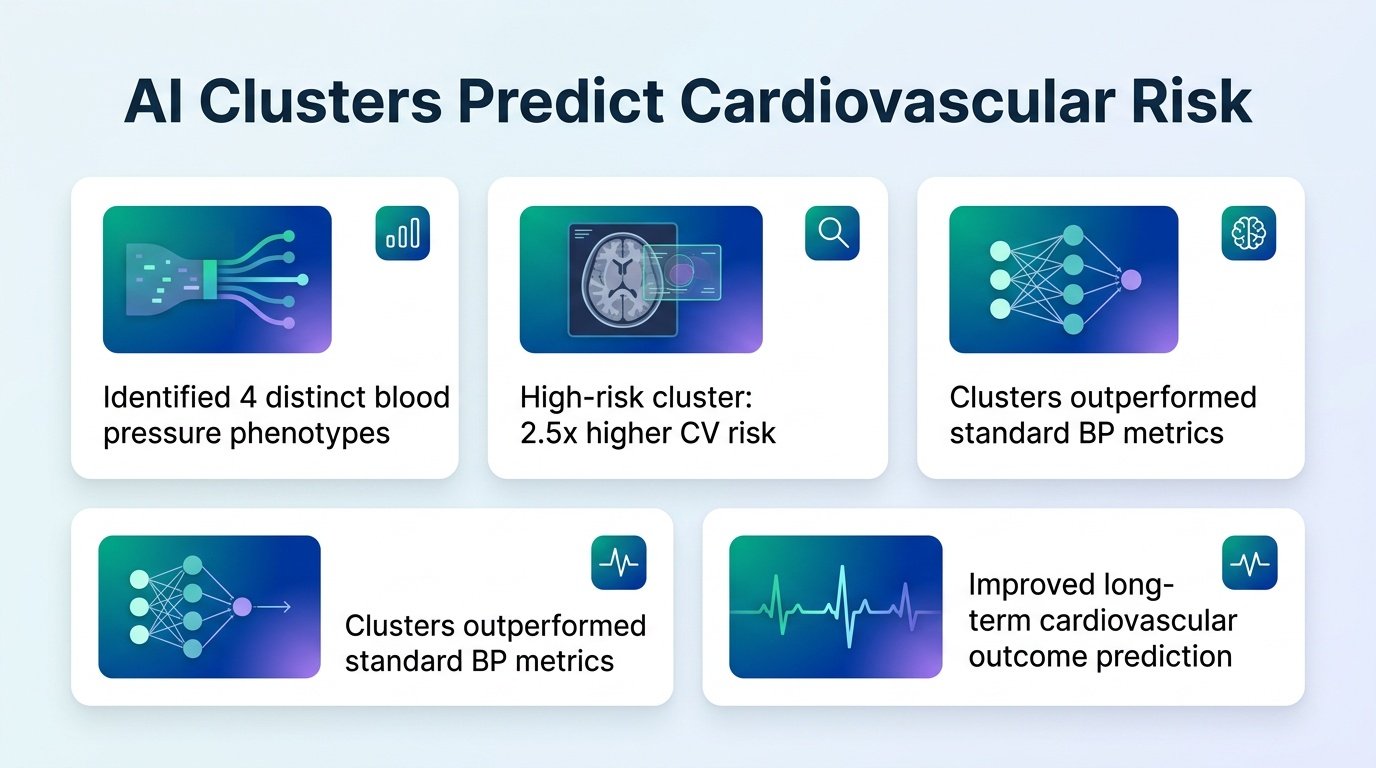
A new machine learning model proves that how your blood pressure fluctuates over 24 hours is far more dangerous than a single high reading at the clinic.
Your doctor takes your blood pressure, writes down two numbers, and decides your cardiovascular health. But blood pressure is not a static metric. It rises and falls with every heartbeat, step, and stressful email over a 24-hour cycle.
This disconnect is where clinical medicine fails. For decades, we have treated blood pressure like a snapshot when it is actually a movie. By ignoring the messy fluctuations of daily life, doctors routinely miss patients who seem healthy in the clinic but remain at high risk of stroke or heart attack at night.
Sorting the chaotic data
To solve this, researchers applied dynamic time warping and k-medoids clustering to 24-hour ambulatory blood pressure recordings. The study tracked **1,344** community-dwelling individuals (mean age **46.9** years, **50.6%** women) over a median follow-up of **19.4** years. To ensure the findings held up, they validated the model on an external cohort of **1,219** people.
The algorithm successfully sorted the patients into distinct risk profiles:
- The algorithm identified **4** distinct patient clusters based on their heart rate and blood pressure patterns.
- Cluster 1 represented the healthiest profile, consisting of younger individuals with the lowest 24-hour blood pressure patterns.
- Cluster 4 represented the highest risk, characterized by older participants, higher medication intake, and the highest blood pressure variability.
- Even after adjusting for traditional risk factors, individuals in Cluster 4 had a **1.63** times higher risk of adverse cardiovascular events compared to Cluster 1 (95% CI: **1.15-2.32**, P = **0.006**).
Rethinking dynamic heart health
This finding complicates how we define hypertension. It suggests that high blood pressure variability itself is a silent killer, independent of your average reading. This mirrors broader challenges in cardiology, such as the difficulty of tracking autonomic health through heart rate variability, which is explored in recent research on autonomic analysis shortcomings.
Cardiologists must shift from treating static numbers to managing dynamic trends. If we only medicate patients to lower their average pressure, we may leave their dangerous spikes untouched. This requires a transition to continuous, passive monitoring tools that fit seamlessly into daily life.
However, the study has clear limitations. Ambulatory monitoring requires patients to wear a cuff that inflates every 20 minutes for a full day, which is disruptive and hard to scale. We also do not know if therapies designed to stabilize these fluctuations will actually prevent deaths.
Ultimately, this analysis shows that static thresholds are obsolete. If clinical software can flag these high-variability patterns early, we can treat high-risk patients before the damage is done.
Source: PLOS Digital Health