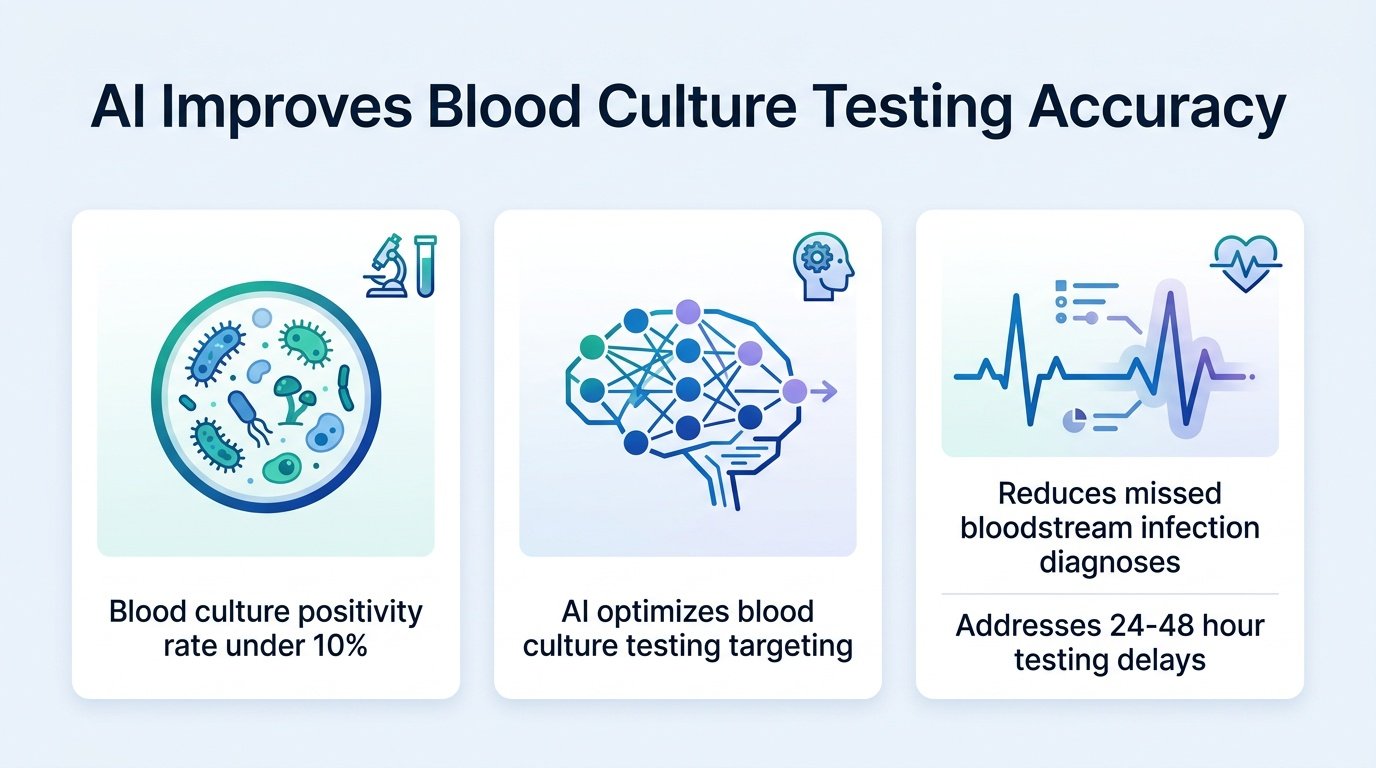
Hospitals waste millions of blood culture tests on low-risk patients while missing critical infections, but a new machine learning model shows we can find more cases without running a single extra test.
Why do doctors order blood cultures for patients who do not need them, while patients with active bloodstream infections go untested? The standard diagnostic approach is a shot in the dark. More than nine out of ten blood cultures come back negative, wasting laboratory capacity and delaying critical care.
This inefficiency is not just a resource drain. It is a clinical blind spot. While traditional sepsis protocols rely on broad biomarkers to flag high-risk patients in the emergency department, as discussed in Critical Care Medicine, they fail to tell clinicians exactly who to test. By shifting the focus from “who looks sick” to “who needs a culture,” machine learning can optimize existing hospital workflows.
Researchers developed an XGBoost model using 294,064 cultures from Oxford University Hospitals with a baseline positivity rate of 5.6%. In a temporal hold-out test of 46,339 samples, the model achieved an AUROC of 0.853, which rose to 0.876 for emergency patients. External validation at University College London Hospitals on 37,326 samples confirmed its accuracy with an AUROC of 0.847.
How reallocation changes outcomes
The real value of this model lies in a simulated, resource-neutral swap. By replacing the 10,000 lowest-risk cultures actually performed with tests for the highest-risk untested emergency admissions, the system found 627 additional positive cultures. This represents a 28.3% relative increase in infection detection without buying more equipment or hiring more staff.
The real-time data bottleneck
There is a major catch that eager health systems must address. When the researchers restricted the model to data strictly available at the exact moment of culture collection, its performance dropped to an AUROC of 0.769. This drop highlights a common failure point in clinical AI: models are only as good as the real-time data pipelines feeding them.
If a hospital cannot deliver rapid laboratory results to the algorithm, the predictive power degrades. This limitation aligns with broader challenges in clinical decision support for bloodstream infections, such as those explored in Open Forum Infectious Diseases, where timing dictates utility.
- The model analyzed 294,064 cultures with an initial 5.6% positivity rate.
- External validation proved stable with an AUROC of 0.847 across 37,326 patients.
- Reallocating 10,000 low-risk tests caught 627 more infections, a 28.3% yield increase.
- Restricting inputs to point-of-collection data reduced accuracy to an AUROC of 0.769.
Diagnostic stewardship is often code for rationing care. This study proves that smart algorithms can achieve true efficiency by redistributing existing resources to where they do the most clinical good.
Source: medRxiv