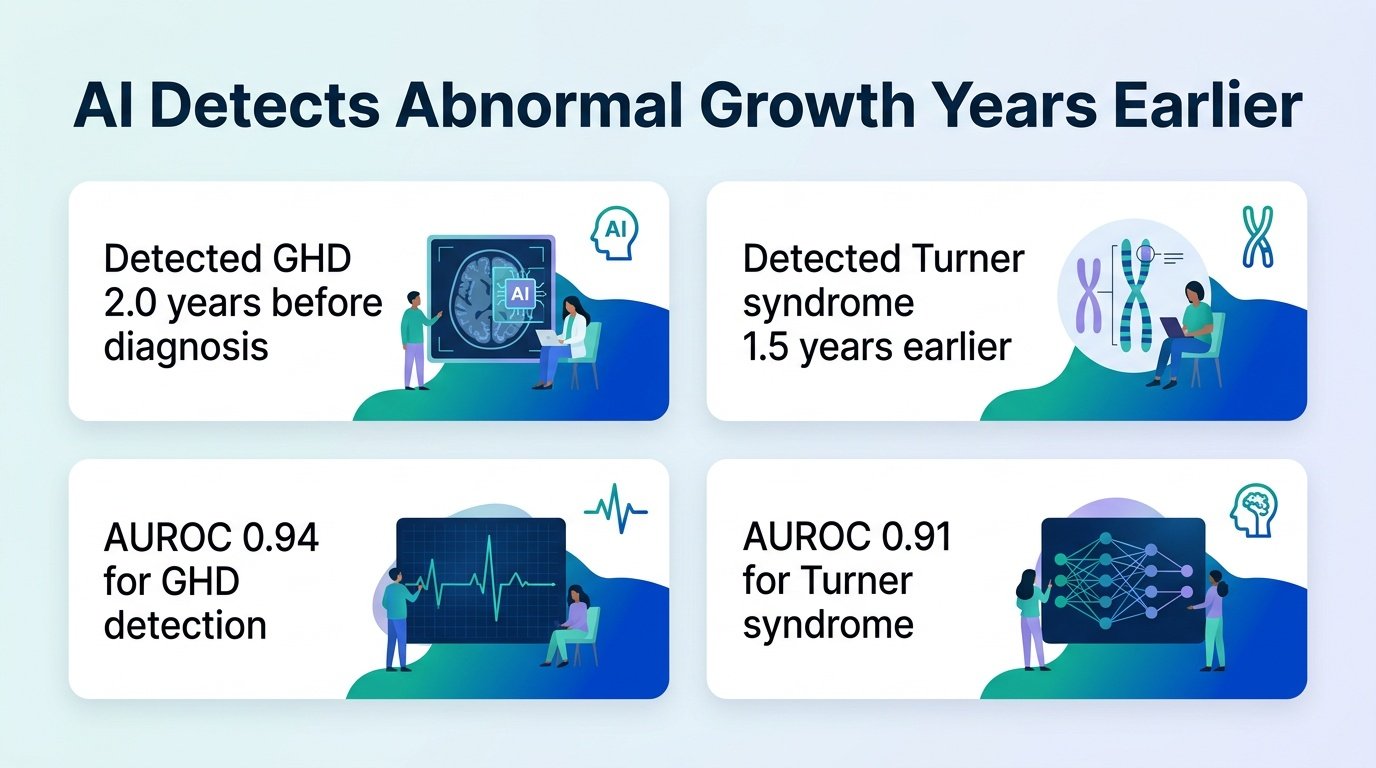
A new algorithm spots rare growth disorders years before traditional clinical methods, shifting the focus of pediatric screening from reactive tracking to active prediction.
Moving beyond static charts
Pediatricians have tracked child growth charts the same way for decades, waiting for a child to visibly fall behind. But what if the warning signs are buried in the math long before the physical lag becomes obvious? This study challenges the standard “wait-and-see” approach to pediatric growth monitoring. By turning static height charts into dynamic trajectory models, researchers prove that machine learning can spot subtle deviations that human eyes miss.
The algorithm was built using historical data from France spanning 1990 to 2014. The development cohort included 86 children diagnosed with growth hormone deficiency (GHD), 87 with Turner syndrome (TS), and 923 healthy referents. Researchers modeled individual height curves using non-linear mixed models across five age ranges from 1 to 12 years to predict abnormal trajectories. To avoid overwhelming clinics with false positives, researchers set a strict pre-defined specificity threshold of 98% during model training.
To test its real-world viability, the team ran an external evaluation. This sample included 77 children with GHD, 40 with Turner syndrome, and a national sample of 5,755 healthy children. The five age-specific predictive models showed high discrimination, with an area under the receiver operating characteristic (AUROC) range of 0.87 to 0.99.
How the algorithm performed
- The model achieved an external cumulative sensitivity of 84.6% and a specificity of 94.3%.
- It cut the median time to diagnosis by 2.0 years overall.
- For children with Turner syndrome, the diagnosis was accelerated by a median of 3.0 years.
- For those with growth hormone deficiency, the diagnostic timeline shrank by 1.6 years.
The cost of waiting
A two-year head start on treatment is not just a statistical victory. For conditions like Turner syndrome, early intervention during critical childhood growth windows dictates final adult height and mitigates systemic health complications. Shrinking the diagnostic timeline preserves the therapeutic window before growth plates fuse. This is where the analysis gets interesting: the tool succeeds because it evaluates the velocity of growth, not just absolute height thresholds.
Yet, implementation faces hurdles. The algorithm was trained and validated on French cohorts, meaning its predictive accuracy must still be tested in more diverse global populations. It also remains restricted to just two target conditions, meaning clinicians cannot yet rely on it as a universal screening tool. Until the algorithm is refined to include other pediatric conditions, it remains a promising proof of concept rather than a clinic-ready solution.
Read the full study in PLOS Digital Health.