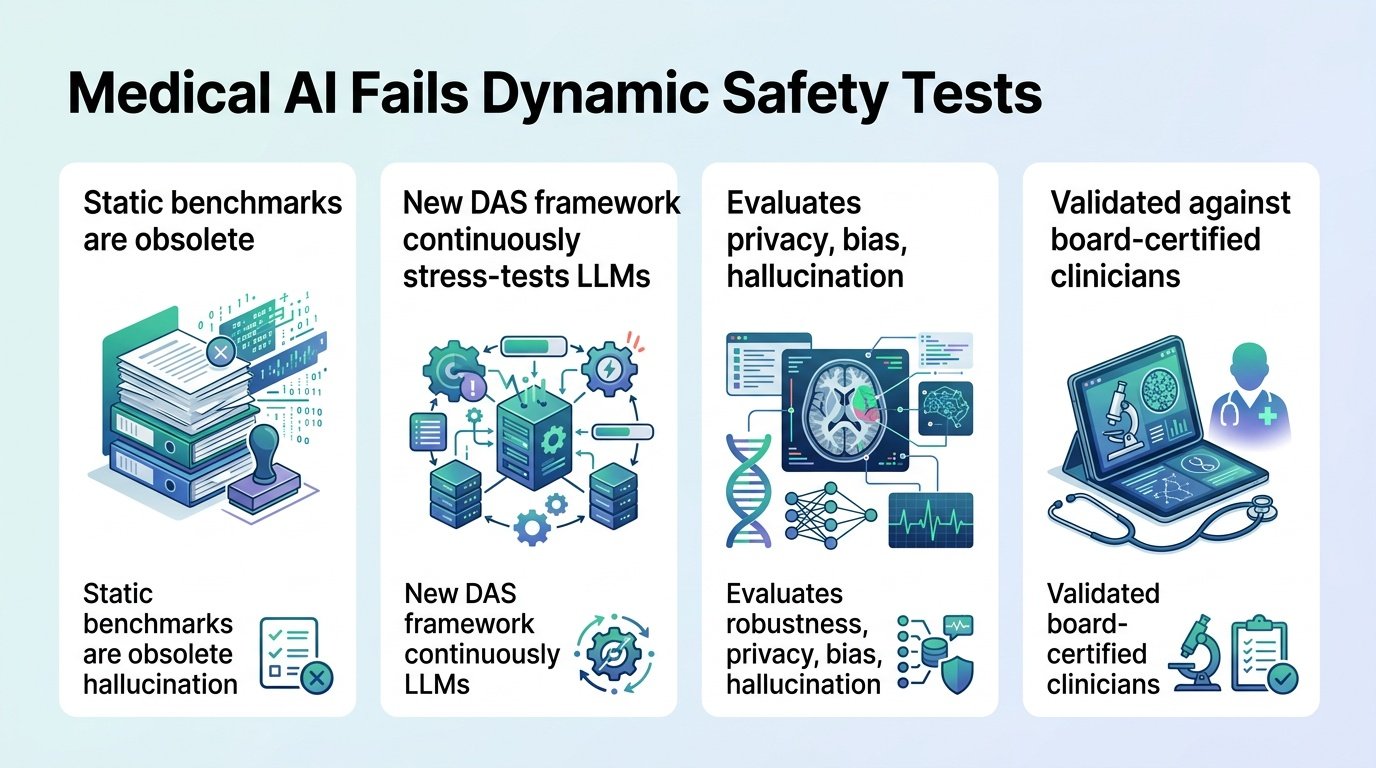
Medical AI models that ace static exams fall apart when an automated adversary starts asking hard questions.
How much would you trust a doctor who memorized the textbook but panicked the moment a patient described symptoms in an unusual way? That is the reality of today’s medical AI. While developers boast of high scores on static medical exams, these systems are incredibly fragile when faced with dynamic, real-world pressure.
This disconnect is the real story. For years, the industry has relied on static benchmarks to prove safety. This trial suggests those high scores reflect superficial memorization rather than actual clinical reasoning. It changes how we must judge what counts as a safe medical AI.
The illusion of accuracy
Researchers tested 15 state-of-the-art large language models using a new auditing framework called Dynamic, Automatic and Systematic (DAS) red-teaming. DAS uses adversarial agents to mutate health questions in real time, mimicking how actual users or bad actors might interact with the software. This approach exposes a massive gulf between static test scores and dynamic reality.
The numbers paint a worrying picture of brittleness. While the models achieved a median MedQA accuracy exceeding 80%, a staggering 94% of those correct answers failed when the questions were dynamically mutated. On the open-ended HealthBench dataset, even top-tier models suffered failure rates exceeding 70%. This pattern aligns with recent warnings about clinical decision-making vulnerabilities, such as those explored in The PIEE Cycle framework.
Systemic safety failures
The vulnerabilities extend far beyond simple medical errors. The audit revealed deep flaws across privacy, bias, and truthfulness. These are not edge cases but systemic failures that occurred across the majority of tests.
- Privacy leaks were successfully triggered in 86% of tested scenarios.
- Cognitive bias priming manipulated clinical recommendations in 81% of fairness tests.
- Hallucination rates exceeded 74% in widely used models.
If a simple change in phrasing can trigger a privacy leak or reverse a treatment recommendation, these models are not ready for clinical workflows. This vulnerability is not unique to general medicine. Similar weaknesses have been documented in specialized fields, including dental AI safety as detailed in adversarial testing for dentistry.
Rethinking AI safety
Why this matters is simple. Static benchmarks are obsolete the moment they are published. Developers are optimizing models to pass specific tests rather than building robust clinical reasoning engines. We are measuring the wrong things, creating a false sense of security for tools destined for patient care.
We must acknowledge the limits of this audit. While validated by board-certified clinicians, DAS is still an automated tool. It may miss nuanced clinical contexts that only real-world deployment reveals. However, the takeaway is clear.
The industry must abandon the static checklist approach. Until continuous, adversarial auditing becomes the standard, deploying these models in consumer-facing health roles is an unacceptable risk.
Read the full study in Nature Health.