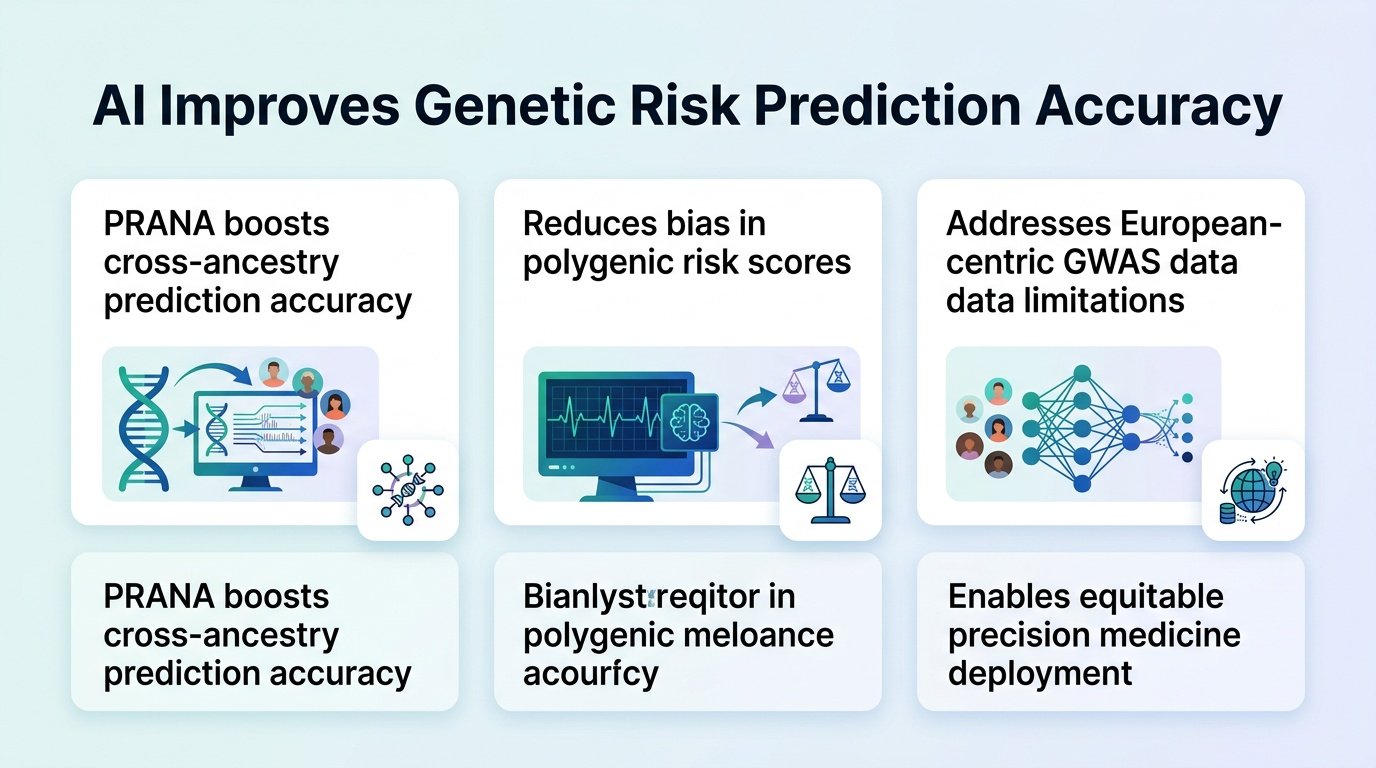
A new deep learning tool bypasses the need for massive non-European genetic trials by adapting existing risk models to diverse populations.
Can we fix the bias in genomic medicine without spending billions on new clinical trials? For years, polygenic risk scores (PRSs) have been built almost entirely on European genetic data. This makes them dangerously inaccurate for everyone else. The standard solution is to wait decades for global biobanks to catch up, but patients are clinical realities today.
Instead of waiting, researchers are turning to neural networks to translate European data for other groups. This shifts the debate from how we gather more data to how we smarter use the data we already have.
Translating genetic risk across populations
The new framework, called PRANA, takes a pre-trained European PRS and refines it using small local datasets. It does not require massive genome-wide association studies in the target populations. Instead, it acts as a translator, adjusting the weights of the genetic predictors to fit the target group’s unique genetic architecture.
This approach addresses a critical bottleneck highlighted in previous research on bridging the genomic diversity gap. Rather than starting from scratch, it recycles existing models. The tool was tested across seven complex traits in South Asian, East Asian, and Ashkenazi Jewish cohorts, as well as in highly specific, data-scarce East Asian subpopulations.
The results show that smart algorithms can compensate for missing diversity in the original research. PRANA achieved the following results:
- Improved predictive performance of baseline models by 5% to 20% in terms of effect size and Nagelkerke’s R^2.
- Outperformed most existing cross-ancestry multi-PRS methods.
- Maintained accuracy even in smaller subpopulations where training data is scarce.
The limits of algorithmic translation
This is a major step forward, but translation has its limits. A neural network cannot invent genetic signals that were never captured in the original European studies. If a crucial disease variant only exists in East Asian populations, PRANA cannot magically discover it from European data.
As noted in studies on how genetic and environmental variation impact transferability, local environmental factors also shape risk. An algorithm can adjust the genetics, but it cannot map the social and physical environments that trigger these genes. PRANA is a practical bridge, not a permanent cure for the lack of diversity in genomics.
Read the full preprint on medRxiv.