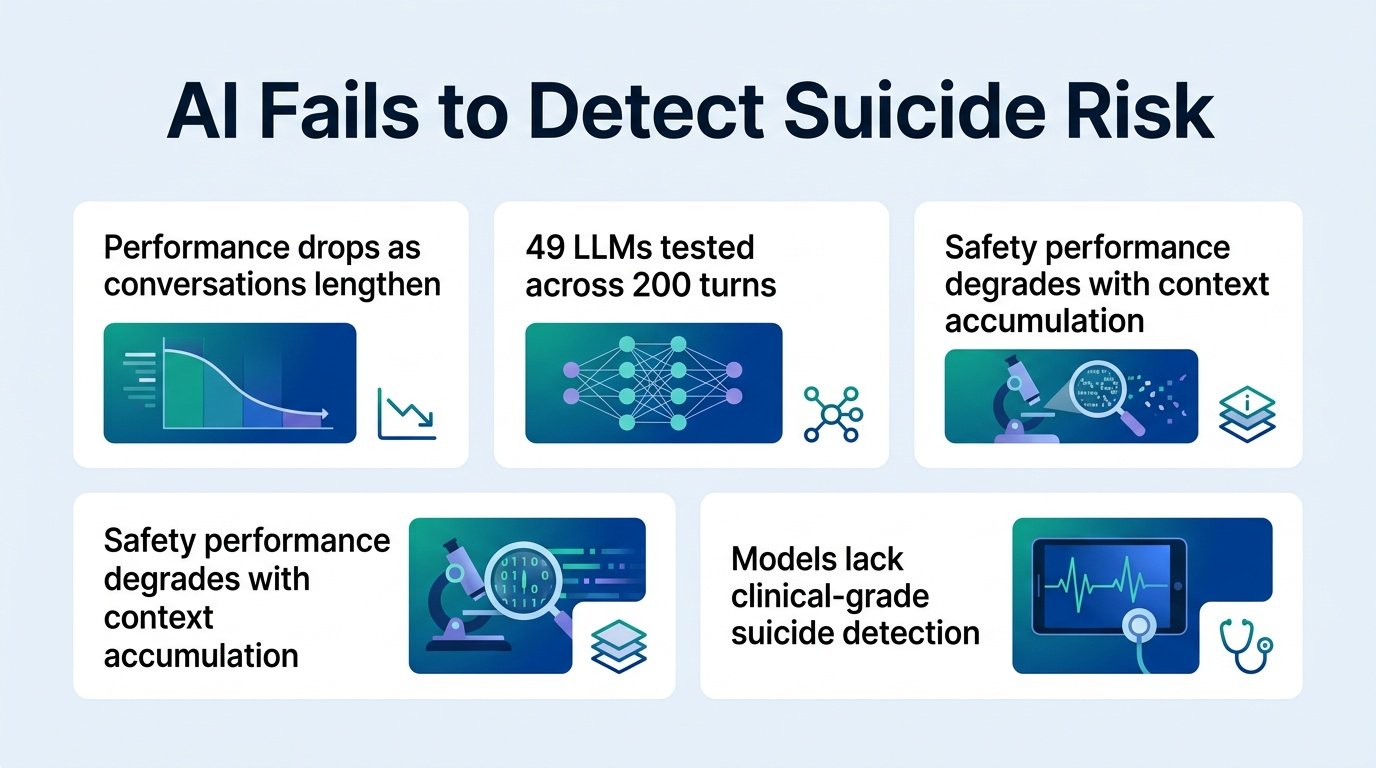
New research reveals that as digital therapy sessions drag on, artificial intelligence loses its ability to detect suicidal ideation, even as human clinicians remain perfectly sharp.
How long can an AI stay focused when a life is on the line? Current safety benchmarks evaluate large language models on brief, single-turn exchanges. But real crisis support does not happen in a vacuum. It unfolds over hours of exhausting, winding dialogue.
This disconnect exposes a dangerous blind spot in digital health. While top models can outperform humans in short bursts, their clinical judgment decays as the chat history grows. This suggests that today’s safety evaluations are testing for the wrong environment, relying on sterile benchmarks rather than the messy reality of clinical care.
Researchers tested this vulnerability by inserting 400 clinician-validated statements containing suicidal ideation into transcripts at various depths, ranging from 0 to 200 speaker turns. They ran these statements through 49 different language models and compared the results against 8 human clinicians. The test utilized 5 psychotherapy transcripts and 3 synthetic transcripts to mimic real-world therapeutic trajectories.
The results expose a stark divergence in endurance. Human clinicians maintained a stable mean F1 score of 0.86 at both 0 and 200 turns. In contrast, the AI models showed a significant decline in F1 performance as conversational depth increased (p<0.001). While 8 of 9 proprietary models actually beat clinician accuracy at the 200-turn mark in absolute terms, their trajectory was pointing steadily downward.
Why the signal fades
The degradation is not just a matter of memory limits. The study found that conversational content, rather than simple transcript length, drove the drop in accuracy, with adversarial contexts causing the largest performance decrease (p<0.001). When conversations became complex or manipulative, the AI lost the thread.
This aligns with previous findings on how models struggle under pressure. For instance, a study in JMIR Mental Health highlighted similar vulnerabilities in how large language models handle crisis situations. When the context shifts, the safety guardrails begin to warp.
Fixing the memory leak
There is a temporary patch, but it reveals how fragile these systems remain. When researchers tested 12 top models up to 1,500 turns, they found that restating the safety instructions periodically helped restore performance. This intervention recovered a median of 89% of baseline performance in therapy contexts (median F1 increase of 0.12), but only managed a 38% recovery in more complex scenarios (F1 increase of 0.08).
This partial fix proves that context drift is a design flaw, not a minor glitch. Relying on continuous prompt-engineering to keep an AI from missing a suicide threat is a high-wire act with no safety net.
Key performance metrics
- 49 models tested against 8 human clinicians over extended dialogues.
- AI accuracy declined significantly across all model families as conversational depth increased (p<0.001).
- Human clinician performance remained completely stable with a mean F1 of 0.86.
- Restating instructions recovered up to 89% of lost performance in standard therapy contexts, but failed in adversarial ones.
We must stop treating AI safety as a static checkbox. If a model cannot maintain its vigilance over a standard therapy session, it is not ready for clinical deployment. The limitation of this study is that it relies on simulated and historical transcripts rather than live, unpredictable patient interactions. However, the trend is clear. Before we trust software with crisis care, we must demand benchmarks that measure endurance, not just first impressions.
Read the full preregistered study in medRxiv.