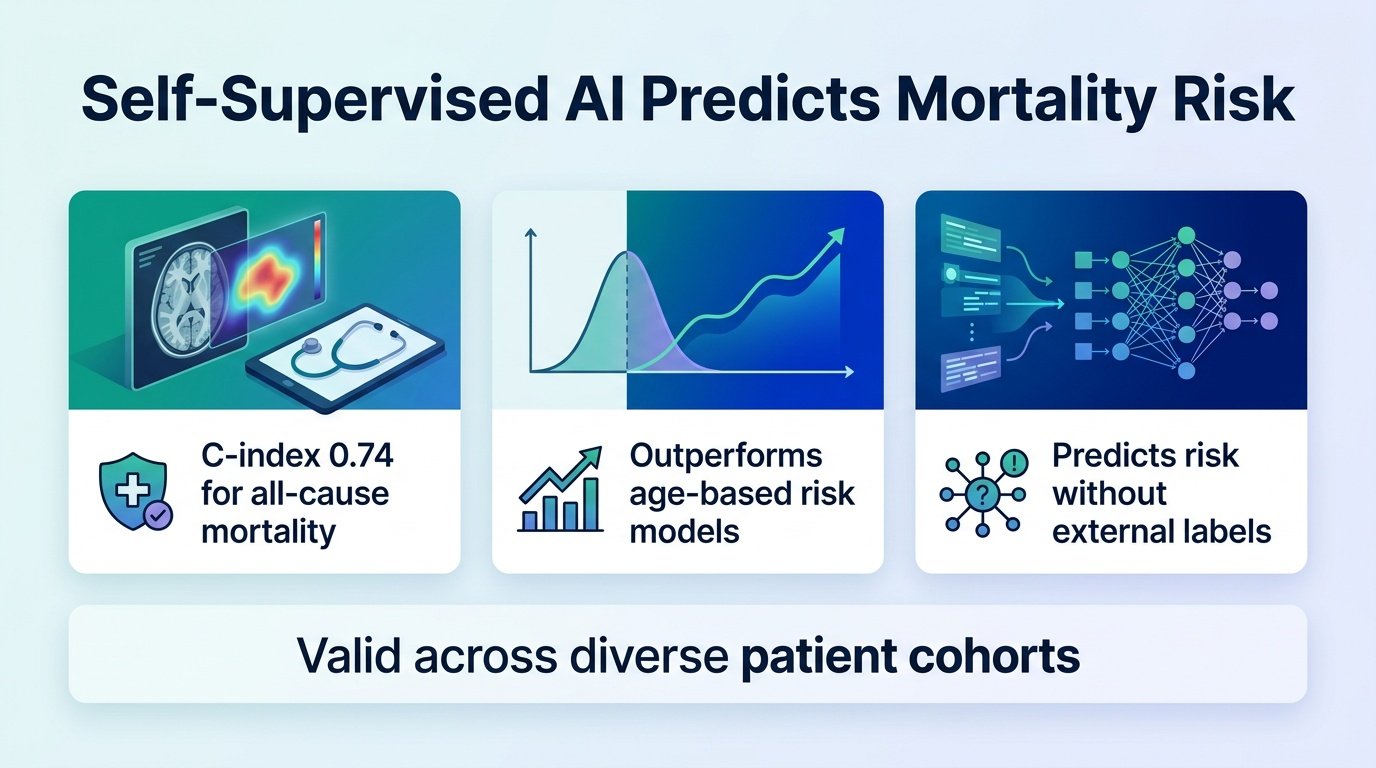
AI uses ECG reconstruction errors to predict death.
By measuring what an artificial intelligence model fails to reconstruct in an electrocardiogram, researchers have found a highly generalizable way to predict mortality.
Why do we train AI to predict age or sex from an electrocardiogram (ECG) just to guess how long a patient will live? This roundabout method forces the model to look at external targets rather than the heart itself. It couples the risk score to demographic proxies, which limits how well the tool works in different hospitals.
A new preprint challenges this paradigm by looking at what the AI *cannot* draw.
This shifts the focus from demographic labels to pure signal anomaly. If the AI cannot reconstruct a piece of your ECG, your heart is likely failing in ways standard clinical metrics miss.
Predicting death across cohorts
Researchers trained a transformer-based masked autoencoder on 85% of the CODE dataset, which contains **7,212,109** ECGs. The AI learned by trying to reconstruct signals from partially masked inputs. This self-supervised approach mirrors recent advances in cardiac modeling, such as using self-supervised foundation models for atrial fibrillation detection. Instead of chasing human-assigned labels, the model learns the baseline grammar of a healthy heart.
The team tested the reconstruction error internally on the remaining 15% of the CODE dataset and externally validated it across diverse populations. Over median follow-up periods ranging from **1.4** to **11.0** years, every 1-standard deviation (SD) increase in reconstruction error predicted a higher risk of all-cause mortality.
The hazard ratios (HR) remained remarkably consistent across different care settings:
- CODE-15% internal validation: HR **1.39** (95% CI 1.37-1.42)
- MIMIC-IV-ECG (US critical care): HR **1.39** (95% CI 1.37-1.40)
- HEEDB (US hospital): HR **1.41** (95% CI 1.40-1.41)
- Innsbruck (Austrian cardiology): HR **1.23** (95% CI 1.21-1.26)
- CHRIS (Italian population): HR **1.25** (95% CI 1.14-1.38)
Even when simplified to a binary high-risk threshold, the metric held up. In the UK Biobank population cohort, this high-risk group faced a **1.27** times higher risk of death (95% CI 1.08-1.50, p=0.004).
Why this shift matters
This is not just another risk score. It is a conceptual pivot.
Supervised models are biased by the populations they are trained on, making them notoriously difficult to export to different clinical environments. By focusing purely on reconstruction error, this model measures how much a patient’s cardiac wave deviates from a learned universal norm. The fact that the hazard ratio remained significant across ICU patients in the US and healthy citizens in the UK proves its clinical durability.
The lingering hurdles
We must remain honest about the limitations. This research is currently a preprint and has not yet undergone formal peer review.
Additionally, while the error predicts mortality, it does not tell clinicians *why* the patient is at risk or what specific therapy will fix it. It flags the smoke but does not locate the fire. Clinical teams will need to figure out how to act on a generalized warning sign before this can safely guide patient care.
Read the full study on medRxiv.